Home
Class 12
MATHS
Which of the following function is/are...

Which of the following function is/are periodic? `(a)f(x)={1,xi sr a t ion a l0,xi si r r a t ion a l` `(b)f(x)={x-[x];`2n

A

`f(x)={(1",",x " is rational"),(0",",x " is irrational"):}`

B

`f(x)={(x-[x]",",2n le x lt 2n+1),((1)/(2)",", 2n+1 le x lt 2n +2):}`
where [.] denotes the greatest integer function `n in Z`

C

`f(x)=(-1)^([(2x)/(pi)])`, where [.] denotes the greatest integer function

D

`f(x)=x-[x+3]+tan((pi x)/(2)),` where [.] denotes the greatest integer function, and a is a rational number

Text Solution

Verified by Experts

The correct Answer is:
A, B, C, D

`f(x)={(1",",x " is rational"),(0",",x " is irrational"):}`
`or f(x+k)={(1",",x+k " is rational"),(0",",x+k " is irrational"):}`, where k is any rational number
`={(1",",x " is rational"),(0",",x " is irrational"):}`
`=f(x)`
Therefore, `f(x)` is periodic function, but its fundamental period cannot be determined. Thus,
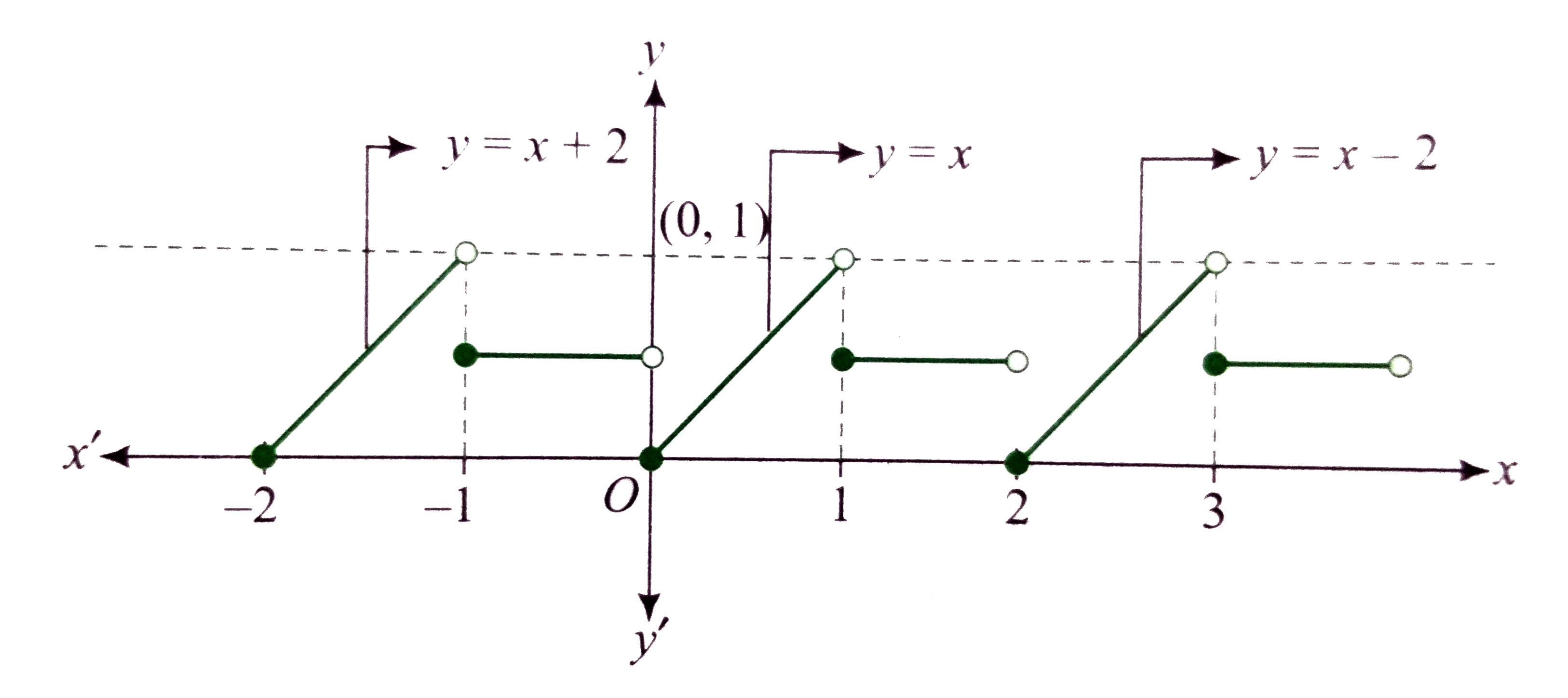
`f(x)={(x-[x]",",2n le x lt 2n+1),(1//2",", 2n+1 le x lt 2n +2):}`
Draw the graph from which it can be verified that period is 2.

`f(x)=(-1)^([(2x)/(pi)])`
`or f(x+pi)=(-1)^([(2(pi+x))/(pi)])=(-1)^([(2x)/(pi)]+2)=(-1)^([(2x)/(pi)])`
Hence, the period is `pi`.
`f(x)=x-[x+3]+tan((pix)/(2))={x}-3+tan((pi x)/(2))`
{x} is periodic with period `1, tan((pi x)/(2))x` is period with period 2.
Now, the LCM of 1 and 2 is 2. Hence, the period of `f(x) ` is 2.
Promotional Banner

Topper's Solved these Questions

  • RELATIONS AND FUNCTIONS

    CENGAGE|Exercise Exercise (Comprehension)|32 Videos
  • RELATIONS AND FUNCTIONS

    CENGAGE|Exercise Exercise (Matrix)|9 Videos
  • RELATIONS AND FUNCTIONS

    CENGAGE|Exercise Exercise (Single)|125 Videos
  • Quadratic Equations, Inequalities, Modulus and Logarithms

    CENGAGE|Exercise Question Bank|28 Videos
  • SCALER TRIPLE PRODUCTS

    CENGAGE|Exercise DPP 2.3|11 Videos

Similar Questions

Explore conceptually related problems

Find the value of x where f(x)={x ,ifxi sr a t ion a l1-x ,ifxi si r r a t ion a li scon t inuou sdot

If the functions f(x)a n dg(x) are defined on R rarr R such that f(x)={0, x in r a t ion a l x ,x in i r r a t ion a l a n dg(x)={O , x in i r r a t ion a l x ,x in r a t ion a l then (f-g)(x)i s (a)one-one and onto (b)neither one-one nor onto (c)one-one but not onto (d)onto but not one-one

Column I: Function, Column II: Type of function f(x)="{"sgnx")"^(sgn)}; x!=0,n is an odd integer, p. odd function f(x)=x/(e^x-1)+x/2+1 , q. even function f(x)={0,ifxi sr a t ion a l1,ifxi si r r a t ion a l , r. neither odd nor even function. f(x)=max{tanx ,cotx} , s. periodic

Which of the following statements are incorrect? 1.If f(x) and g(x) are one-one then 2. f(x)+g(x) is also one-one If f(x) and g(x) are one-one then 3. f(x)dotg(x) is also one-one If f(x) is odd then it is necessarily one-one? Ia n dI Ion l y b. I Ia n dI I Ion l y c. I I Ia n dIon l y d. I ,I Ia n dI I I

f: Rvec[-1,oo)a n df(x)=1n([|s in2x|+|cos2x|]) (where [.] is the greatest integer function.) Then, (a) f(x)h a sr a ngZ (b) f(x)i sp e r iod i c function (c) f(x)i sin v e r t i b l ein[0,pi/4] (d) f(x) is into function

Find the period (if periodic) of the following function ([.] denotes the greatest integer functions): f(x)=x-[x-b],b in R

Prove that period of function f(x)=sinx, x in R " is " 2pi.

If f(x)a n dg(x) are two positive and increasing functions, then which of the following is not always true? [f(x)]^(g(x)) is always increasing [f(x)]^(g(x)) is decreasing, when f(x) 1. If f(x)>1,t h e n[f(x)]^(g(x)) is increasing.

Consider the function f(x) satisfyig the identity f(x)+f((x-1)/x)=1+x, AA x in R-{0,1} and g(x)=2f(x)-x+1

Suppose that f is even, periodic function with period 2, and that f(x) = x for all x in the interval [0, 1]. Then draw the graph of y = f(x).

CENGAGE-RELATIONS AND FUNCTIONS-Exercise (Multiple)
  1. Let f(x)={x^2-4x+3,x<3x-4,xgeq3 a n dg(x)={x-3,x<4x^2+2x+2,xgeq4 the...

    Text Solution

    |

  2. Let f(x)="max"{1+sin x ,1,1-cosx},x in [0,2pi],a n dg(x)=max{1,|x-1|},...

    Text Solution

    |

  3. Consider the function y=f(x) satisfying the condition f(x+1/x)=x^2+1/...

    Text Solution

    |

  4. Consider the real-valued function satisfying 2f(sinx)+f(cosx)=xdot the...

    Text Solution

    |

  5. If f: R^+vecR^+ is a polynomial function satisfying the functional equ...

    Text Solution

    |

  6. f(x)=x^2-2a x+a(a+1),f:[a ,oo)vec[a ,oo)dot If one of the solution of ...

    Text Solution

    |

  7. Which of the following function is/are periodic? (a)f(x)={1,xi sr a ...

    Text Solution

    |

  8. Let f(x)=3/4x+1,f^n(x)b ed efin e da sf^2(x)=f(f(x)),a n dforngeq2,f^(...

    Text Solution

    |

  9. lf the fundamental period of function f(x)=sinx + cos(sqrt(4-a^2))x is...

    Text Solution

    |

  10. f(x)=sin^(-1)[e^(x)]+sin^(-1)[e^(-x)] where [.] greatest integer funct...

    Text Solution

    |

  11. [2x]-2[x]=lambda where [.] represents greatest integer function and {....

    Text Solution

    |

  12. The set of all values of x satisfying {x}=x[xx] " where " [xx] repres...

    Text Solution

    |

  13. about to only mathematics

    Text Solution

    |

  14. If the function / satisfies the relation f(x+y)+f(x-y)=2f(x),f(y)AAx ,...

    Text Solution

    |

  15. Let f(x)+f(y)=f(xsqrt(1-y^2)+ysqrt(1-x^2))[f(x) is not identically zer...

    Text Solution

    |

  16. Let f: RvecR be a function defined by f(x+1)=(f(x)-5)/(f(x)-3)AAx in ...

    Text Solution

    |

  17. Let a function f(x), x ne 0 be such that f(x)+f((1)/(x))=f(x)*f((1)...

    Text Solution

    |

  18. about to only mathematics

    Text Solution

    |

  19. The figure illustrates the graph of the function y=f(x) defined in [-3...

    Text Solution

    |

  20. If graph of a function f(x) which is defined in [-1, 4] is shown in th...

    Text Solution

    |

