Home
Class 12
MATHS
The two adjacent sides of parallelogram ...

The two adjacent sides of parallelogram are y = 0 and `y=sqrt3(x-1)`. If equation of one diagonal is `sqrt3y=(x+1)`, then equation of other diagonal is

Text Solution

Verified by Experts
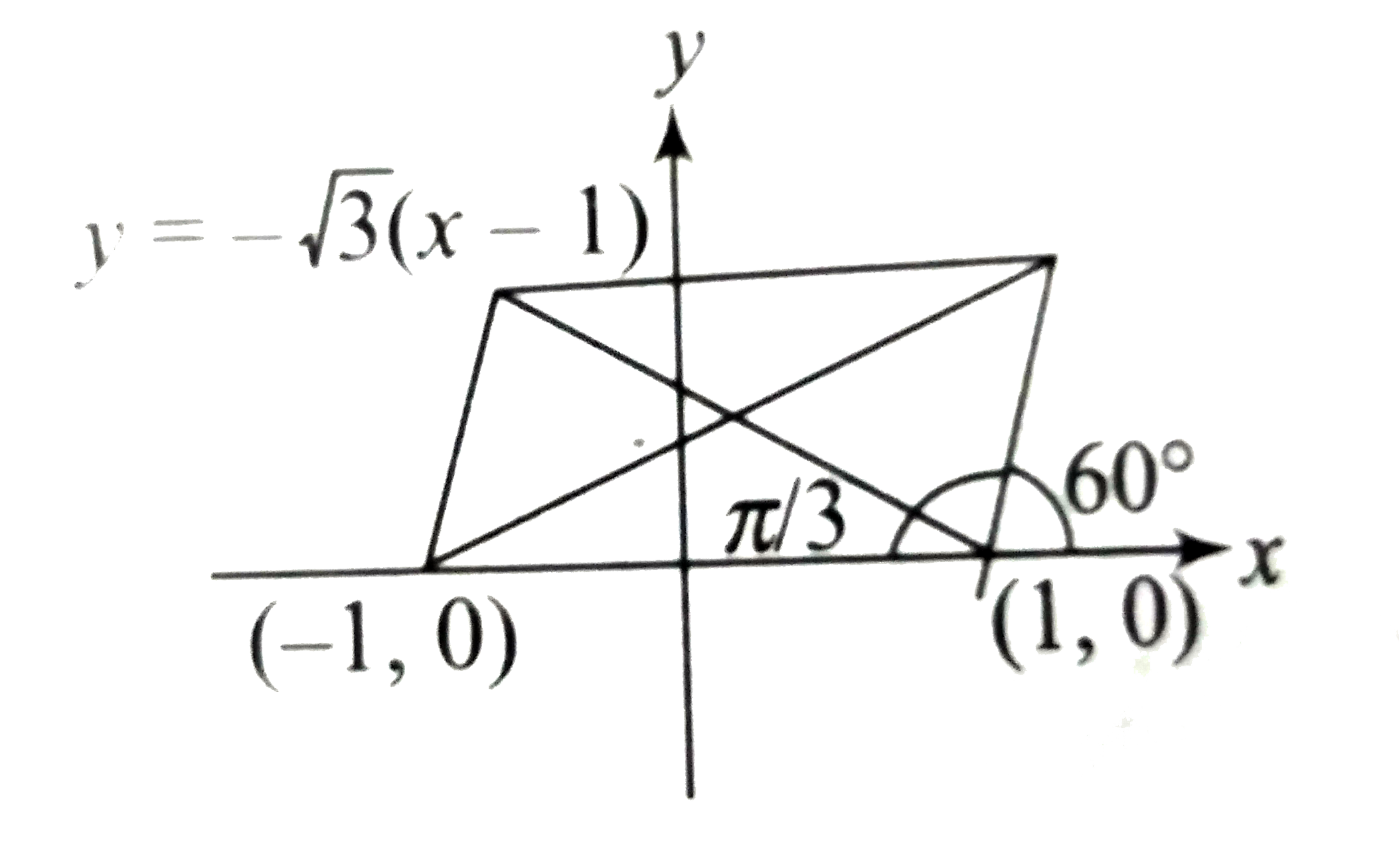
`y = 0` is x-axis
`y = sqrt(3) (x-1)` is line through point (1,0) and making an angle `60^(@)` with x-axis
`sqrt(3)y = (x+1)` is line through point `(-1,0)` and making an angle `30^(@)` with x-axis
Draw these lines on coordinate axis

From the figure clearly another diaonal passes through the point (1,0) and having slope `- sqrt(3)`
`:.` Equation of required diagonal is `y =- sqrt(3) (x-1)`
Promotional Banner

Topper's Solved these Questions

  • STRAIGHT LINE

    CENGAGE|Exercise Comprehension Type|3 Videos
  • STRAIGHT LINE

    CENGAGE|Exercise Multiple Correct Answers Type|8 Videos
  • STATISTICS

    CENGAGE|Exercise JEE Previous Year|10 Videos
  • STRAIGHT LINES

    CENGAGE|Exercise JEE Advanced Previous Year|4 Videos

Similar Questions

Explore conceptually related problems

If the two consecutive sides of a parallelogram are 4x+5y=0 and 7x+2y=0 . If the equation of one diagonal is 11 x+7y=9, find the equation of the other diagonal.

Adjacent sides of a parallelogram are 11 cm and 17 cm. If the length of one of its diagonals is 26 cm, find the length of the other.

If (-4,7) is one vertex of a rhombus and if the equation of one diagonal is 5x-y+7=0, then find the equation of another diagonal.

Two consecutive sides of a parallelogram are 4x + 5y = 0 and 7x + 2y = 0. One diagonal of the parallelogram is 11x+7y=9. If the other diagonal is ax + by + c = 0, then

If (-4,7) is one vertex of a rhombus and if the equation of one diagonal is 5x - y + 7 =0 , then find the equation of another diagonal.

If (-4,5) is one vertex and 7x-y+8 = 0 is one diagonal of a square, then the equation of the second diagonal is

The line 2x - y = 1 bisects angle between two lines. If equation of one line is y = x, then the equation of the other line is

The extremities of the base of an isosceles triangle are (2,0)a n d(0,2) . If the equation of one of the equal side is x=2, then the equation of other equal side is (a) x+y=2 (b) x-y+2=0 (c) y=2 (d) 2x+y=2

