Home
Class 12
MATHS
If (a, b) be an end of a diagonal of a ...

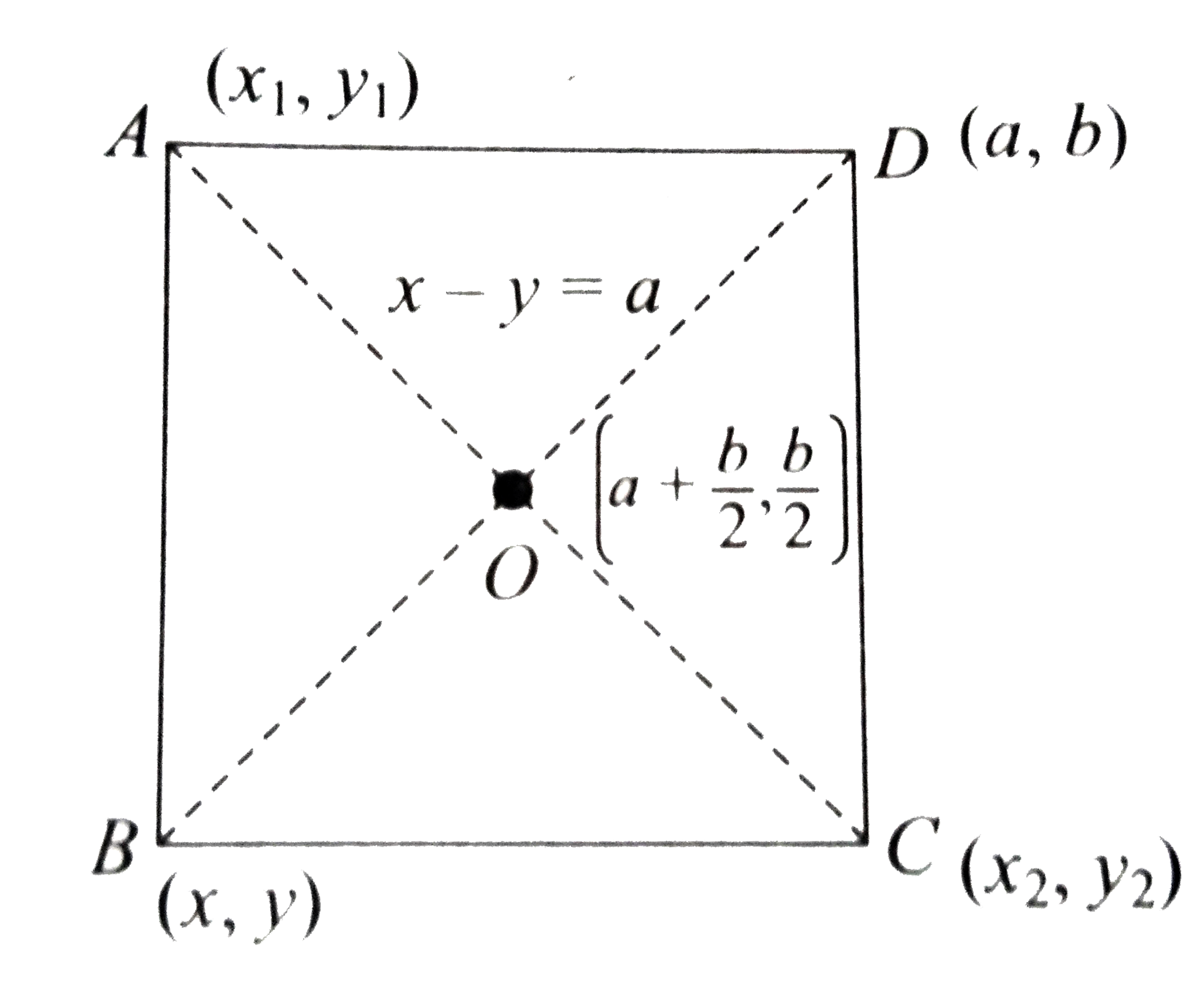
If (a, b) be an end of a diagonal of a square and the other diagonal has the equation `x-y=a`, then another vertex of the square can be

A

`(a-b,a)`

B

`(a,0)`

C

`(0,-a)`

D

`(a+b,b)`

Text Solution

Verified by Experts

The correct Answer is:
B, D


Diagonal AC is `x - y = a`
`:.` Slope `BD =- 1`
Also BD passes through (a,b)
`:.` Equation of BD is `x +y = a+b`
Solving, we get point `O -= (a+(b)/(2),(b)/(2))`
`:.` point `B -= (a+b,0)`
`m_(AC) = 1 = tan theta`
`OA = OD = (b)/(sqrt(2))`
Using parametric form of straight line points A and C are given by
`(a+(b)/(2)+-(b)/(sqrt(2))cos 45^(@),(b)/(2)+-(b)/(sqrt(2))sin45^(@))`
or `A(a,0)` and `C(a+b,b)`
Promotional Banner

Topper's Solved these Questions

  • STRAIGHT LINE

    CENGAGE|Exercise Comprehension Type|3 Videos
  • STATISTICS

    CENGAGE|Exercise JEE Previous Year|10 Videos
  • STRAIGHT LINES

    CENGAGE|Exercise JEE Advanced Previous Year|4 Videos

Similar Questions

Explore conceptually related problems

A square has one vertex at the vertex of the parabola y^2=4a x and the diagonal through the vertex lies along the axis of the parabola. If the ends of the other diagonal lie on the parabola, the coordinates of the vertices of the square are (a) (4a ,4a) (b) (4a ,-4a) (c) (0,0) (d) (8a ,0)

If the diagonal of a square is 'a' units, what is the diagonal of the square, whose are is doubel that of the first square?

If one root is square of the other root of the equation x^2+p x+q=0 then the relation between p and q is

If a vertex of a square is at the origin and its one side lies along the line 4x+3y-20=0, then the area of the square is

Find the side and perimeter of a square whose diagonal is 10 cm.

Four long, straight wires, each carrying a current of 5.0 A, are placed in a plane as shown in figure . The points of intersection form a square of side 5.0 cm. (a) Find the magnetic field at the centre P of the square. (b) Q_1, Q_2, Q_3 and Q_4 are points situated on the diagonals of the square and at a distance from P that is equal to the length of the diagonal of the square. Find the magnetic fields at these points.

