Home
Class 12
MATHS
An ellipse has foci at F1(9, 20) and F2(...

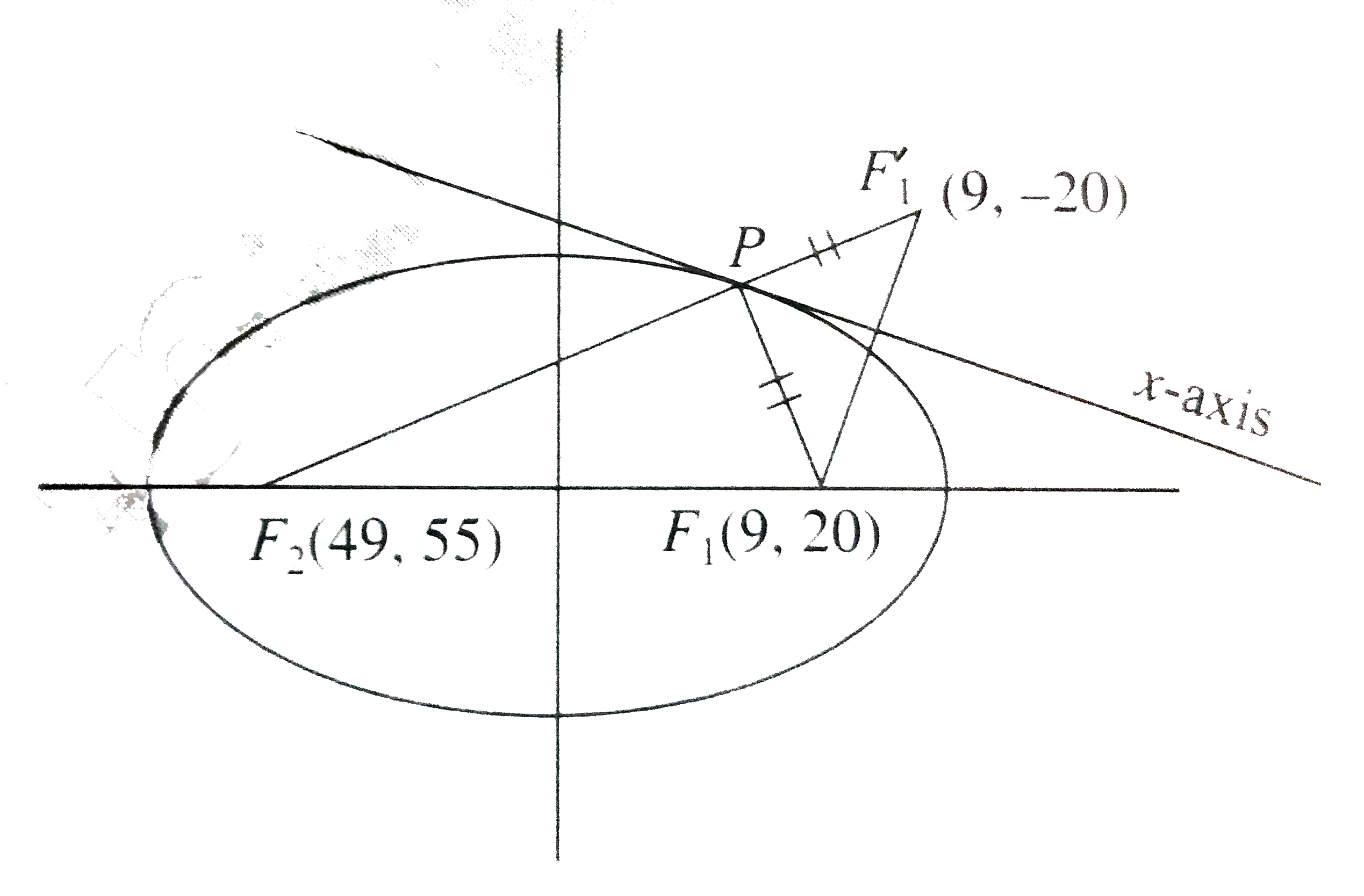
An ellipse has foci at `F_1(9, 20)` and `F_2(49,55)` in the xy-plane and is tangent to the x-axis. Find the length of its major axis.

A

85

B

75

C

65

D

55

Text Solution

Verified by Experts

The correct Answer is:
A


Image of `F_(1)` in tangent (x-axis) is `F'_(1)`. From the property, points `F_(2), P, F'_(1)` are collinear.
`2a = F_(1)P + F_(2)P = F'_(1)P + F_(2)P = F'_(1)F_(2) = 85`
Promotional Banner

Topper's Solved these Questions

  • ELLIPSE

    CENGAGE|Exercise Multiple Correct Answers Type|6 Videos
  • DOT PRODUCT

    CENGAGE|Exercise DPP 2.1|15 Videos
  • ELLIPSE AND HYPERBOLA

    CENGAGE|Exercise Question Bank|1 Videos

Similar Questions

Explore conceptually related problems

For the ellipse x^(2)+ 3y^(2) = a^(2) find the length of major and minor axis.

An ellipse has the points (1, -1) and (2,-1) as its foci and x + y = 5 as one of its tangent then the value of a^2+b^2 where a,b are the lenghta of semi major and minor axes of ellipse respectively is :

An ellipse, with foci at (0, 2) and (0, –2) and minor axis of length 4, passes through which of the following points?

An ellipse has point (1,-1)a n d(2,-1) as its foci and x+y-5=0 as one of its tangents. Then the point where this line touches the ellipse is (a) ((32)/9,(22)/9) (b) ((23)/9,2/9) (c) ((34)/9,(11)/9) (d) none of these

Find the equation of the ellipse, whose length of the major axis is 20 and foci are (0,+-5)

Find the equation of the ellipse whose eccentricity is 1/2 , one of the foci is (2, 3) and a directrix is x = 7. Also find the length of the major and minor axes of the ellipse.

A hyperbola has its centre at the origin, passes through the point (4, 2) and has transverse axis of length 4 along the x-axis. Then the eccentricity of the hyperbola is

An ellipse has OB, as semi minor axis, F and F' its foci and the angle FBF' is a right angle. Then the eccentricity of the ellipse is :

Find the eccentricity of the hyperbola with foci on the x-axis if the length of its conjugate axis is (3/4)^("th") of the length of its tranverse axis.

