Home
Class 12
MATHS
A point moves so that the sum of the squ...

A point moves so that the sum of the squares of the perpendiculars let fall from it on the sides of an equilateral triangle is constant. Prove that its locus is a circle.

Text Solution

Verified by Experts
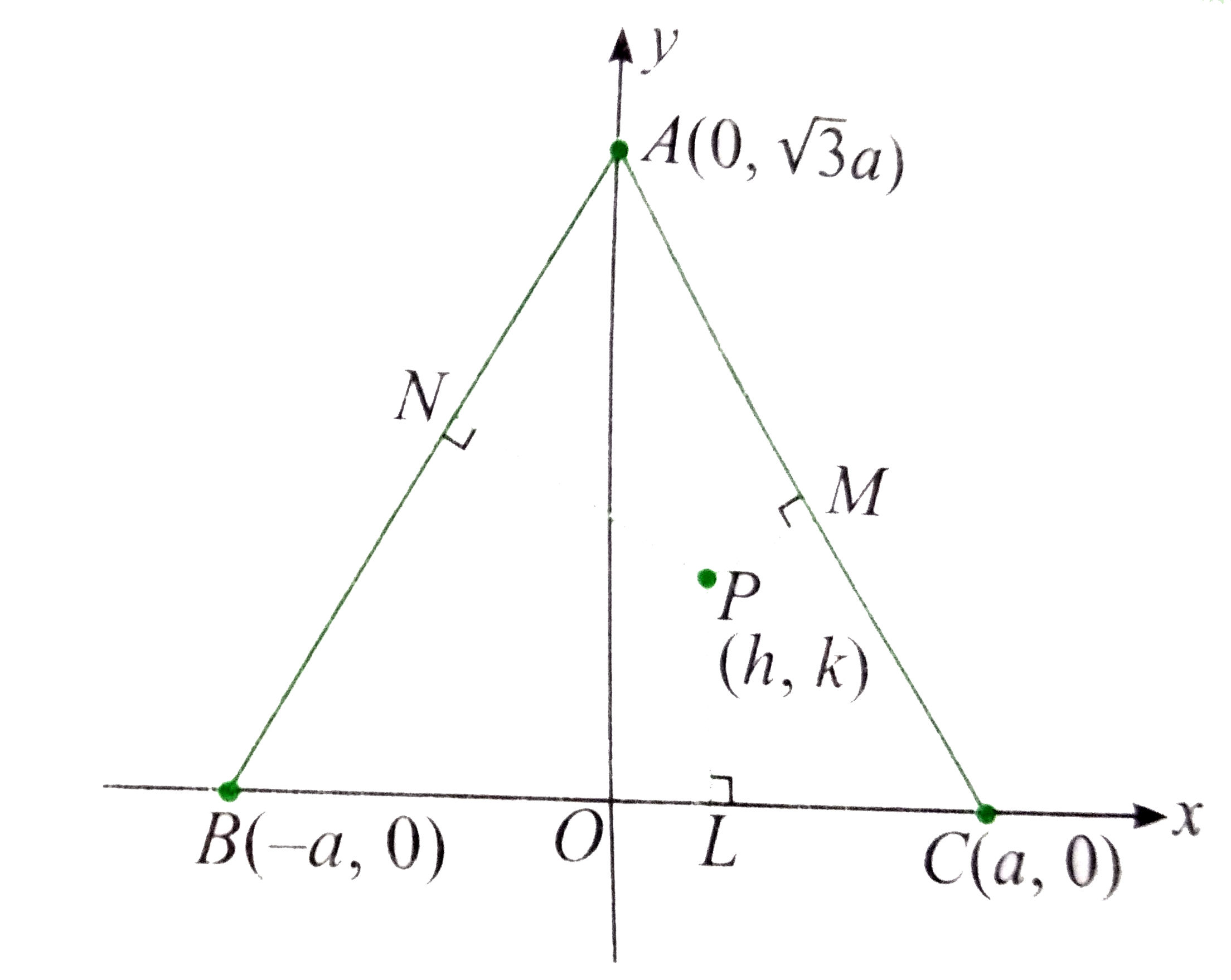

Let vertices B and C of equilateral triangle be (-a,0) and (a,0)
`OA=OB tan 60^(@)=a sqrt(3)`
`:. A -= (0,asqrt(3))`
Let point P be (h,k).
Equations of AC and BC are `xsqrt(3)+y-asqrt(3)=0` and `xsqrt(3)-y+asqrt(3)=0`, respectively.
According to the question,
`PL^(2)+PM^(2)+PN^(2)=` constant (say `lambda)`
`:. k^(2)+((sqrt(3)h+k-sqrt(3)a)/(2))^(2)+((sqrt(3)h-k+sqrt(3)a)/(2))^(2)=lambda`
`implies 6h^(2)+6k^(2)-4sqrt(3)ak+6a^(2)-4 lambda=0`
Hence, the required locus is `6x^(2)+6y^(2)-4sqrt(3)ay+6a^(2)-4 lambda =0` which is a circle
Promotional Banner

Topper's Solved these Questions

Similar Questions

Explore conceptually related problems

A point moves such that the sum of the square of its distances from two fixed straight lines intersecting at angle 2alpha is a constant. Prove that the locus of points is an ellipse

Prove that the locus of the point that moves such that the sum of the squares of its distances from the three vertices of a triangle is constant is a circle.

Prove that the sum of the squares of the sides of a rhombus is equal to the sum of the squares of its diagonals

A straight line moves so that the product of the length of the perpendiculars on it from two fixed points is constant. Prove that the locus of the feet of the perpendiculars from each of these points upon the straight line is a unique circle.

A point moves such that the sum of the squares of its distances from the two sides of length ‘a’ of a rectangle is twice the sum of the squares of its distances from the other two sides of length b. The locus of the point can be:

The locus of a point which moves such that the sum of the square of its distance from three vertices of a triangle is constant is a/an (a)circle (b) straight line (c) ellipse (d) none of these

Prove by vector method that the perpendiculars (altitudes) from the vertices to the sides of a triangle are concurrent.

A point P moves such that the sum of the slopes of the normals drawn from it to the hyperbola xy = 16 is equal to the sum of ordinates of feet of normals . The locus of P is a curve C. The area of the equilateral triangle inscribed in the curve C having one vertex as the vertex of curve C is

Prove that the sum of the squares of the squares of tha diagonals of a parallelogram is equal to tha sum of the squares of its sides.

A point P moves such that sum of the slopes of the normals drawn from it to the hyperbola xy=16 is equal to the sum of ordinates of feet of normals. The locus of P is a curve C

