Home
Class 12
MATHS
A circle x^(2)+y^(2)=a^(2) meets the x-a...

A circle `x^(2)+y^(2)=a^(2)` meets the x-axis at A(-a,0) and B(a,0). `P(alpha)` and Q(`beta`) are two points on the circle so that `alpha-beta=2 gamma,` where `gamma` is a constant. Find the locus of the point of intersection of AP and BQ.

Text Solution

Verified by Experts
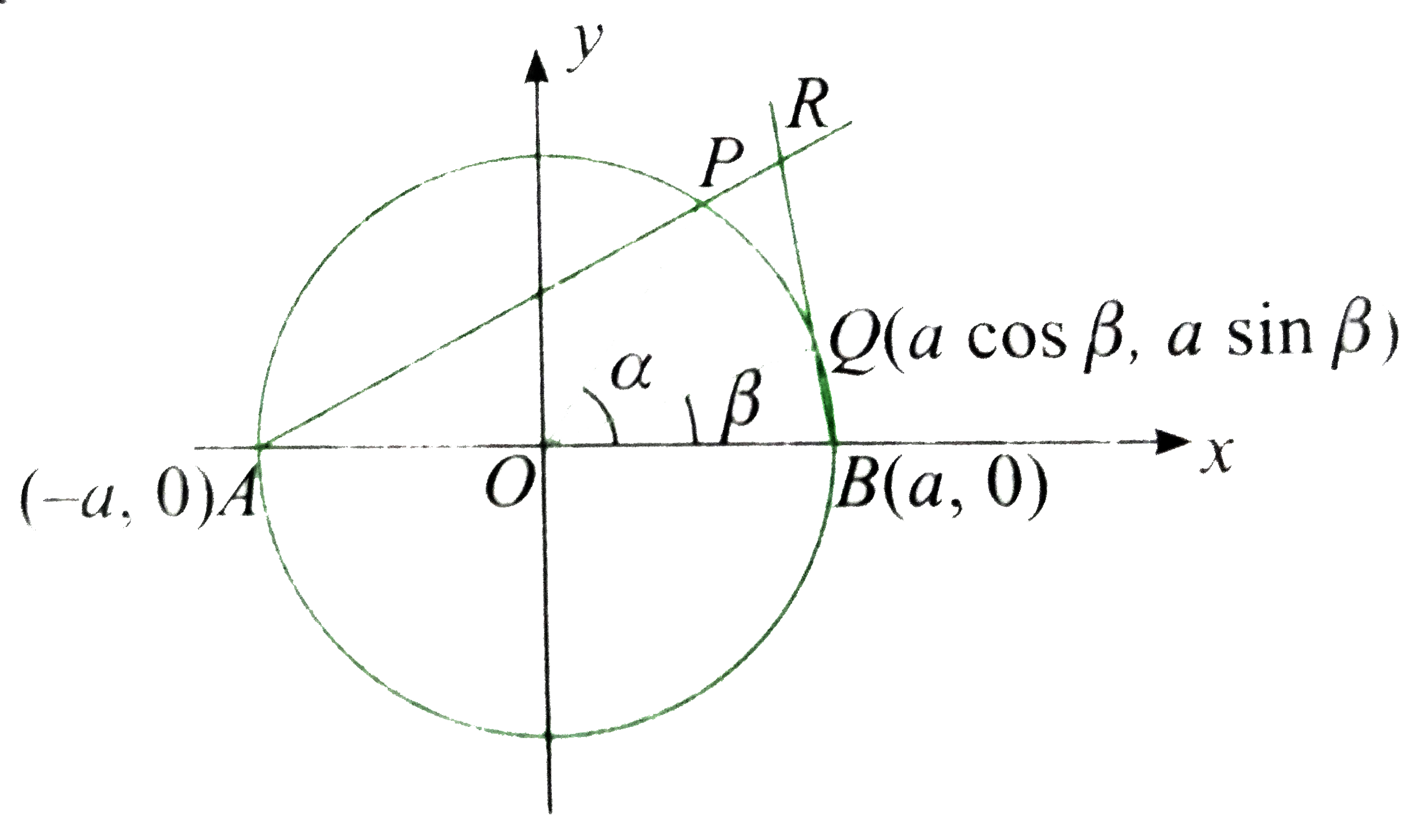
Let

The coordinates of A are ( -a,0) and that of P are `(a cos alpha, a sin alpha)`.
Therefore, the equation of AP is
`y=(a sin alpha)/(a(cos alpha+1))(x+a)`
or `y=tan.(alpha)/(2)(x+a)` (1)
Similarly, the equationof BQ is
`y=( a sin beta)/(a(cos beta-1))(x-a)`
or `y=- cot . (beta)/(2)(x-a)` (2)
We now eliminate `alpha` and `beta` from (1) and (2). Therefore,
`tan.(alpha)/(2)=(y)/(a+x),tan.(beta)/(2)=(a-x)/(y)`
Now, `alpha-beta=2gammaimpliesgamma=(alpha)/(2)-(beta)/(2)`
`:. tan gamma=(tan.(alpha)/(2)-tan.(beta)/(2))/(1+tan.(alpha)/(2)tan.(beta)/(2))=((y)/(a+x)-(a-x)/(y))/(1+(y)/(a+x).(a-x)/(y))`
or `tan gamma=(y^(2)-(a^(2)-x^(2)))/((a+x)y+(a-x)y)`
`=(x^(2)+y^(2)-a^(2))/(2ay)`
or `x^(2)+y^(2)-2ay tan gamma=a^(2)`
Promotional Banner

Topper's Solved these Questions

Similar Questions

Explore conceptually related problems

A circle with center at the origin and radius equal to a meets the axis of x at Aa n dBdotP(alpha) and Q(beta) are two points on the circle so that alpha-beta=2y , where gamma is a constant. Find the locus of the point of intersection of A P and B Qdot

If the tangents are drawn to the circle x^2+y^2=12 at the point where it meets the circle x^2+y^2-5x+3y-2=0, then find the point of intersection of these tangents.

If alpha, beta, gamma are the roots of 9x^3 - 7x + 6 = 0 , then alpha beta gamma is …………

A parabola y=a x^2+b x+c crosses the x-axis at (alpha,0) and (beta,0) both to the right of the origin. A circle also pass through these two points. The length of a tangent from the origin to the circle is

If alpha, beta, gamma are the roots of the equation x^3 - 3x + 11 =0 , then alpha + beta + gamma is ………….

If A=[(alpha, beta),(gamma, -alpha)] is such that A^(2)=I , then

If alpha and beta are the roots of the equation x^(2)-ax+b=0 ,find Q (a)(alpha)/(beta)+(beta)/(alpha)

If alpha , beta , gamma in [0,pi] and if alpha , beta , gamma are in A.P then ( sin alpha - sin gamma)/( cos gamma -cos alpha) is equal to

The circle x^2+y^2=4 cuts the line joining the points A(1, 0) and B(3, 4) in two points P and Q . Let BP/PA=alpha and BQ/QA=beta . Then alpha and beta are roots of the quadratic equation

If alpha,beta,gamma, in (0,pi/2) , then prove that (s i(alpha+beta+gamma))/(sinalpha+sinbeta+singamma)<1

