Home
Class 12
MATHS
If the circle x^2+y^2+2gx+2fy+c=0 bisect...

If the circle `x^2+y^2+2gx+2fy+c=0` bisects the circumference of the circle `x^2+y^2+2g^(prime)x+2f^(prime)y+c^(prime)=0` then prove that `2g^(prime)(g-g^(prime))+2f^(prime)(f-f^(prime))=c-c '`

Text Solution

Verified by Experts
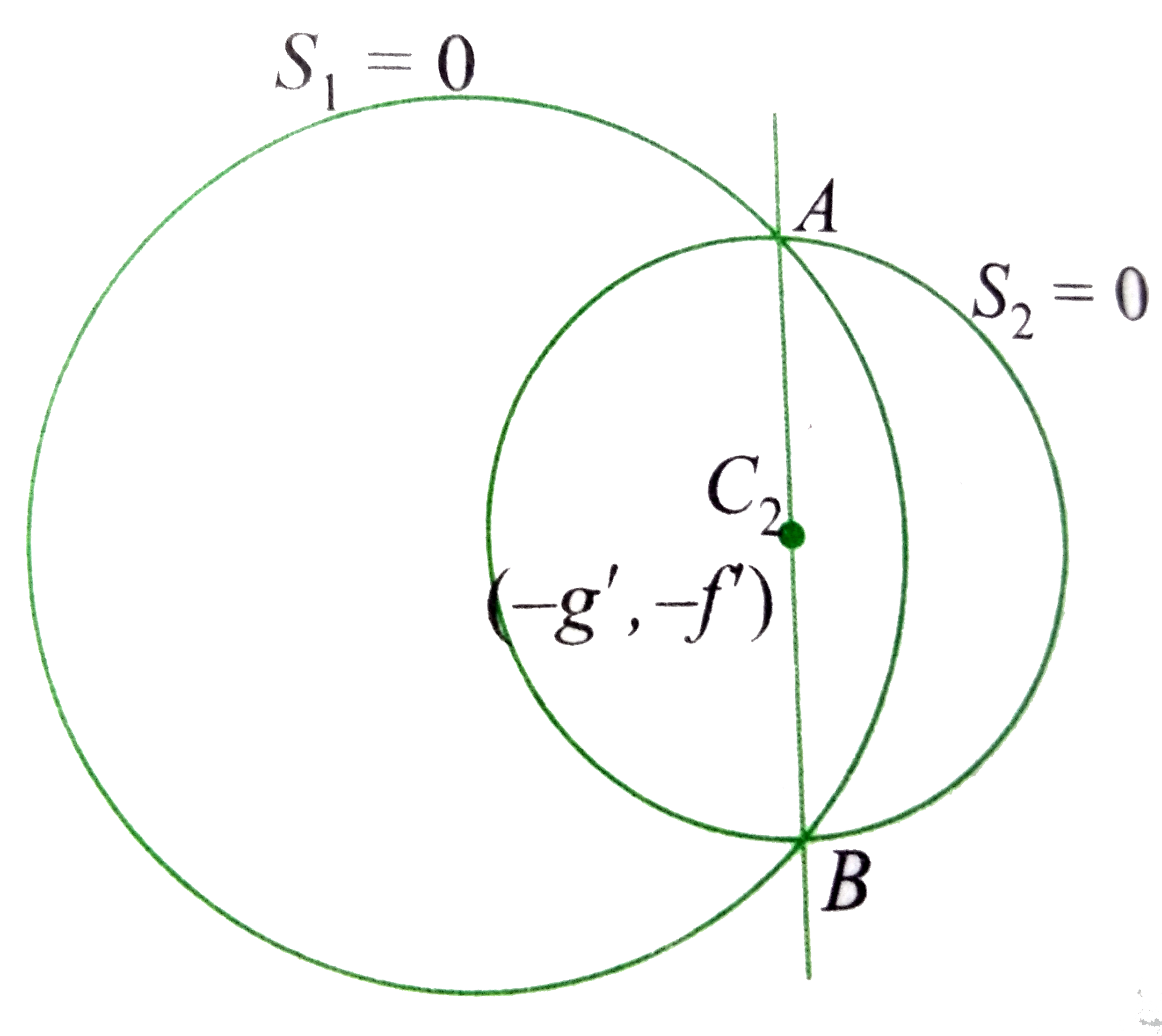
Given circels are
`S_(2)-=x^(2)+y^(2)+2gx+2fy+c=0` (1)
`S_(2)-= x^(2)+y^(2)+2g'x+2f'y+c'=0` (2)
It is given that circle `S_(1)=0` bisects the circumference of the circle `S_(2)=0`. So, the common chord of circles paseses through the centre of the circle `S_(2)=0`.
Equation of common chord of the circles is `2x(g-g')+2y(f-f')+c-c'=0`.
This chord passes through the centre `( -g',-f')` of second circle.

`:. -2g'(g-g')-2f'(f-f')+c-c'=0`
`implies 2g'(g-g')+2f'(f-f')=c-c'`
Promotional Banner

Topper's Solved these Questions

Similar Questions

Explore conceptually related problems

If f(x)=x|x|, then prove that f^(prime)(x)=2|x|

The condition that one of the straight lines given by the equation a x^2+2h x y+b y^2=0 may coincide with one of those given by the equation a^(prime)x^2+2h^(prime)x y+b^(prime)y^2=0 is (a b^(prime)-a^(prime)b)^2=4(h a^(prime)-h^(prime)a)(b h^(prime)-b^(prime)h) (a b^(prime)-a^(prime)b)^2=(h a^(prime)-h^(prime)a)(b h^(prime)-b^(prime)h) (h a^(prime)-h^(prime)a)^2=4(a b^(prime)-a^(prime)b)(b h^(prime)-b^(prime)h) (b h^(prime)-b^(prime)h)^2=4(a b^(prime)-a^(prime)b)(h a^(prime)-h^(prime)a)

If the circles x^2+y^2+2a^(prime)x+2b^(prime)y+c^(prime)=0 and 2x^2+2y^2+2a x+2b y+c=0 intersect othrogonally, then prove that a a^(prime) + b b prime=c+c^(prime)/2dot

The line A x+B y+C=0 cuts the circle x^2+y^2+a x+b y+c=0 at Pa n dQ . The line A^(prime)x+B^(prime)x+C^(prime)=0 cuts the circle x^2+y^2+a^(prime)x+b^(prime)y+c^(prime)=0 at Ra n dSdot If P ,Q ,R , and S are concyclic, then show that |a-a ' b-b ' c-c ' A B C A ' B ' C '|=0

Statement 1 : If two circles x^2+y^2+2gx+2fy=0 and x^2+y^2+2g^(prime)x+2f^(prime)y=0 touch each other, then f^(prime)g=fg^(prime)dot Statement 2 : Two circles touch other if the line joining their centers is perpendicular to all possible common tangents.

If a function is represented parametrically be the equations x=(1+(log)_e t)/(t^2); y=(3+2(log)_e t)/t , then which of the following statements are true? (a) y^('')(x-2x y^(prime))=y (b) y y^(prime)=2x(y^(prime))^2+1 (c) x y^(prime)=2y(y^(prime))^2+2 (d) y^('')(y-4x y^(prime))=(y^(prime))^2

Consider the family of all circles whose centers lie on the straight line y=x . If this family of circles is represented by the differential equation P y^(primeprime)+Q y^(prime)+1=0, where P ,Q are functions of x , y and y^(prime)(h e r ey^(prime)=(dy)/(dx),y^=(d^2y)/(dx^2)), then which of the following statements is (are) true? (a) P=y+x (b) P=y-x (c) P+Q=1-x+y+y^(prime)+(y^(prime))^2 (d) P-Q=x+y-y^(prime)-(y^(prime))^2

If alpha,beta are the roots of x^2-p x+q=0a n dalpha^(prime),beta' are the roots of x^2-p^(prime)x+q^(prime)=0, then the value of (alpha-alpha^(prime))^2+(beta-alpha^(prime))^2+(alpha-beta^(prime))^2+(beta-beta^(prime))^2 is a. 2{p^2-2q+p^('2)-2q^(prime)-p p '} b. 2{p^2-2q+p^('2)-2q^(prime)-q q '} c. 2{p^2-2q-p^('2)-2q^(prime)-p p '} d. 2{p^2-2q-p^('2)-2q^(prime)-q q '}

If the quadrilateral formed by the lines a x+b y+c=0,a^(prime)x+b^(prime)y+c=0,a x+b y+c^(prime)=0,a^(prime)x+b^(prime)y+c^(prime)=0 has perpendicular diagonals, then (a) b^2+c^2=b^('2)+c^('2) (b) c^2+a^2=c^('2)+a^('2) (c) a^2+b^2=a^('2)+b^('2) (d) none of these

Let y=f(x) be a parabola, having its axis parallel to the y-axis, which is touched by the line y=x at x=1. Then, (a) 2f(0)=1-f^(prime)(0) (b) f(0)+f^(prime)(0)+f^(0)=1 (c) f^(prime)(1)=1 (d) f^(prime)(0)=f^(prime)(1)

