Home
Class 12
MATHS
The line A x+B y+C=0 cuts the circle x^2...

The line `A x+B y+C=0` cuts the circle `x^2+y^2+a x+b y+c=0` at `Pa n dQ` . The line `A^(prime)x+B^(prime)x+C^(prime)=0` cuts the circle `x^2+y^2+a^(prime)x+b^(prime)y+c^(prime)=0` at `Ra n dSdot` If `P ,Q ,R ,` and `S` are concyclic, then show that `|a-a ' b-b ' c-c ' A B C A ' B ' C '|=0`

Text Solution

Verified by Experts
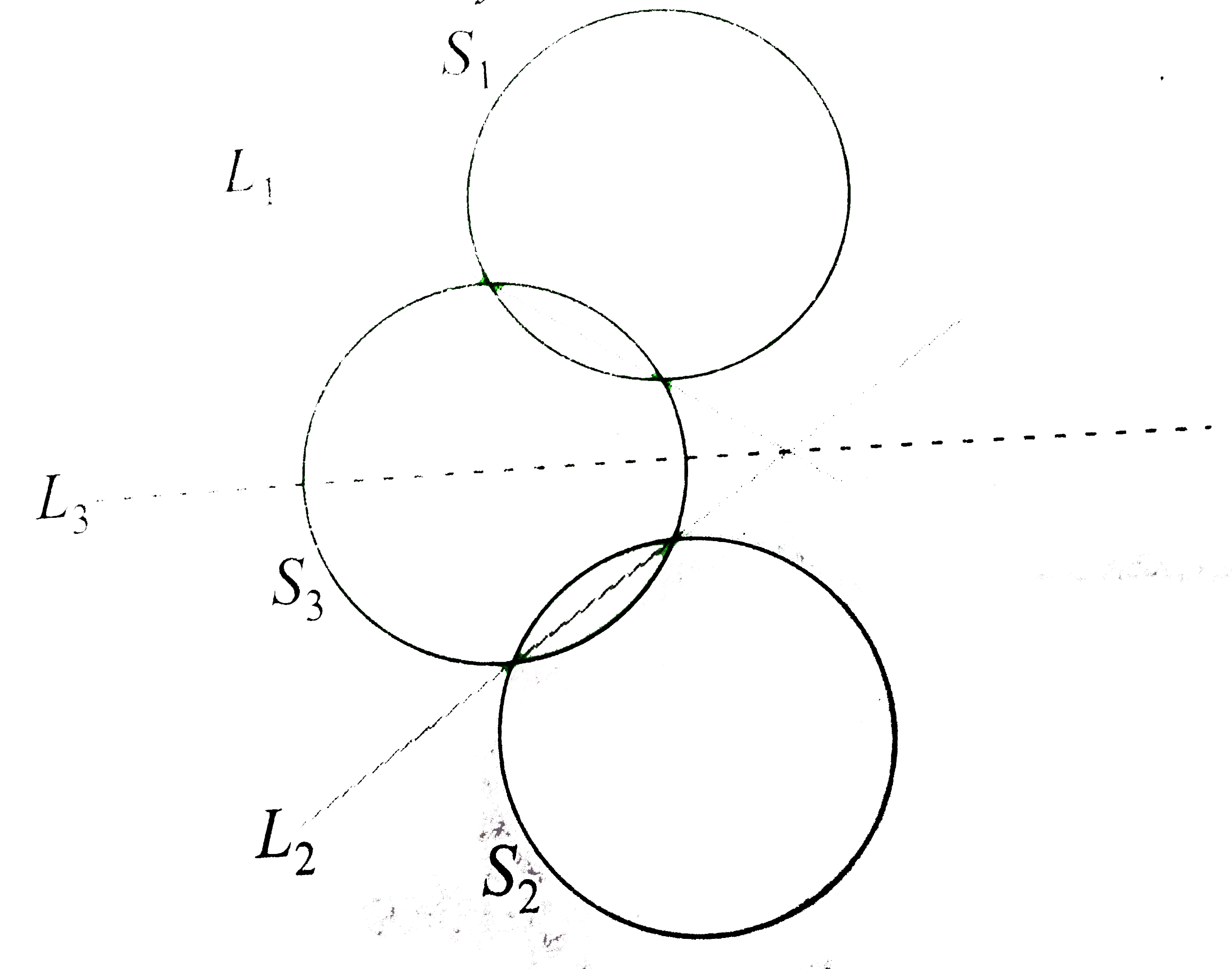
P and Q are the points of intersection of the line
`L_(1)-=Ax+By+C=0` (1)
and the circle
`S_(1)-= x^(2)+y^(2)+ax+by+c=0` (2)
R and S are the ponits of intersection of the line
`L_(2)-=A'x+B'y+C'=0` (3)
and the circle
`S_(2) -= x^(2)+y^(2)+a'x+b'y+c'=0` (4)

The radical axis of the circles `S_(1)=` and `S_(2)=` is
`S_(1)- S_(2)=0`
i.e., `L_(3)-= (a-a')x+(b-b')y+(c-c')=0` (5)
If P,Q,R, and S are concyclic and `S_(3)=` is the equation of this circle thorugh P,Q,R, and S, line (1) is the radical axis of the circle `S_(1)=0` and `S_(3)=0` and line (2) is the radical axis of the circles `S_(2)` and `S_(3)=`0.
Thus, the straight line gives by (5),(1), and (3) are the radical axsed of the circles `S_(1)=0,S_(2)=0` and `S_(3)=0` taken in pairs. Since the radical axes of the three circles taken in pairs concurrent or parrallel, we have
`|{:(a-a',b-b',c-c'),(A,B,C),(A',B',C'):}|=0`
Promotional Banner

Topper's Solved these Questions

Similar Questions

Explore conceptually related problems

If the circle x^2+y^2+2gx+2fy+c=0 bisects the circumference of the circle x^2+y^2+2g^(prime)x+2f^(prime)y+c^(prime)=0 then prove that 2g^(prime)(g-g^(prime))+2f^(prime)(f-f^(prime))=c-c '

If the circles x^2+y^2+2a^(prime)x+2b^(prime)y+c^(prime)=0 and 2x^2+2y^2+2a x+2b y+c=0 intersect othrogonally, then prove that a a^(prime) + b b prime=c+c^(prime)/2dot

Fid the condition if lines x=a y+b ,z=c y+da n dx=a^(prime)y+b^(prime), z=c^(prime)y+d ' are perpendicular.

Find the condition if lines x=a y+b ,z=c y+da n dx=a^(prime)y+b^(prime), z=c^(prime)y+d ' are perpendicular.

If the quadrilateral formed by the lines a x+b y+c=0,a^(prime)x+b^(prime)y+c=0,a x+b y+c^(prime)=0,a^(prime)x+b^(prime)y+c^(prime)=0 has perpendicular diagonals, then (a) b^2+c^2=b^('2)+c^('2) (b) c^2+a^2=c^('2)+a^('2) (c) a^2+b^2=a^('2)+b^('2) (d) none of these

The equations of tangents to the circle x^2+y^2-6x-6y+9=0 drawn from the origin in (a) x=0 (b) x=y (c) y=0 (d) x+y=0

If the circles x^2+y^2+2a x+c y+a=0 and x^2+y^2-3a x+d y-1=0 intersects at points P and Q , then find the values of a for which the line 5x+b y-a=0 passes through Pa n dQdot

If (a x^2+c)y+(a^(prime)x^2+c^(prime) )=0 and x is a rational function of y and ac is negative, then a. a c^(prime)+c^(prime)c=0 b. a//a '=c//c ' c. a^2+c^2=a^('2)+c^('2) d. a a^(prime)+c c^(prime)=1

Show that the reflection of the line a x+b y+c=0 on the line x+y+1=0 is the line b+a y+(a+b-c)=0 where a!=bdot

The condition that one of the straight lines given by the equation a x^2+2h x y+b y^2=0 may coincide with one of those given by the equation a^(prime)x^2+2h^(prime)x y+b^(prime)y^2=0 is (a b^(prime)-a^(prime)b)^2=4(h a^(prime)-h^(prime)a)(b h^(prime)-b^(prime)h) (a b^(prime)-a^(prime)b)^2=(h a^(prime)-h^(prime)a)(b h^(prime)-b^(prime)h) (h a^(prime)-h^(prime)a)^2=4(a b^(prime)-a^(prime)b)(b h^(prime)-b^(prime)h) (b h^(prime)-b^(prime)h)^2=4(a b^(prime)-a^(prime)b)(h a^(prime)-h^(prime)a)

