Home
Class 12
MATHS
A circle C of radius 1 is inscribed in a...

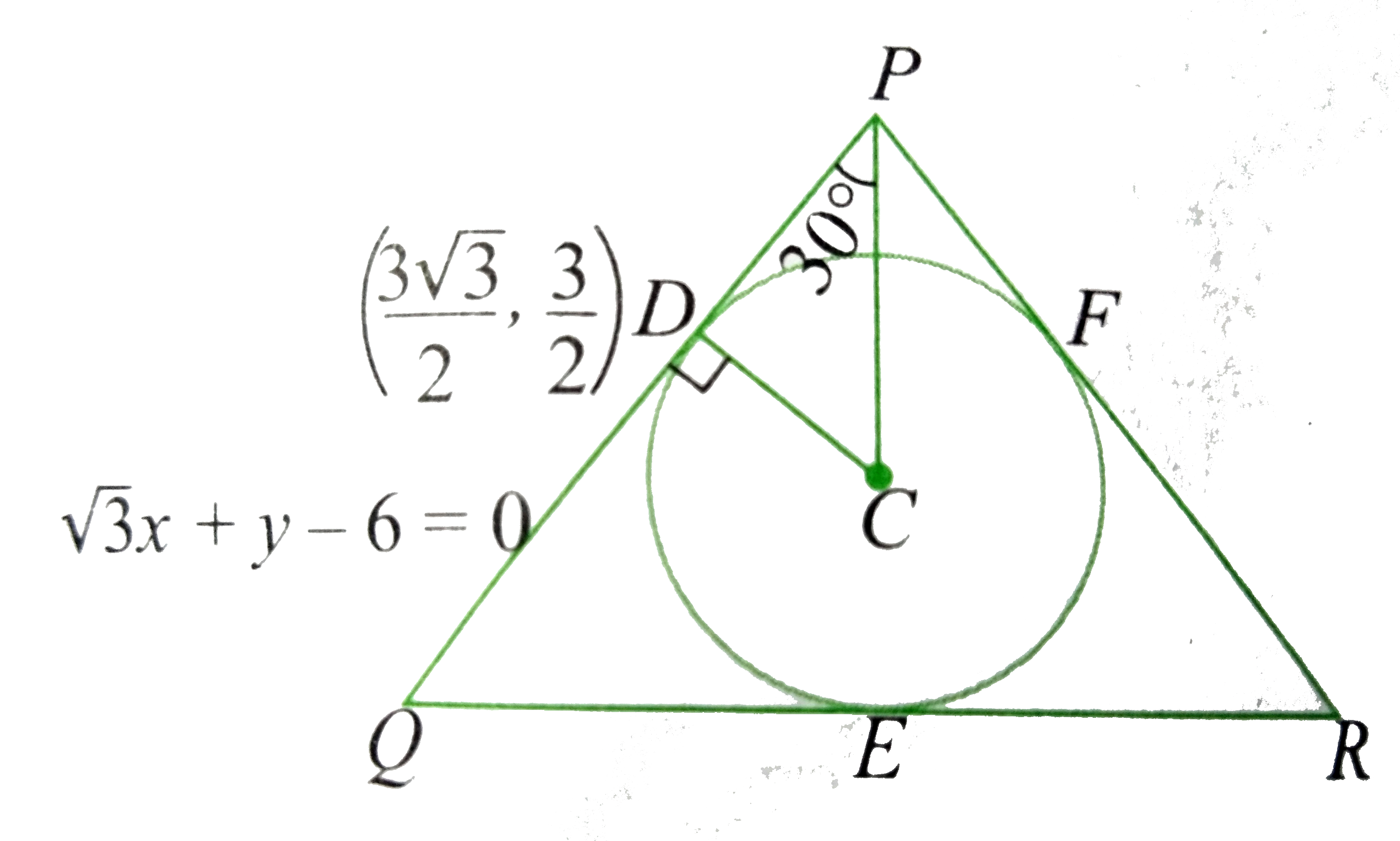
A circle C of radius 1 is inscribed in an equilateral triangle PQR. The points of contact of C with the sides PQ, QR, RP are D, E, F, respectively. The line PQ is given by the equation `sqrt3 x+ y -6 = 0` and the point D is (3 `sqrt3/2, 3/2). Further, it is given that the origin and the centre of C are on the same side of the line PQ. The equation of circle C is

A

a)`(x-2sqrt(3))^(2)+(y-1)^(2)=1`

B

b)`(x-2sqrt(3))^(2)+(y+(1)/(2))^(2)=1`

C

c)`(x-sqrt(3))^(2)+(y+1)^(2)=1`

D

d)`(x-sqrt(3))^(2)+(y-1)^(2)=1`

Text Solution

Verified by Experts

The correct Answer is:
4


Equation of `PQ` is `L_(1) : sqrt(3) x +y-6=0` (1)
Slope of PQ is `- sqrt(3)`
`:. `Slope of CD is `(1)/(sqrt(3))`.
`:. `Equation of line CD in parametric from is
`(x-(3sqrt(3))/(2))/(cos 30^(@))=(y-(3)/(2))/(sin 30^(@))=r`
or `(x-(3sqrt(3))/(2))/((sqrt(3))/(2))=(y-(3)/(2))/((1)/(2))=r`
For centre C, `r = +- 1`
Two possible coordinates of centre are `(2sqrt(3),2),(sqrt(3),1)`
According to the question, center lies on the same side where origin lies with respect to line PQ.
Now `L_(1) (0,0) = -6 lt0`
And `L_(1) ( sqrt(3),1) = 3+1-6 lt0`
So Centre C must be `( sqrt(3), 1)`
Hence, equation of the circle is `(x-sqrt(3))^(2)+(y-1)^(2) =1`
Promotional Banner

Topper's Solved these Questions

  • CIRCLE

    CENGAGE|Exercise Exercise (Matrix)|1 Videos
  • CIRCLE

    CENGAGE|Exercise Exercise (Numerical)|18 Videos
  • CIRCLE

    CENGAGE|Exercise Exercise (Multiple)|25 Videos
  • BINOMIAL THEOREM

    CENGAGE|Exercise Comprehension|11 Videos
  • CIRCLES

    CENGAGE|Exercise Question Bank|16 Videos

Similar Questions

Explore conceptually related problems

A circle C of radius 1 is inscribed in an equilateral triangle PQR. The points of contact of C with the sides PQ, QR, RP are D, E, F, respectively. The line PQ is given by the equation sqrt3 x+ y -6 = 0 and the point D is (3 sqrt3/2, 3/2). Further, it is given that the origin and the centre of C are on the same side of the line PQ. Equation of the sides QR, RP are

A circle C of radius 1 is inscribed in an equilateral triangle PQR. The points of contact of C with the sides PQ, QR, RP are D, E, F, respectively. The line PQ is given by the equation sqrt3 x+ y -6 = 0 and the point D is (3 sqrt3/2, 3/2). Further, it is given that the origin and the centre of C are on the same side of the line PQ.Points E and F are given by

The sides of a triangle are in the ratio 1: sqrt3:2. Then the angles are in the ratio

The vertex P of an equilateral triangle trianglePQR is at (2,3) and the equation of the opposite side QR is given by x+y=2 . Find the possible equations of the side PQ.

Delta PQR is an "equilateral triangle", "seg" PM bot side QR, Q -M- R "Prove that" : PQ^(2) = 4QM^(2)

In a triangle PQR, let anglePQR = 30^(@) and the sides PQ and QR have lengths 10 sqrt3 and 10, respectively. Then, which of the following statement(s) is (are) TRUE ?

A straight line through the point (2, 2) intersects the lines sqrt3 x + y = 0 and sqrt3 x - y = 0 at the points A and B. The equation of AB so that the triangle OAB is equilateral, where O is the origin.

In triangle Delta PQR , E and F are points on the sides PQ and PR respectively. State whether EF ||QR or not? (i) PE = 3.9 cm EQ = 3 cm PF = 3.6 cm and FR = 2.4 cm

In a triangle, the lengths of the two larger sides are 10 and 9, respectively. If the angles are in A.P., then the length of the third side can be (a) 5-sqrt(6) (b) 3sqrt(3) (c) 5 (d) 5+sqrt(6)

A triangle A B C is inscribed in a circle with centre at O , The lines A O ,B Oa n dC O meet the opposite sides at D , E ,a n dF , respectively. Prove that 1/(A D)+1/(B E)+1/(C F)=(acosA+bcosB+ccosC)/

CENGAGE-CIRCLE -Exercise (Comprehension)
  1. Two variable chords AB and BC of a circle x^(2)+y^(2)=a^(2) are such t...

    Text Solution

    |

  2. Give two circles intersecting orthogonally having the length of common...

    Text Solution

    |

  3. Give two circles intersecting orthogonally having the length of common...

    Text Solution

    |

  4. Give two circles intersecting orthogonally having the length of common...

    Text Solution

    |

  5. In the given figure, there are two circles with centers A and B. The c...

    Text Solution

    |

  6. In the given figure, there are two circles with centers A and B. The c...

    Text Solution

    |

  7. In the given figure, there are two circles with centers A and B. The c...

    Text Solution

    |

  8. Let each of the circles S(1)-=x^(2)+y^(2)+4y-1=0 S(1)-= x^(2)+y^(2...

    Text Solution

    |

  9. Let each of the circles S(1)-=x^(2)+y^(2)+4y-1=0 S(1)-= x^(2)+y^(2...

    Text Solution

    |

  10. Let each of the circles S(1)-=x^(2)+y^(2)+4y-1=0 S(1)-= x^(2)+y^(2...

    Text Solution

    |

  11. The line x + 2y = a intersects the circle x^2 + y^2 = 4 at two distinc...

    Text Solution

    |

  12. The line x + 2y = a intersects the circle x^2 + y^2 = 4 at two distinc...

    Text Solution

    |

  13. Let A,B, and C be three sets such that A={(x,y)|(x)/(cos theta)=(y)/...

    Text Solution

    |

  14. Let A,B, and C be three sets such that A={(x,y)|(x)/(cos theta)=(y)/...

    Text Solution

    |

  15. Consider the family of circles x^(2)+y^(2)-2x-2ay-8=0 passing through...

    Text Solution

    |

  16. Show that equation x^2+y^2-2ay-8=0 represents, for different values o...

    Text Solution

    |

  17. Consider the family of circles x^(2)+y^(2)-2x-6y-8=0 passing through ...

    Text Solution

    |

  18. A circle C of radius 1 is inscribed in an equilateral triangle PQR. Th...

    Text Solution

    |

  19. A circle C of radius 1 is inscribed in an equilateral triangle PQR. Th...

    Text Solution

    |

  20. A circle C of radius 1 is inscribed in an equilateral triangle PQR. Th...

    Text Solution

    |

