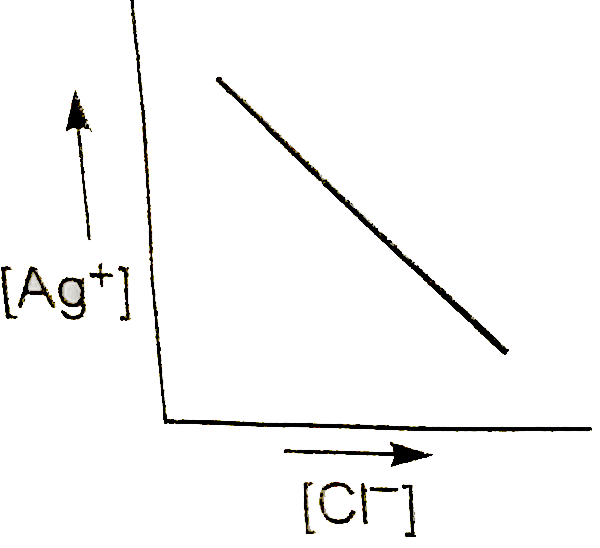
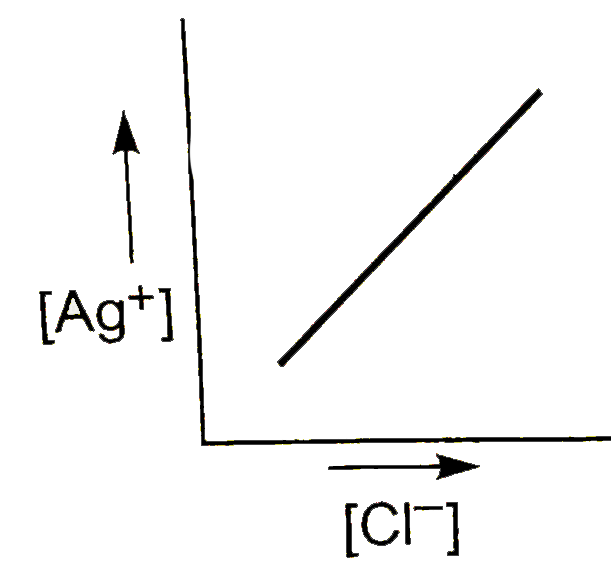
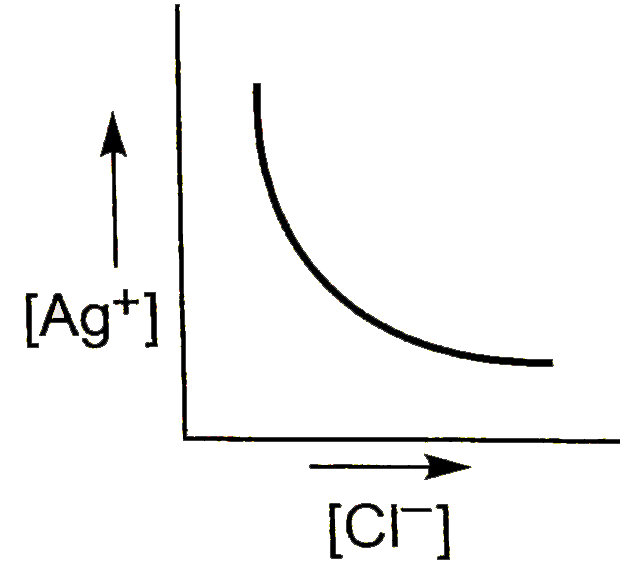
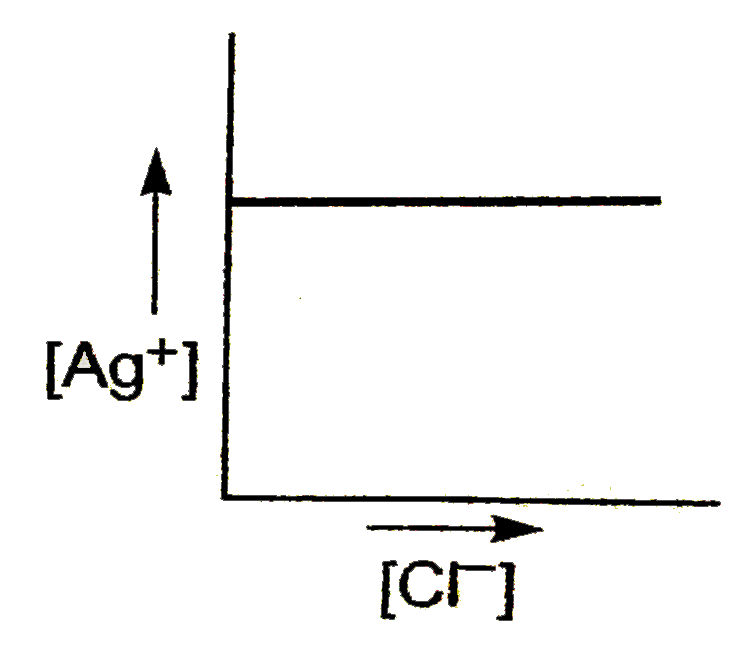
In a saturated solution of AgCl, NaCl is added gradually. The concentration of `Ag^(+)` is plotted against the concentration of `Cl^(-)`. The graph appears as :
A solution contains 40 g of NaCl in 320g of water. Calculate its concentration in terms of mass percentage of solution
Consider the following half cell reaction: Br_2+2barerarr2Br^- , E^@=1.09V I_2+2barerarr2I^- , E^@=0.54V If I_2 and Br_2 are added to solution containing 1M concentration of I^- and Br^- resepctively. How will the increase in the concentration of Br^- affect E_(cell) ?
The standard reduction potential of normal calomel electrode and reduction potential of saturated calomel electrodes are 0.27 and 0.33 volt respectively. What is the concentration of Cl^- in saturated solution of KCL?
To make a saturated solution, 36 g of sodium chloride is dissolved in 100 g of water at 293 K. Find its concentration at this temperature.
Choose the correct set of True/Fasle for following statements: (i) Silver chloride is more soluble in very concentrated sodium chloride solution than in pure water. (ii) The pH of a buffer solution does not change on addition of small amount of an acid or a base. (iii) Addition of NH_(4)Cl does not affect the pH of a solution of NH_(4)OH (iv) Degree of hydrolysis of ammonium acetate does not depend upon the concentration of ammonium acetate solution. (v) A mixture of acetic acid and sodium acetate can act as buffer solution.
Hydrolysis of methyl acetate in aqueous solution has been studied by titrating the liberated acetic acid against sodium hydroxide. The concentration of the ester at different times is given below. Show that it follows a pseudo first order reaction, as the concentration of water remains nearly constant (55 mol L^(-1)), during the course of the reaction. What is the value of k in this equation? Rate = k [CH_3C00CH_3][H_20]
The following curve is obtained when molar conductivty, Lambda_m is plotted against the square rot of concentration, C^(1//2) along y and x axis respectively for the two electrolytes X and Y. How do you account for the increase in Lambda_m for the electolytes X and Y with dilution?
For a general reaction A rarr B, plot of concentration of A vs time is given in figure below. Answer the following question on the basis of this graph. What is the order of the reaction?
For a general reaction A rarr B, plot of concentration of A vs time is given in figure below. Answer the following question on the basis of this graph. What is the slope of the curve?
NARENDRA AWASTHI-IONIC EEQUILIBRIUM-Assertin-Reason Type Questions