Home
Class 12
BIOLOGY
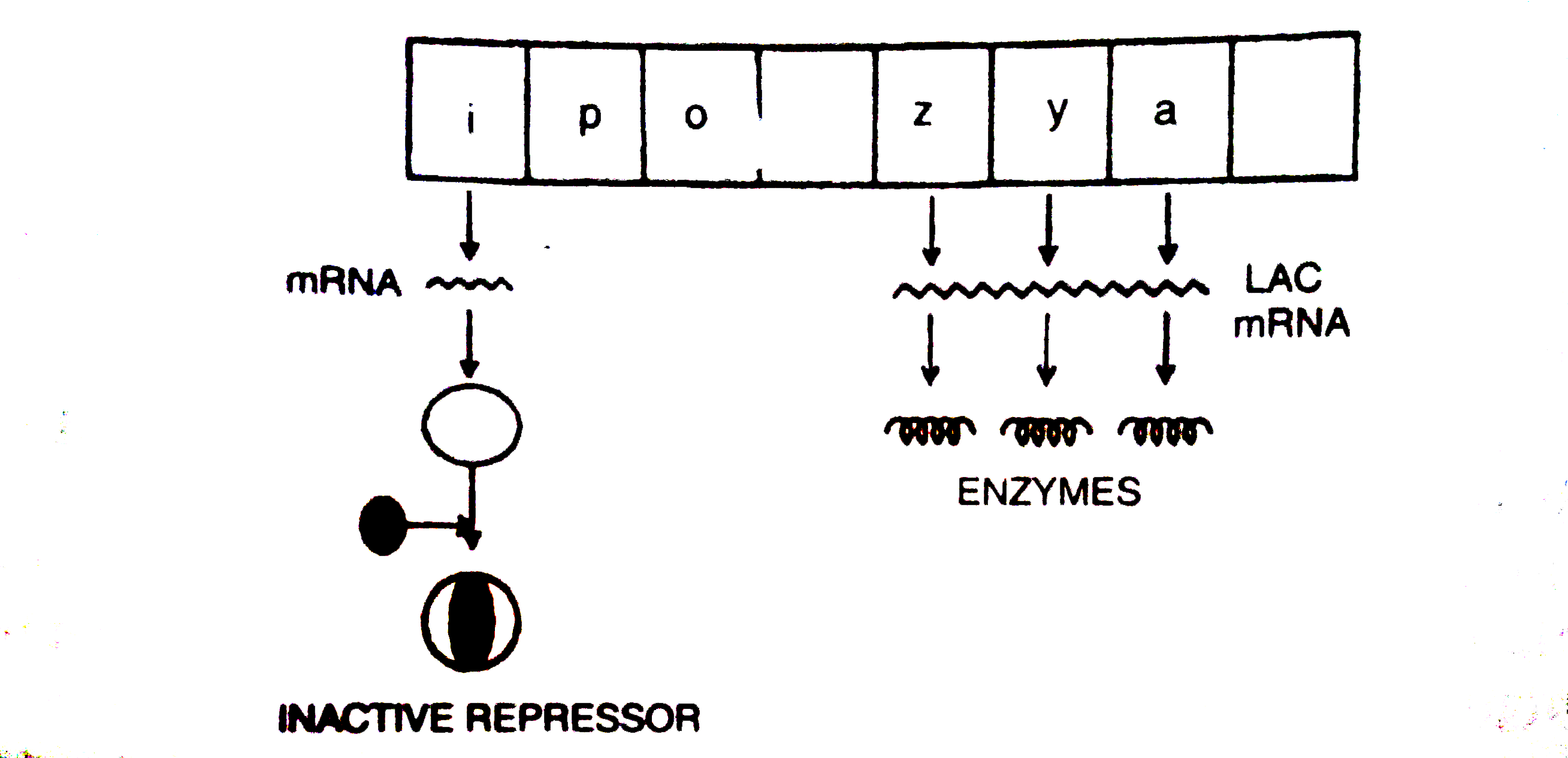
Study the figure given below and answer ...

Study the figure given below and answer the questions:

(i) How does the repressor molecule get inactivated?
(ii) When does the transcription of lac mRNA stop?
(iii) Name the enzyme transcribed by the gene Z'.

Text Solution

Verified by Experts

(i)The repressor molecule gets inactivated after coming in contact with the inducer
(ii) The transcription of lac mRNA stops when inactivate repressor turns active, attaches itself to the operator and switches of the operation.
(iii) The enzyme synthesized by the gene Z is galactosidase.
Promotional Banner

Topper's Solved these Questions

  • GENETICS AND EVOLUTION

    TRUEMAN BIOLOGY|Exercise SECTION-C|45 Videos
  • GENETICS AND EVOLUTION

    TRUEMAN BIOLOGY|Exercise SECTION-D|25 Videos
  • GENETICS AND EVOLUTION

    TRUEMAN BIOLOGY|Exercise SECTION-D|25 Videos
  • Genetics

    TRUEMAN BIOLOGY|Exercise ASSERTION AND REASON|122 Videos
  • HUMAN HEALTH AND DISEASE

    TRUEMAN BIOLOGY|Exercise MULTIPLE CHOICE QUESTIONS|211 Videos

Similar Questions

Explore conceptually related problems

Study the ladder of human evolution given above and answer the following questions. (i) Where did Australopithecus evolve? (ii) Write the scientific name of Java man?

Study the figure given below and answer the questions that follow : (a)Name the stage of human embryo the figure represents. (b)Identify 'A' in the figure and mention its function . ( c )Mention the fate of the inner cell mass after implantation in the uterus . (d)Where are the stem cells located in this embryo ?

Study the given pedigree chart and answer the questions that follow. Is the trait recessive or dominant? Is the trait sex linked or autosomal? Give the genotypes of the parents shown in generation I and their III child shown in generation II and the first grandchild shown in generation III.

Select the two correct statements out of the four (1-4) given below about lac operon. 1. Glucose or galactose may bind with the repressor and inactivate it 2. In the absence of lactose the repressor binds with the operator region 3. The z-gene codes for permease 4. This was elucidated Francois Jacob and Jacque Monod The correct statements are :

Four elements A, B, C and D along with their electronic configuration are given below: Now answer the following questions: (i) Which two elements belong to the same period ? (ii) Which two elements belong to the same group ? (iii) Which element out of A and C is more reactive and why?

Using the given part of the periodic table, answer the following questions with reason : (i) Name the element having smallest atomic size. (ii) Write electronic configuration of element E. (iii) Identify the elements which have similar physical and chemical properties as the element Y.

From the following part of the periodic table, answer the following questions: (i) Which is the most reactive metal ? (ii) Name the family of fluorine Q, R, T. (iii) Name one element each of group 2 and 15. (iv) Give the name of the element P placed below carbon. (v) Compare X and P with respect to the size of atoms.

Study the diagram and answer the questions the follow it : (i) Which defect of vision is represented in the case ? Give reason for your answer. (ii) What could be two causes of this defect ? (iii) With the help of a diagram show how this defect can be corrected by the use of a suitable lens.

TRUEMAN BIOLOGY-GENETICS AND EVOLUTION -SECTION-B
  1. Given below is a sequence of steps of transcription in a eukaryotic ce...

    Text Solution

    |

  2. Study the figure given below and answer the questions: (i) How do...

    Text Solution

    |

  3. Expand DNA and RNA. Name the sugar moiety present in these structures.

    Text Solution

    |

  4. Answer the questions based on the dinucleotide shown below : (i)N...

    Text Solution

    |

  5. How do histones acquire positive charge?

    Text Solution

    |

  6. State the dual role of deoxyribonucleoside triphosphates during DNA re...

    Text Solution

    |

  7. Mention the role of ribosomes in peptide-bond formation. How does ATP ...

    Text Solution

    |

  8. In a Mendelian monohybrid cross the F2 generation shows identical geno...

    Text Solution

    |

  9. What is Down's syndrome? Give its symptoms and cause. Why is it that t...

    Text Solution

    |

  10. What are the characteristic features of a trur-breeding line?

    Text Solution

    |

  11. If a father and son are both defective in red-green color vision, is i...

    Text Solution

    |

  12. What would happen if histones were to be mutated and made rich in acid...

    Text Solution

    |

  13. Recall the experiment done by Frederick Griffith. If RNA, instead of D...

    Text Solution

    |

  14. Describe Chargaff rule.

    Text Solution

    |

  15. Differentiate between nucleotide and nucleoside.

    Text Solution

    |

  16. Mention the indusers in Lac and tryptophan operon concept.

    Text Solution

    |

  17. Expand VNTR. Mention its application.

    Text Solution

    |

  18. Define DNA polymerisation. Mention the role of REN and DNA ligase.

    Text Solution

    |

  19. Name the accepted model of plasma membrane. Who proposed it?

    Text Solution

    |

  20. What are the functions of (i) methylated guanasine cap, (ii) poly-A"ta...

    Text Solution

    |
