Home
Class 12
BIOLOGY
Study the pedigree chart given, showing ...

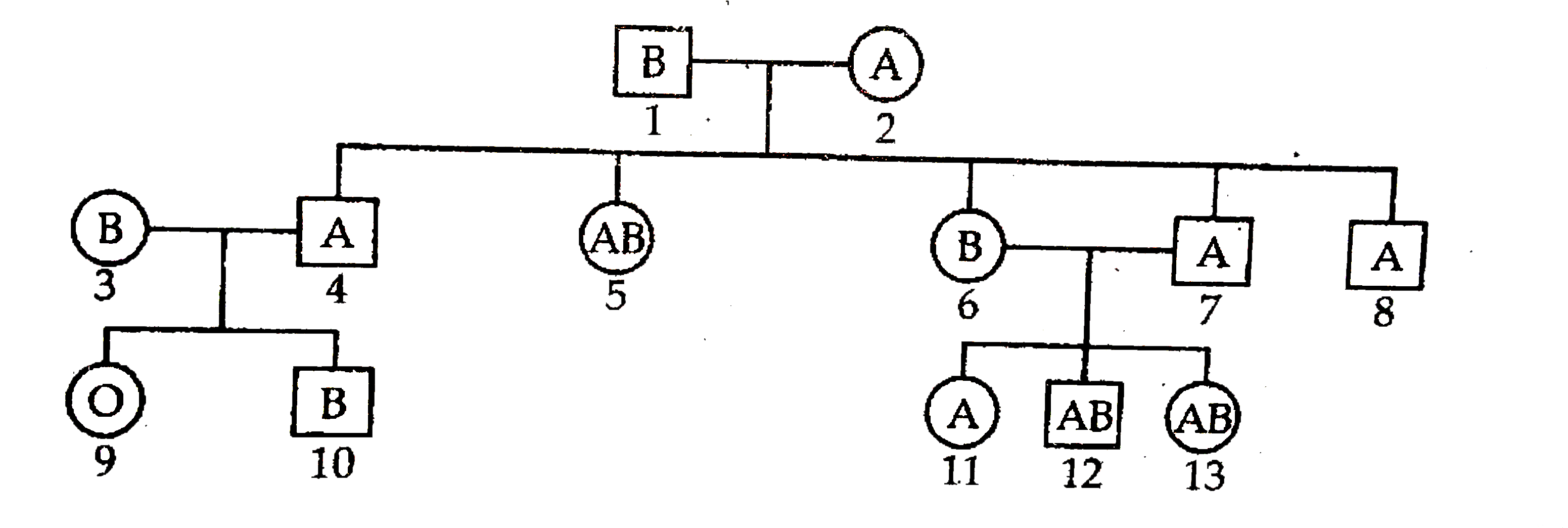
Study the pedigree chart given, showing the Inheritance pattern of blood groups in a family and answer the following questions

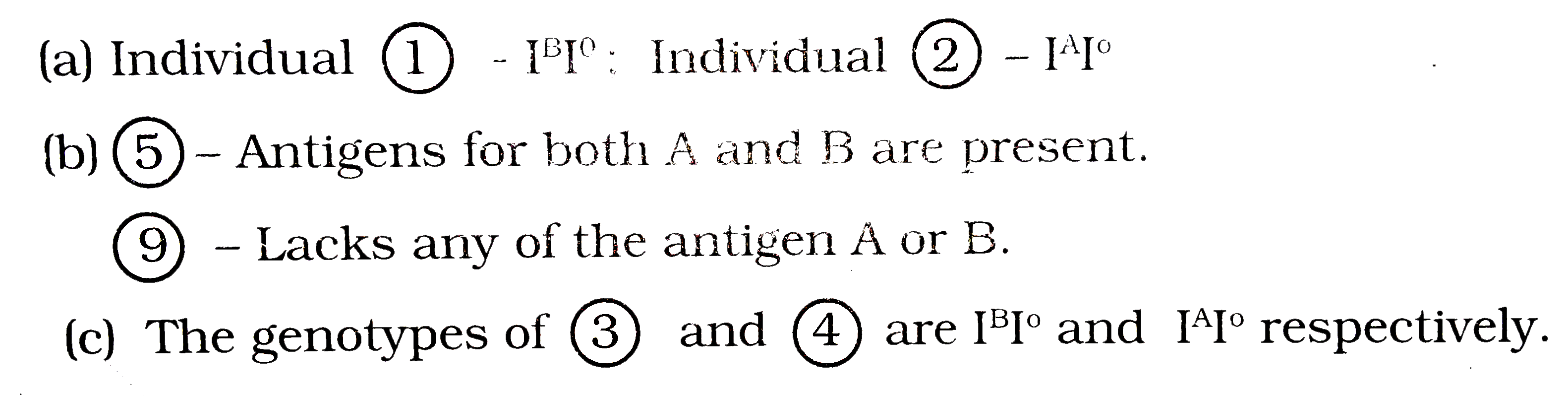
(a) Give the possible genotypes of the individuals 1 and 2.
(b) Which antigen or antigens will be present on the plasma membranes of the RBC's of individuals 5 and 9.
(c) Give the genotypes of the individuals 3 and 4.

Text Solution

Verified by Experts
Promotional Banner

Topper's Solved these Questions

  • GENETICS AND EVOLUTION

    TRUEMAN BIOLOGY|Exercise SECTION-D|25 Videos
  • GENETICS AND EVOLUTION

    TRUEMAN BIOLOGY|Exercise SECTION-A|34 Videos
  • GENETICS AND EVOLUTION

    TRUEMAN BIOLOGY|Exercise SECTION-A|34 Videos
  • Genetics

    TRUEMAN BIOLOGY|Exercise ASSERTION AND REASON|123 Videos
  • HUMAN HEALTH AND DISEASE

    TRUEMAN BIOLOGY|Exercise MULTIPLE CHOICE QUESTIONS|210 Videos

Similar Questions

Explore conceptually related problems

Study the given pedigree chart showing the pattern of blood group inheritance in a family (a) Given the genotype of the following: (i)Parents (ii) The individual 'X' in second generation (b) State the possible blood groups of the individual 'Y' in third generation (c) How does the inheritance of this blood group explain codominance?

Haemophilia is a sex linked recessive disorder of humans. The pedigree chart given below shows the inheritance of Haemophilia in one family. Study the pattern of inheritance and answer the questions given. (a) Give all the possible genotypes of the members 4, 5 and 6 in the pedigree chart. (b) A blood test shows that the individual 14 is a carrier of haemophilia. The member numbered 15 has recently married the member numbered 14. What is the probability that their first child will be a haemophilic male ? Show with the help of Punnett square.

Given below is a pedigree chart of a family with five children. It shows the inheritance of attached ear-lobes as opposed to the free ones. The squares represent the mae individuals and circls represent the female individuals. Which one of the following conclusions drawn is correct?

(b) answer the following questions: 1. if A=[[1,2,2],[2,1,2],[2,2,1]] , then show that A^2-4A-5I_3=0

Consider a family of circles passing through the points (3, 7) and (6,5). Answer the following questions. Number of circles which belong to the family and also touching x- axis are (a) 0 (b) 1 (c) 2 (d) Infinite

Given below is a pedigree chart of a family with five children. It shows the inheritance of attached ear lobes as opposed to the free ones. The squares represent the male indiones. The squares represent the male individuals and circles the female individuals Which of one of the following conclusions drawn is correct?

There are some experiment in which the outcomes cannot be identified discretely. For example, an ellipse of eccentricity 2sqrt(2)//3 is inscribed in a circle and a point within the circle is chosen at random. Now, we want to find the probability that this point lies outside the ellipse. Then, the point must lie in the shaded region shown in Figure. Let the radius of the circle be a and length of minor axis of the ellipse be 2b. Given that 1 - (b^(2))/(a^(2)) = (8)/(9) or (b^(2))/(a^(2)) = (1)/(9) Then, the area of circle serves as sample space and area of the shaded region represents the area for favorable cases. Then, required probability is p= ("Area of shaded region")/("Area of circle") =(pia^(2) - piab)/(pia^(2)) = 1 - (b)/(a) = 1 - (1)/(3) = (2)/(3) Now, answer the following questions. Two persons A and B agree to meet at a place between 5 and 6 pm. The first one to arrive waits for 20 min and then leave. If the time of their arrival be independant and at random, then the probability that A and B meet is

A problem of Statistics is given to three students A, B and C, where chances of solving the problem individually are 1/2, 1/3 and 1/4 respectively. Find the probability that exactly one of them solve the problem.

CoSO_(4)Cl.5NH_(3) exists in two isomeric forms 'A' and 'B'. Isomer 'A' reacts with AgNO_(3) to give white precipitate, but does not react with BaCl_(2) . Isomer 'B' gives white precipitate with BaCl_(2) but does not react with AgNO_(3) . Answer the following questions. (i) Identify 'A' & 'B' and write their structural formulas. (ii) Name the type of isomerism involved. (iii) Give the IUPAC name of 'A' and 'B'.

TRUEMAN BIOLOGY-GENETICS AND EVOLUTION -SECTION-C
  1. (a) What is this diagram representing? (b) Name the parts a, b and c...

    Text Solution

    |

  2. (a) In human genome which one of the chromosomes has the most genes an...

    Text Solution

    |

  3. Study the pedigree chart given, showing the Inheritance pattern of blo...

    Text Solution

    |

  4. Why are F(2) phenotypic and genotypic ratios same in a cross between r...

    Text Solution

    |

  5. (i) Why are grasshopper and Drosophila said to show male heterogamety ...

    Text Solution

    |

  6. Why is tRNA called an adapter molecule?

    Text Solution

    |

  7. (i) List the chromosomal disorders a human may suffer from if karyotyp...

    Text Solution

    |

  8. How are dominance, codominance and incomplete dominance patterns of in...

    Text Solution

    |

  9. A pea plant with purple flowers was crossed with white flowers produci...

    Text Solution

    |

  10. (i) Name the enzyme that catalysis the transcription of hnRNA.

    Text Solution

    |

  11. Unambiguous, universal and degenerate are some of the terms used for t...

    Text Solution

    |

  12. (a) Name the scientist who called t-RNA an adapter molecule. (b) D...

    Text Solution

    |

  13. During the studies on genes in Drosopila that were sex-linked T.H. Mor...

    Text Solution

    |

  14. Explain the mechanism of sex determination in insects like Drosophila ...

    Text Solution

    |

  15. Who determines the sex of an unborn child? Mention whether temperature...

    Text Solution

    |

  16. The following is the flow chart highlighting the steps in DNA finger p...

    Text Solution

    |

  17. Study the given pedigree chart showing the pattern of blood group inhe...

    Text Solution

    |

  18. a) Construct a complete transcription unit with promoter and terminato...

    Text Solution

    |

  19. What is the genetic basis for proof that codon is a triplet?

    Text Solution

    |

  20. Comment on the utility of variability in number of tandem repeats duri...

    Text Solution

    |

