



Home
Class 11
PHYSICS
A small puck is sliding to the right wit...

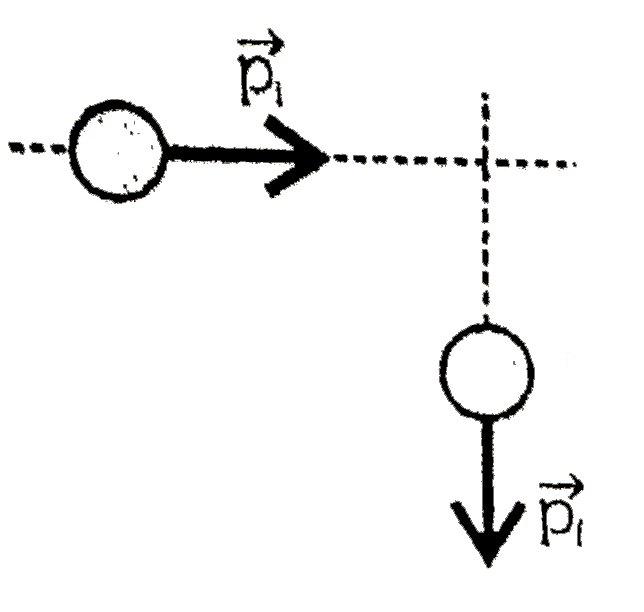
A small puck is sliding to the right with momentum `vec(P)_(1)` on a horizontal, frictionless surface, as shown in figure. A force is applied to the puck for a short time and its momentum afterward is `vec(P)_(f)`. Which lettered arrow shows the direction of the impulse that was delovered to the puck ?

A

B

C

D

Text Solution

Verified by Experts

The correct Answer is:

B
Promotional Banner

Topper's Solved these Questions

  • CENTRE OF MASS

    ALLEN |Exercise EXERCISE-II|43 Videos
  • CENTRE OF MASS

    ALLEN |Exercise EXERCISE-III|41 Videos
  • CENTRE OF MASS

    ALLEN |Exercise EXERCISE-V B|19 Videos
  • BASIC MATHEMATICS USED IN PHYSICS &VECTORS

    ALLEN |Exercise EXERCISE-IV ASSERTION & REASON|11 Videos
  • ELASTICITY, SURFACE TENSION AND FLUID MECHANICS

    ALLEN |Exercise Exercise 5 B (Integer Type Questions)|3 Videos

Similar Questions

Explore conceptually related problems

Three blocks of m asses 1 kg, 2 kg and 3 kg are placed in contact w ith each other on a horizontal frictionless surface, as show n in figure. A force of 12 N is applied as shown in the figure. Calculate (i) the acceleration of the system o f these three blocks, (ii) the contact force acting on 2 kg block by first block of 1 kg and (iii) the contact force on 3 kg block.

Two pucks are initially moving along a frictionless surface as shown in the diagram. The pucks have mass m_(1)ltm_(2) and begin with equal magnitude of momentum. A constant force vec(F) is applied to each puck direactly to the right for the same amount of nonzero time. After the pushes are complete, what is the relationship for the size of the moments of pucks ( p_(1) and p_(2) ) ?

A block of mass m lies on a horizontal frictionless surface and is attached to one end of a horizontal spring (with spring constant k ) whose other end is fixed . The block is intinally at rest at the position where the spring is unstretched (x=0) . When a constant horizontal force vec(F) in the positive direction of the x- axis is applied to it, a plot of the resulting kinetic energy of the block versus its position x is shown in figure. What is the magnitude of vec(F) ?

A block of mass m lies on a horizontal frictionless surface and is attached to one end of a horizontal spring (with spring constant k ) whose other end is fixed . The block is intinally at rest at the position where the spring is unstretched (x=0) . When a constant horizontal force vec(F) in the positive direction of the x- axis is applied to it, a plot of the resulting kinetic energy of the block versus its position x is shown in figure. What is the magnitude of vec(F) ?

Two blocks each of mass m, connected by an un-stretched spring are kept at rest on a frictionless horizontal surface. A constant force F is applied on one of the blocks pulling it away from the other as shown in figure. (a)Find accelaration of the mass center. (b) Find the displacement of the centre of mass as function of time t. (c) If the extension of the spring is X_(0) at an instant t, find the displacements of the two blocks relative to the ground at this instant.

A wedge of mass M = 2m rests on a smooth horizontal plane. A small block of mass m rests over it at left end A as shown in figure. A sharp impulse is applied on the block, due to which it starts moving to the right with velocity v_(0) = 6 ms^(-1) . At highest point of its trajectory, the block collides with a particle of same mass m moving vertically downwards with velocity v = 2 ms^(-1) and gets stuck with it. If the combined body lands at the end point A of body of mass M, calculate length l . Neglect friction (g = 10 ms^(-2)) .

A block of mass'm' it kept over the smooth surface of the plank of mass M. the plank of length l is kept over the smooth horizontal surface. A constant horizontal force F is applied onto the plank as shown in figure. Calculate the time after which the block falls off the plank?

A block lying on a rough horizontal surfaces as show in figure . Its mass is M and it is dispalced through a distance d by a force vec(F ) acting at an angle theta with horizontal . If mu is the coefficient of friction between a block and the surface and mass of block is M . then work done is ...........

A circus wishes to develop a new clown act. Fig. (1) shows a diagram of the proposed setup. A clown will be shot out of a cannot with velocity v_(0) at a trajectory that makes an angle theta=45^(@) with the ground. At this angile, the clown will travell a maximum horizontal distance. The cannot will accelerate the clown by applying a constant force of 10, 000N over a very short time of 0.24s . The height above the ground at which the clown begins his trajectory is 10m . A large hoop is to be suspended from the celling by a massless cable at just the right place so that the clown will be able to dive through it when he reaches a maximum height above the ground. After passing through the hoop he will then continue on his trajectory until arriving at the safety net. Fig (2) shows a graph of the vertical component of the clown's velocity as a function of time between the cannon and the hoop. Since the velocity depends on the mass of the particular clown performing the act, the graph shows data for serveral different masses. The slope of the line segments plotted in figure 2 is a figure constant. Which one of the following physical quantities does this slope represent?

A circus wishes to develop a new clown act. Fig. (1) shows a diagram of the proposed setup. A clown will be shot out of a cannot with velocity v_(0) at a trajectory that makes an angle theta=45^(@) with the ground. At this angile, the clown will travell a maximum horizontal distance. The cannot will accelerate the clown by applying a constant force of 10, 000N over a very short time of 0.24s . The height above the ground at which the clown begins his trajectory is 10m . A large hoop is to be suspended from the celling by a massless cable at just the right place so that the clown will be able to dive through it when he reaches a maximum height above the ground. After passing through the hoop he will then continue on his trajectory until arriving at the safety net. Fig (2) shows a graph of the vertical component of the clown's velocity as a function of time between the cannon and the hoop. Since the velocity depends on the mass of the particular clown performing the act, the graph shows data for serveral different masses. From figure 2, approximately how much time will it take for clown with a mass of 60 kg to reach the safety net located 10 m below the height of the cannot?

ALLEN -CENTRE OF MASS-EXERCISE-I
  1. Two blocks A(3 kg) and B(2 kg) resting on a smooth horizontal surface ...

    Text Solution

    |

  2. A shell is fired vertically upwards with a velocity v(1) from the deck...

    Text Solution

    |

  3. A shell is fired from a cannon with a velocity v (m//sec.) at an angle...

    Text Solution

    |

  4. A ball hits the floor and rebounds after an inelastic collision. In th...

    Text Solution

    |

  5. Three balls A, B and C are placed on a smooth horizontal surface. Give...

    Text Solution

    |

  6. A body of mass 1 kg strikes elastically with another body at rest and ...

    Text Solution

    |

  7. A small bucket of mass M kg is attached to a long inextensible cord of...

    Text Solution

    |

  8. In the figure shown, a particle P strikes the inclined smooth plane ho...

    Text Solution

    |

  9. A ball of mass 2m impinges directly on a ball of mass m, which is at r...

    Text Solution

    |

  10. A body of mass 2 kg is projected upward from the surface of the ground...

    Text Solution

    |

  11. A ball of mass 1 kg strikes a heavy platform, eleastically, moving upw...

    Text Solution

    |

  12. Two paricles of equal mass m go round a circle of radius R under the a...

    Text Solution

    |

  13. Two objects move in the same direction in a straight line. One moves w...

    Text Solution

    |

  14. A uniform rope of linear mass density lambda and length l is coiled on...

    Text Solution

    |

  15. A 10 g rubber ball and a 10g clay ball are each thrown at a wall with ...

    Text Solution

    |

  16. Two friends are sitting in a stationary boat. At t = 30s the person at...

    Text Solution

    |

  17. Two blocks, with masses m(1) 2.5 kg and m(2) = 14 kg, approach each ot...

    Text Solution

    |

  18. A small puck is sliding to the right with momentum vec(P)(1) on a hori...

    Text Solution

    |

  19. A smooth sphere is moving on a horizontal surface with velocity vector...

    Text Solution

    |

  20. A moving 2 kg ball with a speed of 2 ms^(-1) hits obliquely a stationa...

    Text Solution

    |
