Home
Class 11
PHYSICS
The Fig. showns a string of equally plac...

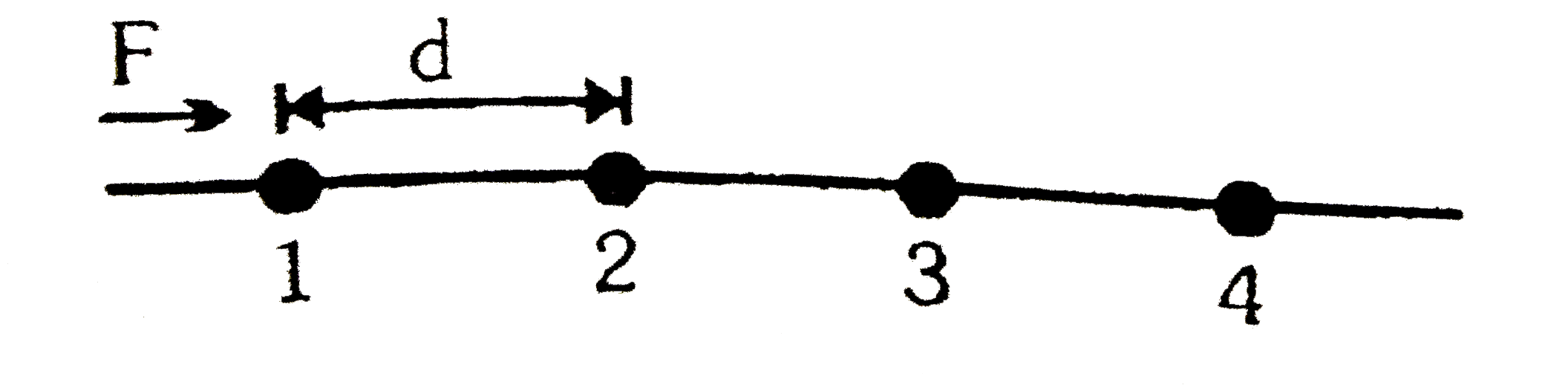
The Fig. showns a string of equally placed beads of mass m, separated by distance. The beads are free to slide without friction on a thin wire. A constant force F act on the first bead initially at rest till it makes collision with the second bead. The second bead then collides with the third and so on. Supposed that all collisions are elastic,

A

Speed of the first immediately before and immediately after its collision with the second bead is `sqrt((2Fd)/(m))` and zero respectively

B

Speed of the first bead immediately before and immediately after its collision with the second bead is `sqrt((2Fd)/(m))` and `(1)/(2) sqrt((2Fd)/(m))` respectively

C

Speed of the second bead immediately after collision with third bead is zero

D

The average speed of the first bead is `(1)/(2)sqrt(2Fd)/(m)`

Text Solution

Verified by Experts

The correct Answer is:

A, C

In elastic head on collision if the masses of the collision bodies are eaqual, the velocities after for `Ist` bead, `Fd = (1)/(2) m u^(2) rArr u = sqrt((2Fd)/(m))`
Promotional Banner

Topper's Solved these Questions

  • CENTRE OF MASS

    ALLEN |Exercise EXERCISE-III|41 Videos
  • CENTRE OF MASS

    ALLEN |Exercise EXERCISE-IV A|32 Videos
  • CENTRE OF MASS

    ALLEN |Exercise EXERCISE-I|40 Videos
  • BASIC MATHEMATICS USED IN PHYSICS &VECTORS

    ALLEN |Exercise EXERCISE-IV ASSERTION & REASON|11 Videos
  • ELASTICITY, SURFACE TENSION AND FLUID MECHANICS

    ALLEN |Exercise Exercise 5 B (Integer Type Questions)|3 Videos

Similar Questions

Explore conceptually related problems

The Fig. shows a string of equally placed beads of mass m , separated by distance d . The beads are free to slide without friction on a thin wire. A constant force F act on the first bead initially at rest till it makes collision with the second bead. The second bead then collides with the third and so on. Supposed that all collisions are elastic,

A bead of mass m and diameter d is sliding back and forth with velocity v on a wire held between two right walls of length L. Assume that th ecollisions with the wall are perfectly elastic and ther is no friction. The average force that the bouncing bead exerts on the one of the walls is :_

Two blocks of equal mass m are connected by an unstretched spring and the system is kept at rest on a frictionless horizontal surface. A constant force F is applied on the first block pulling away from the other as shown in Fig. If the extension of the spring is x_(0) at time t , then the displacement of the second block at this instant is

A piece of wire is bent in the shape of a parabola y=kx^(2) (y-axis vertical) with a bead of mass m on it. The bead can slide on the wire without friction. It stays at the lowest point of the parabola when the wire is at rest. The wire is now accelerated parallel to the x-axis with a constant acceleration a. The distance of the new equilibrium position of the bead, where the bead can stay at rest with respect to the wire, from the y-axis is:

On end of a light spring of natural length d and spring constant k is fixed on a rigid wall and the other is attached to a smooth ring of mass m which can slide without friction on a vertical rod fixed at a distance d from the wall. Initially the spring makes an angle of 37^@ with the horizontal. as shown in figure. When the system is released from rest, find the speed of the ring when the spring becomes horizontal. (sin 37^@=3/5) .

On a frictionless surface , a block of mass . M moving at speed v collides elastically with another block of same mass M which is intially at rest /After collision the first block moes at an angle theta to its initial direction and has a speed v/3 The second block's speed after the collision is :

Two blocks of masses 2kg and M are at rest on an inclined plane and are separated by a distance of 6.0m as shown. The coefficient of friction between each block and the inclined plane is 0.25 . The 2kg block is given a velocity of 10.0m//s up the inclined plane. It collides with M, comes back and has a velocity of 1.0m//s when it reaches its initial position. The other block M after the collision moves 0.5m up and comes to rest. Calculate the coefficient of restitution between the blocks and the mass of the block M. [Take sintheta=tantheta=0.05 and g=10m//s^2 ]

One end of a light spring of natural length 4m and spring constant 170 N/m is fixed on a rigid wall and the other is fixed to a smooth ring of mass (1)/(2) kg which can slide without friction in a verical rod fixed at a distance 4 m from the wall. Initially the spring makes an angle of 37^(@) with the horizontal as shown in figure. When the system is released from rest, find the speed of the ring when the spring becomes horizontal.

A bead can slide on asmooth straight wire and a particle of mass m attached to the bead by a light string of length L. The particle is held in contact with the wire and with the string taut and is then let fall. If the bead has mass 2m then when the string makes an angle theta with the wire, the bead will have slipped a dsitance.

Two beads of masses m_(1) and m_(2) are closed threaded on a smooth circular loop of wire of radius R. Intially both the beads are in position A and B in vertical plane . Now , the bead A is pushed slightly so that it slide on the wire and collides with B . if B rises to the height of the centre , the centre of the loop O on the wire and becomes stationary after the collision , prove m_(1) : m_(2) = 1 : sqrt(2)

ALLEN -CENTRE OF MASS-EXERCISE-II
  1. A bead of mass m and diameter d is sliding back and forth with velocit...

    Text Solution

    |

  2. A set of n identical cubical blocks lies at rest parallel to each othe...

    Text Solution

    |

  3. The Fig. showns a string of equally placed beads of mass m, separated ...

    Text Solution

    |

  4. Two persons A and B of weight 80 kg and 50 kg respectively are standin...

    Text Solution

    |

  5. In a one dimensional collision between two identical particles A and B...

    Text Solution

    |

  6. Two balls of same mass are dropped from the same height onto the floor...

    Text Solution

    |

  7. A small ball falling vertically downward with constant velocity 4m//s ...

    Text Solution

    |

  8. A particle of mass 4m which is at rest explodes into four equal fragme...

    Text Solution

    |

  9. The figure shown the velocity as a function of the time for an object ...

    Text Solution

    |

  10. A particle mass m = 0.1 kg is released from rest from a point A of a w...

    Text Solution

    |

  11. A ball of mass 1kg is suspended by an inextensible string 1m long atta...

    Text Solution

    |

  12. Find the distance between centre of gravity and centre of mass of a tw...

    Text Solution

    |

  13. After calling a wall of 3 m heigh a mass of weight W drops himself to ...

    Text Solution

    |

  14. An open water tight railway wagon of mass 5 xx 10(3) kg coats at an in...

    Text Solution

    |

  15. Three blocks A, B and C each of mass m are placed on a surface as show...

    Text Solution

    |

  16. Two masses A and B of mass M and 2M respectively are connected by a co...

    Text Solution

    |

  17. A disk A of radious r moving on perfectly smooth surface at a speed v ...

    Text Solution

    |

  18. A spherical ball of mass 1 kg moving with a uniform speed of 1 m//s co...

    Text Solution

    |

  19. A smooth sphere A of mass m collides elastically with an identical sph...

    Text Solution

    |

  20. A particle moving with kinetic energy = 3J makes an elastic head-on co...

    Text Solution

    |
