Home
Class 11
PHYSICS
The bob A of a simple pendulum released ...

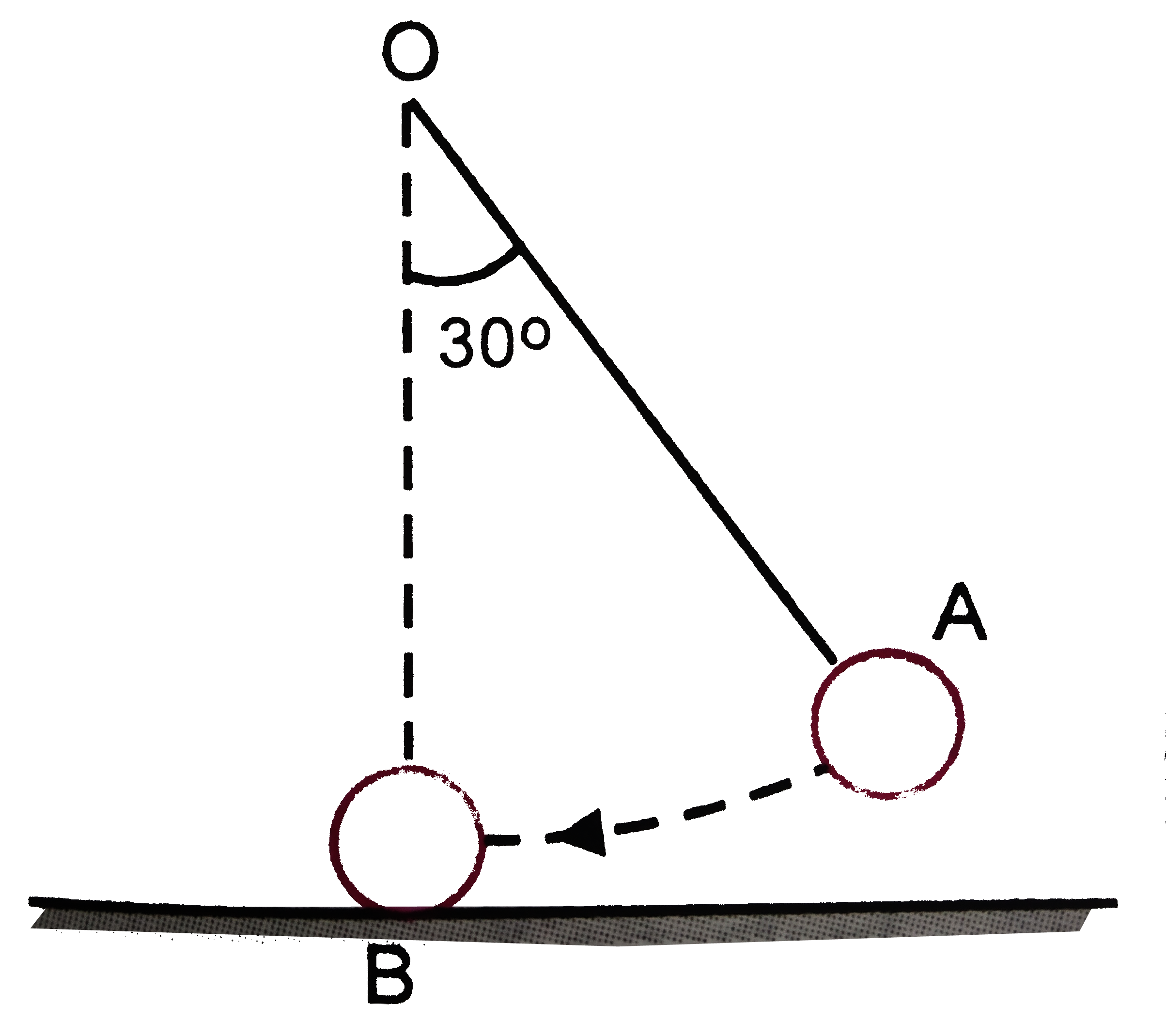
The bob A of a simple pendulum released from `30^(@)` to the vertical hits another bobo B of the same mass at rest on a table as shown in figure. How high does the bob A rise after the collision ? Neglect the size of the bobs and assume the collision to be elastic.

Text Solution

Verified by Experts

The correct Answer is:

bob A does not rise

In this elastic collision velocity of masses are exchaged.
So `v_(A) = 0 rArr A` does not rise
Promotional Banner

Topper's Solved these Questions

  • CENTRE OF MASS

    ALLEN |Exercise EXERCISE-IV B|14 Videos
  • CENTRE OF MASS

    ALLEN |Exercise EXERCISE-V A|20 Videos
  • CENTRE OF MASS

    ALLEN |Exercise EXERCISE-III|41 Videos
  • BASIC MATHEMATICS USED IN PHYSICS &VECTORS

    ALLEN |Exercise EXERCISE-IV ASSERTION & REASON|11 Videos
  • ELASTICITY, SURFACE TENSION AND FLUID MECHANICS

    ALLEN |Exercise Exercise 5 B (Integer Type Questions)|3 Videos

Similar Questions

Explore conceptually related problems

The bob A of a pendulum released from 30^(@) to the vertical hits another bob B of the same mass at rest on a table as shown in figure . How high does the bob A rise after the collision ? Neglect the size of the bobs and assume the collision to be elastic .

Two identical ball bearings in contact with each other and resting on a frictionless table are hit heat-on by another ball bearing of the same mass moving initially with a speed V as shown in figure. If the collision is elastic, which of the following (figure) is a possible result after collision ?

Two identical ball bearing in contact each other and resting on a frictionless table are hit head - on by another ball bearing of the same mass moving intially with a speed c as shown in figure . If the collision is elastic mwhich of the following (figure ) is a possible result after collision ?

A simple pendulum of bob of mass m and length L has one of its ends fixed at the centre O of a vertical circle, as shown in the figure. If 0=60^(@) at the point P , the minimum speed u that should be given to the bob so that it completes vetical circle is

Two fixed, identical conducting plates (a and (3), each of surface area S are charged to - Q and q, respectively, where Q > q > 0. A third identical plate ( lambda ), free to move Is located on the other side of the plate with charge q at a distance d as per figure. The third plate is released and collides with the plate f_3 . Assume the collision is elastic and the time of collision is sufficient to redistribute charge amongst beta and gamma . (a) Find the electric field acting on the plate gamma before collision. (b) Find the charges on beta and gamma after the collision. (c) Find the velocity of the plate gamma after the collision and at a distance d from the plate beta

The bob of mass 50 gm of a pendulum is released from a horizontal position A as shown in the figure . .If the length of the pendulum is 1.5 m , what is its kinetic energy at the lower most point B ? (g = 10 m/(s^(2)))

A simple pendulum of mass m and length L is held in horizontal position. If it is released from this position, then find the angular momentum of the bob about the point of suspension when it is vertically below the point of suspension.

Two identical ball bearings in contact with each other and resting on a frictionless table are hit head - on by another ball bearing of the same mass moving initially with a speed V. If the collision is elastic , which of the following fgures is a possible result after collision ?

A pendulum has a period T for small osillations. An obstacle is placed directly beneath the pivot, so that only the lowest one - quarter of the string can follow the pendulum bob when it swings to the left of its resting position. The pendulum is released from rest at a certain point. How long will it take to return to that point again ? In answering this question, you may assume that the angle between the moving string and the vertical stays small throughout the motion.

ALLEN -CENTRE OF MASS-EXERCISE-IV A
  1. Two bodies of same mass tied with an inelastic string of length l lie ...

    Text Solution

    |

  2. A man whose mass is m kg jumps vertically into air from a sitting posi...

    Text Solution

    |

  3. A uniform thin rod of mass m and length L is standing vertically along...

    Text Solution

    |

  4. A hemisphere of radius R and mass 4 m is free to slide with its base o...

    Text Solution

    |

  5. A ball of mass 100 gm is projected vertically upwards from the ground ...

    Text Solution

    |

  6. A block of mass M with a semicircualr of radius R, rests on a horizont...

    Text Solution

    |

  7. Two bodies A and B of masses m and 2 m respectively are placed on a sm...

    Text Solution

    |

  8. A sphere of mass m(1) in motion hits directly another sphere of mass m...

    Text Solution

    |

  9. A simple pendalum is suspended from a peg on a verticle wall . The pen...

    Text Solution

    |

  10. A small sphere of radius R is held against the inner surface of a larg...

    Text Solution

    |

  11. The bob A of a simple pendulum released from 30^(@) to the vertical hi...

    Text Solution

    |

  12. A massless platform is kept on a light elastic spring as shown in figu...

    Text Solution

    |

  13. In an elastic collision of two billiard balls,which of the the followi...

    Text Solution

    |

  14. A body 'A' moving in a straight line with velocity v makes a collision...

    Text Solution

    |

  15. A particle of mass 2kg moving with a velocity 5hatim//s collides head-...

    Text Solution

    |

  16. Three particles with equal mass move with equal speed v along the medi...

    Text Solution

    |

  17. Block A of mass m//2 is connected to one end of light rope which passe...

    Text Solution

    |

  18. Two masses A & B each of 5 kg are suspended by a light inextensible st...

    Text Solution

    |

  19. Three identical balls eah of mass m=0.5 kg are connected with each oth...

    Text Solution

    |

  20. Consider the system shown in figure. We know the masses of bodies : m ...

    Text Solution

    |
