Home
Class 11
PHYSICS
In the diagram (given below), the broken...

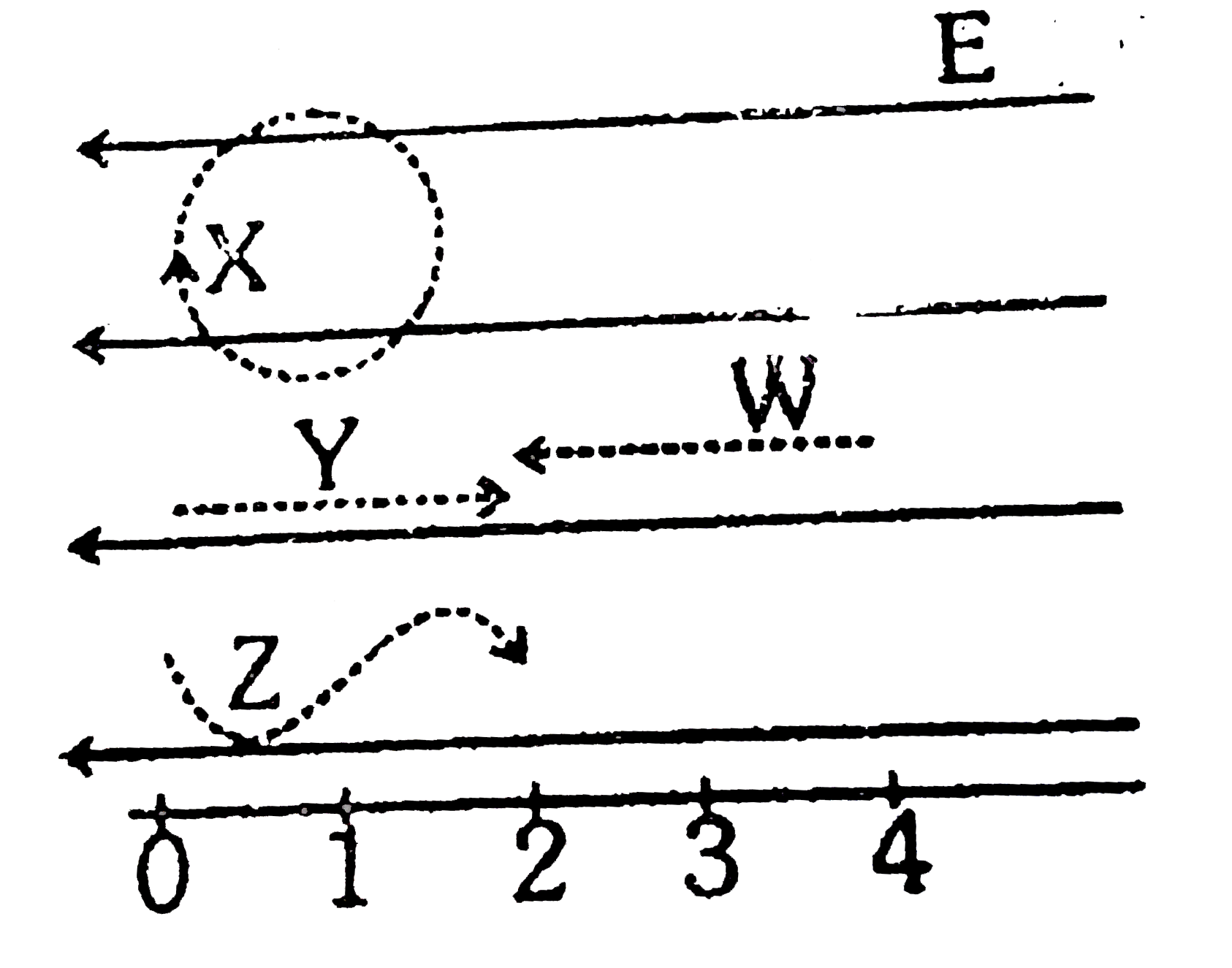
In the diagram (given below), the broken lines represent the paths followed by particles W, X, Y and Z respectively through the contant field E. The number below the field represent meters.

If the particles are positively charged, which particles increased their electric potential energy
constant, none of the particle increased their electric potential energy

A

X and Z

B

Y and Z

C

W, X, Y and Z

D

since the electric field is

Text Solution

Verified by Experts

The correct Answer is:

B

Concept based
Promotional Banner

Topper's Solved these Questions

  • MISCELLANEOUS

    ALLEN |Exercise Comprehension 9|2 Videos
  • MISCELLANEOUS

    ALLEN |Exercise Exersice-04[A]|34 Videos
  • MISCELLANEOUS

    ALLEN |Exercise Comprehension 7|3 Videos
  • KINEMATICS (MOTION ALONG A STRAIGHT LINE AND MOTION IN A PLANE)

    ALLEN |Exercise BEGINNER S BOX-7|8 Videos
  • PHYSICAL WORLD, UNITS AND DIMENSIONS & ERRORS IN MEASUREMENT

    ALLEN |Exercise EXERCISE-IV|7 Videos

Similar Questions

Explore conceptually related problems

In the diagram (given below), the broken lines represent the paths followed by particles W, X, Y and Z respectively through the contant field E. The number below the field represent meters. Suppose that the field strength E is 10 N//C and particle Y has a charge of -10 C . When is the mass of particle Y

In the diagram (given below), the broken lines represent the paths followed by particles W, X, Y and Z respectively through the contant field E. The number below the field represent meters. Suppose particle Z has a charge of +2C , and is begins and end at rest. If E is 5N//C , how much work is done on particle Z

A positively charged particle is released from rest in an unform electric field. The electric potential energy of the charge

In previous question if the particles started from rest and all are positively charge which particles must have been acted upon by a force other than that produced by the electric field.

Even though an electric field E exerts a force qE on a charged particle yet the electric field of an EM wave does not contribute to the radiation pressure (but transfers energy). Explain.

A particles is in a unidirectional potential field where the potential energy (U) of a particle depends on the x-coordinate given by U_(x)=k(1-cos ax) & k and 'a' are constant. Find the physical dimensions of 'a' & k .

An accelration produces a narrow beam of protons, each having an initial speed of v_(0) . The beam is directed towards an initially uncharges distant metal sphere of radius R and centered at point O. The initial path of the beam is parallel to the axis of the sphere at a distance of (R//2) from the axis, as indicated in the diagram. The protons in the beam that collide with the sphere will cause it to becomes charged. The subsequentpotential field at the accelerator due to the sphere can be neglected. The angular momentum of a particle is defined in a similar way to the moment of a force. It is defined as the moment of its linear momentum, linear replacing the force. We may assume the angular momentum of a proton about point O to be conserved. Assume the mass of the proton as m_(P) and the charge on it as e. Given that the potential of the sphere increases with time and eventually reaches a constant velue. The limiting electric potential of the sphere is

The potential energy U(x) of a particle moving along x- axis is shown in figure. Which one of the following graphs represents the variation of kinetic energy of this particle if its total mechanical enery is E_(0)

On a particle placed at origin a variable force F=-ax (where a is a positive constant) is applied. If U(0)=0, the graph between potential energy of particle U(x) and x is best represented by:-

The potential energy of a particle of mass 1 kg moving in X-Y plane is given by U=(12x+5y) joules, where x an y are in meters. If the particle is initially at rest at origin, then select incorrect alternative :-
