In the diagram (given below), the broken lines represent the paths followed by particles W, X, Y and Z respectively through the contant field E. The number below the field represent meters.
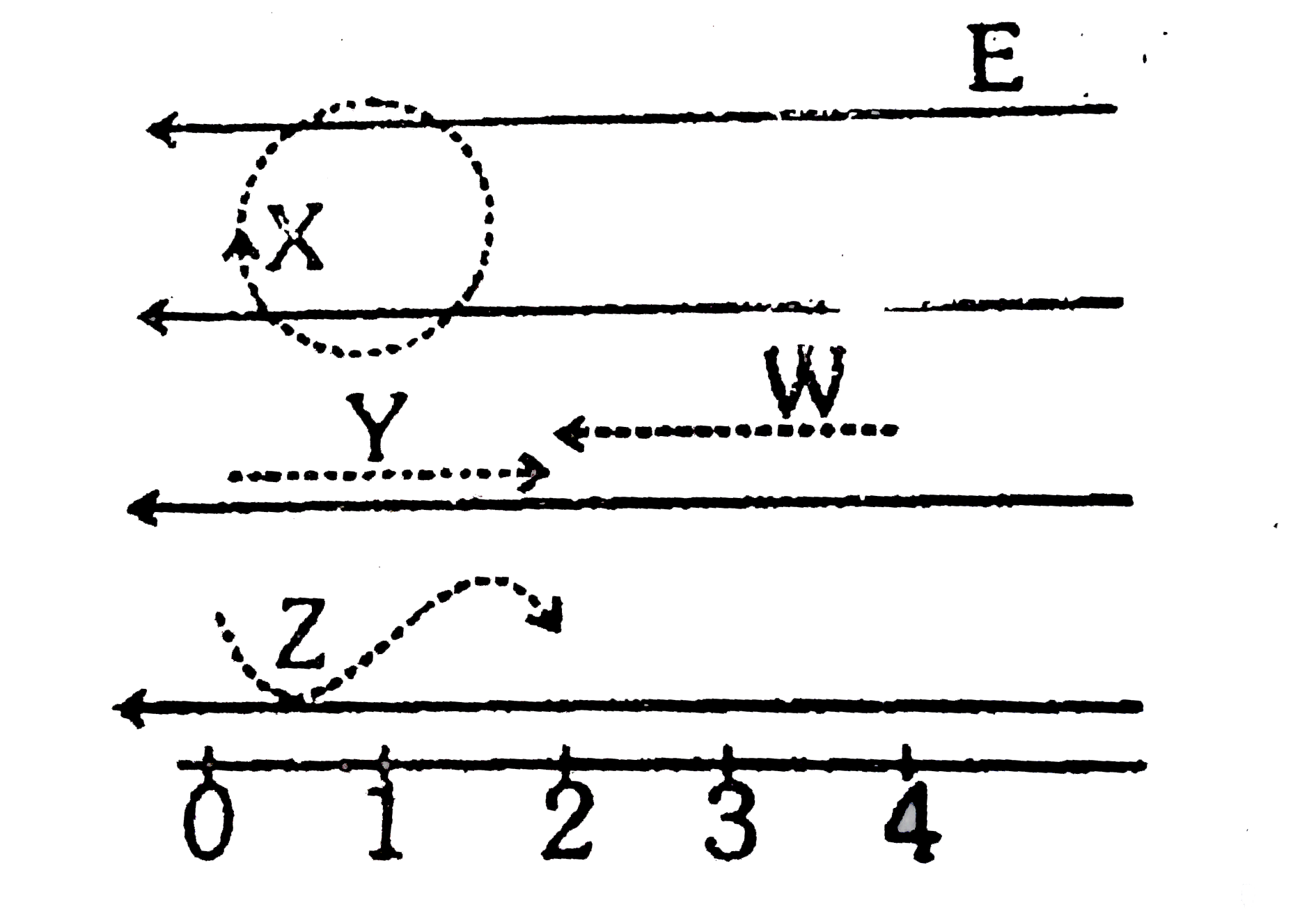
Suppose particle Z has a charge of `+2C`, and is begins and end at rest. If E is `5N//C`, how much work is done on particle Z
In the diagram (given below), the broken lines represent the paths followed by particles W, X, Y and Z respectively through the contant field E. The number below the field represent meters.
Suppose particle Z has a charge of `+2C`, and is begins and end at rest. If E is `5N//C`, how much work is done on particle Z
Suppose particle Z has a charge of `+2C`, and is begins and end at rest. If E is `5N//C`, how much work is done on particle Z
A
`10 J`
B
`20 J`
C
`40 J`
D
`80 J`
Text Solution
Verified by Experts
The correct Answer is:
B
`W= int F_("ext").ds`
`rArr (5xx2)xx2`
`rArr (5xx2)xx2`



Topper's Solved these Questions
MISCELLANEOUS
ALLEN |Exercise Comprehension 9|2 VideosMISCELLANEOUS
ALLEN |Exercise Exersice-04[A]|34 VideosMISCELLANEOUS
ALLEN |Exercise Comprehension 7|3 VideosKINEMATICS (MOTION ALONG A STRAIGHT LINE AND MOTION IN A PLANE)
ALLEN |Exercise BEGINNER S BOX-7|8 VideosPHYSICAL WORLD, UNITS AND DIMENSIONS & ERRORS IN MEASUREMENT
ALLEN |Exercise EXERCISE-IV|7 Videos
Similar Questions
Explore conceptually related problems
In the diagram (given below), the broken lines represent the paths followed by particles W, X, Y and Z respectively through the contant field E. The number below the field represent meters. Suppose that the field strength E is 10 N//C and particle Y has a charge of -10 C . When is the mass of particle Y
In the diagram (given below), the broken lines represent the paths followed by particles W, X, Y and Z respectively through the contant field E. The number below the field represent meters. If the particles are positively charged, which particles increased their electric potential energy constant, none of the particle increased their electric potential energy
Two charges –q and +q are located at points (0, 0, –a) and (0, 0, a), respectively. (a) What is the electrostatic potential at the points (0, 0, z) and (x, y, 0) ? (b) Obtain the dependence of potential on the distance r of a point from the origin when r//a gt gt 1 . (c) How much work is done in moving a small test charge from the point (5,0,0) to (–7,0,0) along the x-axis? Does the answer change if the path of the test charge between the same points is not along the x-axis?
An accelration produces a narrow beam of protons, each having an initial speed of v_(0) . The beam is directed towards an initially uncharges distant metal sphere of radius R and centered at point O. The initial path of the beam is parallel to the axis of the sphere at a distance of (R//2) from the axis, as indicated in the diagram. The protons in the beam that collide with the sphere will cause it to becomes charged. The subsequentpotential field at the accelerator due to the sphere can be neglected. The angular momentum of a particle is defined in a similar way to the moment of a force. It is defined as the moment of its linear momentum, linear replacing the force. We may assume the angular momentum of a proton about point O to be conserved. Assume the mass of the proton as m_(P) and the charge on it as e. Given that the potential of the sphere increases with time and eventually reaches a constant velue. The limiting electric potential of the sphere is
When a particle is restricted to move aong x axis between x =0 and x = a , where a is of nanometer dimension. Its energy can take only certain specific values. The allowed energies of the particle moving in such a restricted region, correspond to the formation of standing waves with nodes at its ends x = 0 and x = a . The wavelength of this standing wave is realated to the linear momentum p of the particle according to the de Breogile relation. The energy of the particl e of mass m is reelated to its linear momentum as E = (p^(2))/(2m) . Thus, the energy of the particle can be denoted by a quantum number 'n' taking values 1,2,3,"......." ( n=1 , called the ground state) corresponding to the number of loop in the standing wave. Use the model decribed above to answer the following three questions for a particle moving in the line x = 0 to x =a . Take h = 6.6 xx 10^(-34) J s and e = 1.6 xx 10^(-19) C . If the mass of the particle is m = 1.0 xx 10^(-30) kg and a = 6.6 nm , the energy of the particle in its ground state is closet to
(a) Magnetic field lines show the direction (at every point) along which a small magnetised needle aligns at the point). Do the magnetic field lines also represent the lines of force on a moving charged particle at every point? (b) Magnetic field lines can be entirely confined within the core of a toroid, but not within a straight solenoid. Why? (c) If magnetic monopoles existed, how would the Gauss's law of magnetism be modified? (d) Does a bar magnet exert a torque on itsell due to its own field? Does one element of a current-carrying wire exert a force on another element of the same wtre? (e) Magnetic field arises due to charges in motion. Can a system have magnetic moments even though its net charge is zero?
When a particle is restricted to move aong x axis between x =0 and x = a , where a is of nanometer dimension. Its energy can take only certain specific values. The allowed energies of the particle moving in such a restricted region, correspond to the formation of standing waves with nodes at its ends x = 0 and x = a . The wavelength of this standing wave is realated to the linear momentum p of the particle according to the de Breogile relation. The energy of the particl e of mass m is reelated to its linear momentum as E = (p^(2))/(2m) . Thus, the energy of the particle can be denoted by a quantum number 'n' taking values 1,2,3,"......." ( n=1 , called the ground state) corresponding to the number of loop in the standing wave. Use the model decribed above to answer the following three questions for a particle moving in the line x = 0 to x =a . Take h = 6.6 xx 10^(-34) J s and e = 1.6 xx 10^(-19) C . The allowed energy for the particle for a particular value of n is proportional to
When a particle is restricted to move aong x axis between x =0 and x = a , where a is of nanometer dimension. Its energy can take only certain specific values. The allowed energies of the particle moving in such a restricted region, correspond to the formation of standing waves with nodes at its ends x = 0 and x = a . The wavelength of this standing wave is realated to the linear momentum p of the particle according to the de Breogile relation. The energy of the particl e of mass m is reelated to its linear momentum as E = (p^(2))/(2m) . Thus, the energy of the particle can be denoted by a quantum number 'n' taking values 1,2,3,"......." ( n=1 , called the ground state) corresponding to the number of loop in the standing wave. Use the model decribed above to answer the following three questions for a particle moving in the line x = 0 to x =a . Take h = 6.6 xx 10^(-34) J s and e = 1.6 xx 10^(-19) C . The speed of the particle, that can take disrete values, is proportional to
ALLEN -MISCELLANEOUS-Comprehension 8
- In previous question if the particles started from rest and all are po...
Text Solution
|
- In the diagram (given below), the broken lines represent the paths fol...
Text Solution
|
- In the diagram (given below), the broken lines represent the paths fol...
Text Solution
|
- In the diagram (given below), the broken lines represent the paths fol...
Text Solution
|