Home
Class 11
PHYSICS
An infinite dielectric sheet having char...

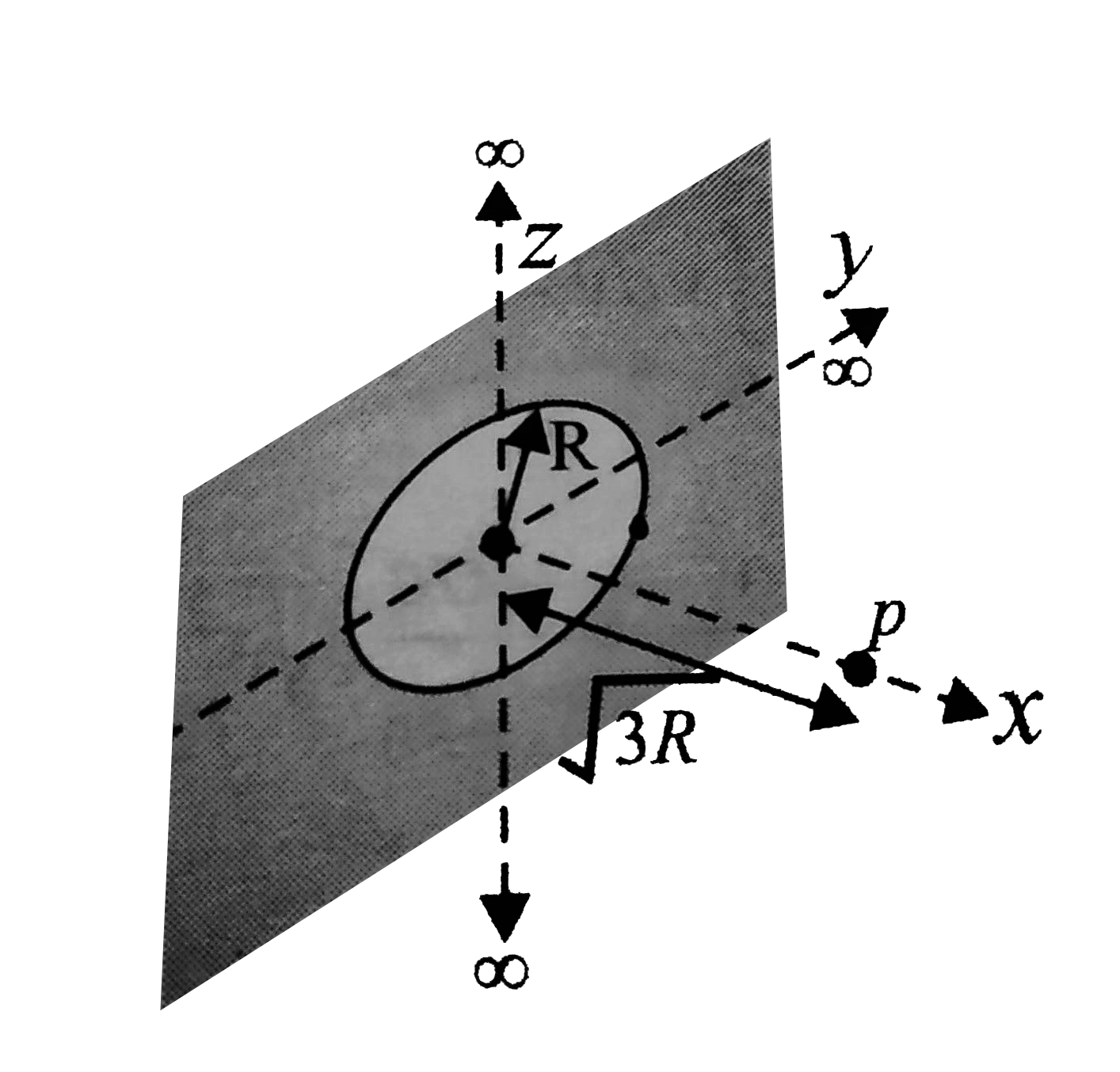
An infinite dielectric sheet having charge density `sigma` has a hole of radius R in it. An electron is released from point P on the axis of the hole at a distance `sqrt(3)R` from the center. Find the speed with which it crosses the plane of the sheet.
.

Text Solution

Verified by Experts

The correct Answer is:
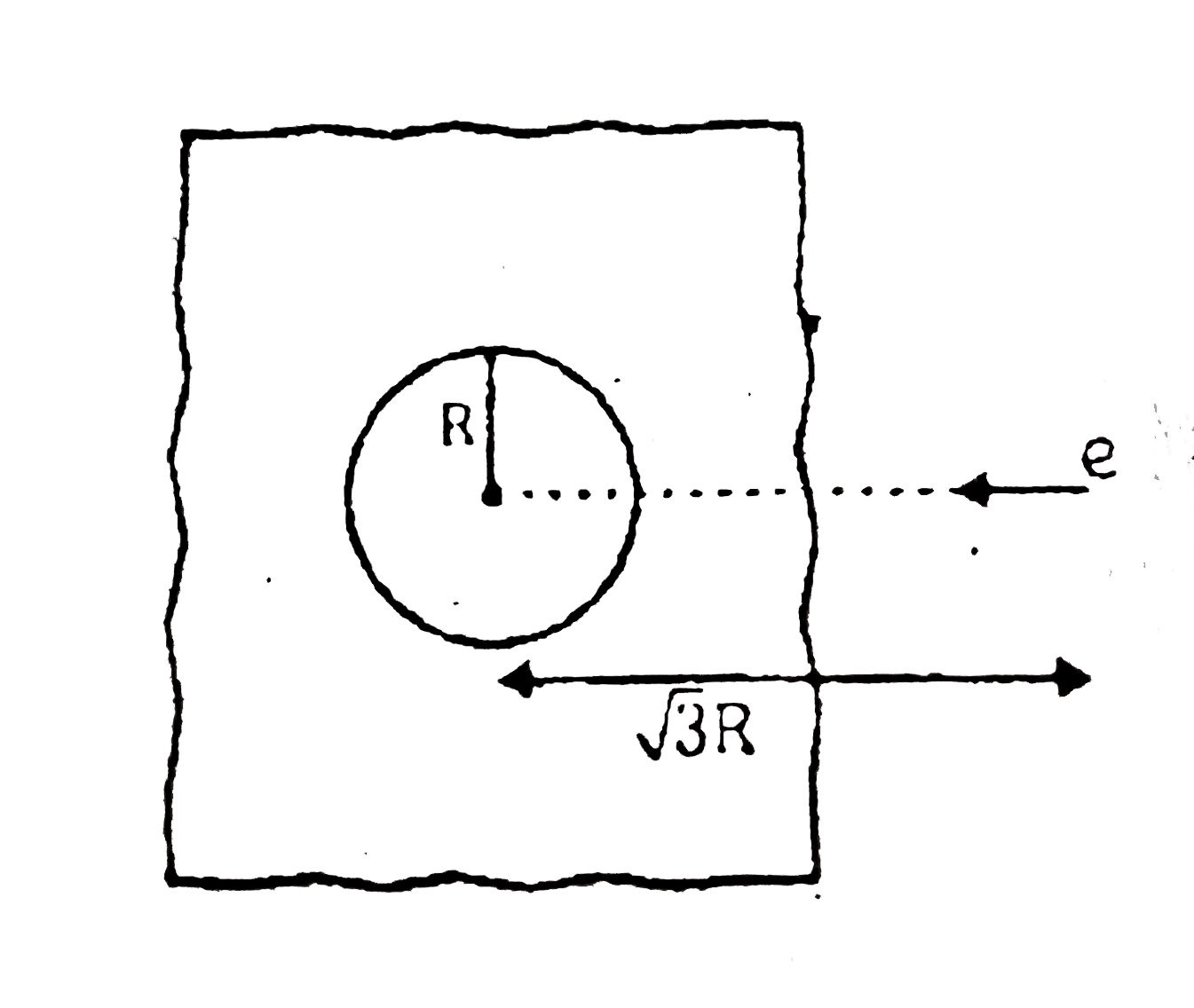
`v=sqrt((sigma eR)/(m in_(0)))`

From energy conservation
`[(sigma R)/(2 in_(0))-sigma/(2in_(0))xx2R]e=-1/2 mv^(2)`
`-(sigmaRe)/(2in_(0))+(sigmaRe)/in_(0)=1/2 mv^(2)`
`v=sqrt((sigma eR)/(m in_(0)))`
Promotional Banner

Topper's Solved these Questions

  • MISCELLANEOUS

    ALLEN |Exercise Exercise-05(A)|35 Videos
  • MISCELLANEOUS

    ALLEN |Exercise Exercise-05(B)|19 Videos
  • MISCELLANEOUS

    ALLEN |Exercise Exersice-04[A]|34 Videos
  • KINEMATICS (MOTION ALONG A STRAIGHT LINE AND MOTION IN A PLANE)

    ALLEN |Exercise BEGINNER S BOX-7|8 Videos
  • PHYSICAL WORLD, UNITS AND DIMENSIONS & ERRORS IN MEASUREMENT

    ALLEN |Exercise EXERCISE-IV|7 Videos

Similar Questions

Explore conceptually related problems

Find the point of Z-axis at the distance 2sqrt3 from point P(3, -2, 5).

Find the co-ordinates of a point on Y-axis which are at a distance of 5sqrt2 from the point P(3, -2, 5).

Find point on Y-axis which is of the distance sqrt10 from point (1, 2, 3).

Let P(r)=(Q)/(piR^4)r be the charge density distribution for a solid sphere of radius R and total charge Q. For a point 'p' inside the sphere at distance r_1 from the centre of the sphere, the magnitude of electric field is:

Find the equation of a plane which is at a distance 3sqrt3 units from origin and the normal to which is equally inclined to coordinate axis.

A simple pendulum of length l and bob mass m is hanging in front of a large nonconducting sheet having surface charge density sigma . If suddenly a charge +q is given to the bob & it is released from the position shown in figure. Find the maximum angle through which the string is deflected from vertical . .

An accelration produces a narrow beam of protons, each having an initial speed of v_(0) . The beam is directed towards an initially uncharges distant metal sphere of radius R and centered at point O. The initial path of the beam is parallel to the axis of the sphere at a distance of (R//2) from the axis, as indicated in the diagram. The protons in the beam that collide with the sphere will cause it to becomes charged. The subsequentpotential field at the accelerator due to the sphere can be neglected. The angular momentum of a particle is defined in a similar way to the moment of a force. It is defined as the moment of its linear momentum, linear replacing the force. We may assume the angular momentum of a proton about point O to be conserved. Assume the mass of the proton as m_(P) and the charge on it as e. Given that the potential of the sphere increases with time and eventually reaches a constant velue. One the potential of the sphere has reached its final, constant value, the minimum speed v of a proton along its trajectory path is given by

An accelration produces a narrow beam of protons, each having an initial speed of v_(0) . The beam is directed towards an initially uncharges distant metal sphere of radius R and centered at point O. The initial path of the beam is parallel to the axis of the sphere at a distance of (R//2) from the axis, as indicated in the diagram. The protons in the beam that collide with the sphere will cause it to becomes charged. The subsequentpotential field at the accelerator due to the sphere can be neglected. The angular momentum of a particle is defined in a similar way to the moment of a force. It is defined as the moment of its linear momentum, linear replacing the force. We may assume the angular momentum of a proton about point O to be conserved. Assume the mass of the proton as m_(P) and the charge on it as e. Given that the potential of the sphere increases with time and eventually reaches a constant velue. The total energy (E) of a proton in the beam travelling with seed v at a distance of r (r ge R) from point O. Assuming that the sphere has acquired an electrostatic charge Q is

An accelration produces a narrow beam of protons, each having an initial speed of v_(0) . The beam is directed towards an initially uncharges distant metal sphere of radius R and centered at point O. The initial path of the beam is parallel to the axis of the sphere at a distance of (R//2) from the axis, as indicated in the diagram. The protons in the beam that collide with the sphere will cause it to becomes charged. The subsequentpotential field at the accelerator due to the sphere can be neglected. The angular momentum of a particle is defined in a similar way to the moment of a force. It is defined as the moment of its linear momentum, linear replacing the force. We may assume the angular momentum of a proton about point O to be conserved. Assume the mass of the proton as m_(P) and the charge on it as e. Given that the potential of the sphere increases with time and eventually reaches a constant velue. The limiting electric potential of the sphere is

An accelration produces a narrow beam of protons, each having an initial speed of v_(0) . The beam is directed towards an initially uncharges distant metal sphere of radius R and centered at point O. The initial path of the beam is parallel to the axis of the sphere at a distance of (R//2) from the axis, as indicated in the diagram. The protons in the beam that collide with the sphere will cause it to becomes charged. The subsequentpotential field at the accelerator due to the sphere can be neglected. The angular momentum of a particle is defined in a similar way to the moment of a force. It is defined as the moment of its linear momentum, linear replacing the force. We may assume the angular momentum of a proton about point O to be conserved. Assume the mass of the proton as m_(P) and the charge on it as e. Given that the potential of the sphere increases with time and eventually reaches a constant velue. If the initial kinetic energy of a proton is 2.56 ke V , then the final potential of the sphere is

