Home
Class 11
PHYSICS
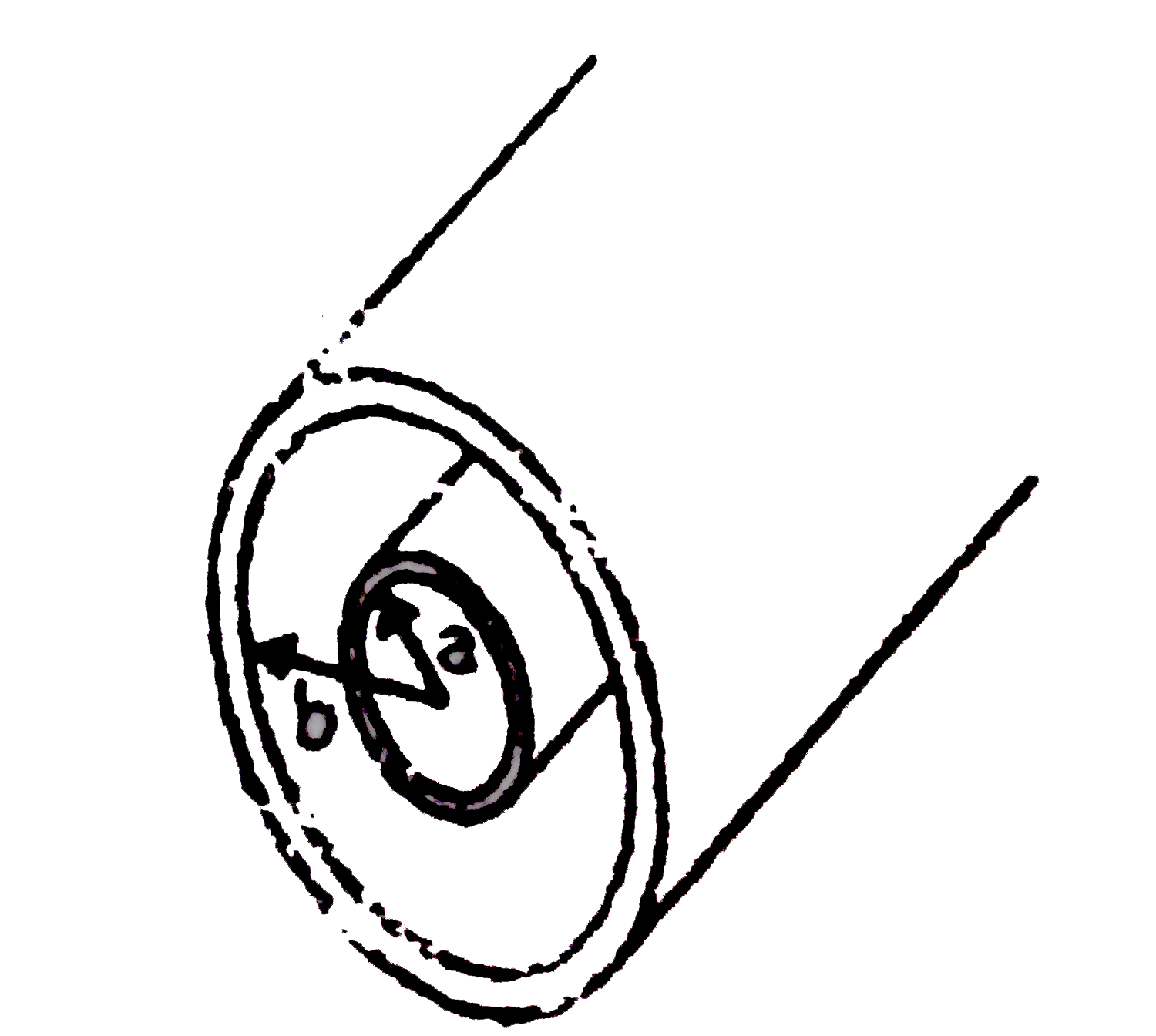
Figure shown a section through two long ...

Figure shown a section through two long thin concentric cylinders of radii a & b with `a gt b`. The cylinders have equal and opposite per unit length `lambda`. Find the electric field at a distance r from the axis for (i) `r lt a` (ii) `a lt r lt b` (iii) `r gt b`

Text Solution

Verified by Experts

[i] `r lt a rArr` Point inside `rArr E=0`
[ii] `a lt r lt b rArr` Point outside the inner and inside the outer so field due to only inner cylinder
hence `E=(2xxlambda)/(r)`
[iii] `r gt b rArr` point outside from both cylinders so the charge per unit length `(lambda)` is zero point `(r gt b) :. E=0`
Promotional Banner

Topper's Solved these Questions

  • MISCELLANEOUS

    ALLEN |Exercise Exercise-05(A)|35 Videos
  • MISCELLANEOUS

    ALLEN |Exercise Exercise-05(B)|19 Videos
  • MISCELLANEOUS

    ALLEN |Exercise Exersice-04[A]|34 Videos
  • KINEMATICS (MOTION ALONG A STRAIGHT LINE AND MOTION IN A PLANE)

    ALLEN |Exercise BEGINNER S BOX-7|8 Videos
  • PHYSICAL WORLD, UNITS AND DIMENSIONS & ERRORS IN MEASUREMENT

    ALLEN |Exercise EXERCISE-IV|7 Videos

Similar Questions

Explore conceptually related problems

A long straight solid metal wire of radius R carries a current I, uniformly distributed over its circular cross-section. Find the magnetic field at a distance r from axis of wire (i) inside and (ii) outside the wire.

When two concentric shells are connected by a thin conducting wire, whole of the charge of inner shell transfers to the outer shell and potential difference between them becomes zero. Surface charge densities of two thin concentric spherical shells are sigma and -sigma respectively. Their radii are R and 2R . Now they are connected by a thin wire. Suppose electric field at a distance r (gt 2R) was E_(1) before connecting the two shells and E_(2) after connecting the two shells, then |E_(2)/E_(1)| is :-

Find the electric field due to an infinitely long cylindrical charge distribution of radius R and having linear charge density lambda at a distance half of the radius from its axis.

A solid metallic sphere has a charge +3Q . Concentric with this sphere is a conducting spherical shell having charge -Q . The radius of the sphere is a and that of the spherical shell is b(bgta) What is the electric field at a distance R(a lt R lt b) from the centre

Charge Q is distributed uniformly over a non conducting sphere of radius R. Find the electric p-0tential at distance r from the centre of the sphere r (r lt R) . The electric field at a distance r from the centre of the sphere is given as (1)/(4pi epsilon_(0)). (Q)/(R^(3))hatr . Also find the potential at the centre of the sphere .

A very long straight wire of radius r carries current I. Intensity of magnetic field B at point lying at a perpendicular distance 'a' from the axis is alpha ______ . (where altr )

A long straight cable of length l is placed symmetrically along z - axis and has radius a(lt lt l) . The cable consists of a thin wire and a co-axial conducting tube. An alternating current thin wire and returns along the coaxial conducting tube. The induced electric field at a distance s from the wire inside the cable is vec(E )(s, t)=mu_(0)I_(0)v cos (2pi vt) ln ((s)/(a))hat(k) Calculate the displacement current density inside the cable.

A long straight cable of length l is placed symmetrically along z - axis and has radius a(lt lt l) . The cable consists of a thin wire and a co-axial conducting tube. An alternating current thin wire and returns along the coaxial conducting tube. The induced electric field at a distance s from the wire inside the cable is vec(E )(s, t)=mu_(0)I_(0)v cos (2pi vt) ln ((s)/(a))hat(k) Integrate the displacement current density across the cross - section of the cable to find the total displacement current I^(d) .

A long straight cable of length l is placed symmetrically along z - axis and has radius a(lt lt l) . The cable consists of a thin wire and a co-axial conducting tube. An alternating current thin wire and returns along the coaxial conducting tube. The induced electric field at a distance s from the wire inside the cable is vec(E )(s, t)=mu_(0)I_(0)v cos (2pi vt) ln ((s)/(a))hat(k) Compare the conduction current I_(0) with the displacement current I_(0)^(d) .
