Home
Class 11
PHYSICS
Two identical charged spheres suspended ...

Two identical charged spheres suspended from a common point by two massless strings of lengths I, are initially at a distance `d(d ltlt l)` apart because of their mutual repulsion. The charges begin to leak from both the spheres at a constant rate. As a result, the spheres approach each other with a velocity v. Then v varies as a function of the distance x between as:

A

`v prop x^(1//2)`

B

`v prop x`

C

`v prop x^(-1//2)`

D

`v prop x^(-1)`

Text Solution

Verified by Experts

The correct Answer is:
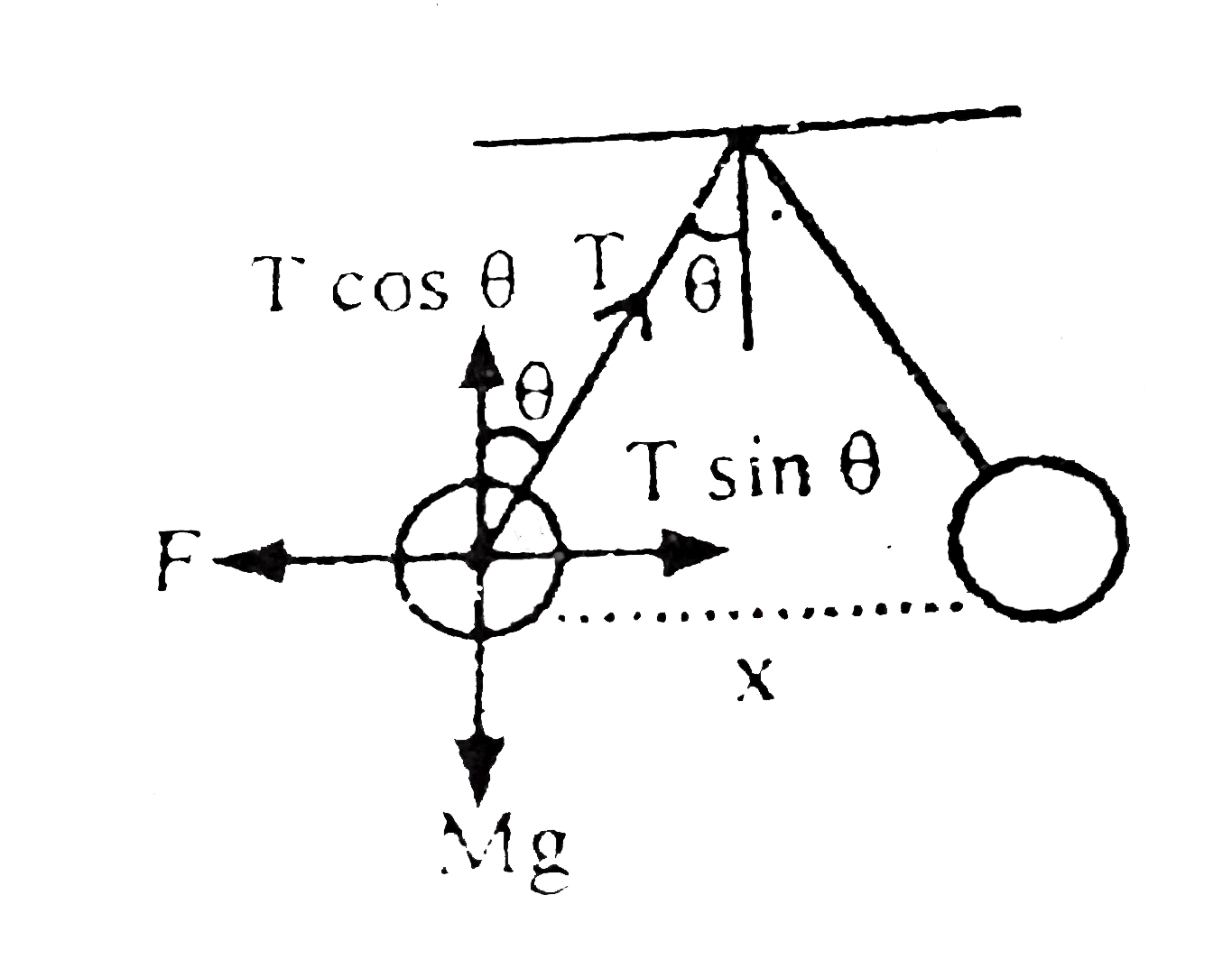
C

`tan theta=F/(Mg)` (since `theta` small)
`theta=F/(Mg)rArr F= Mg theta`
`(KQ^(2))/x^(2)=Mgx/l`
`Q^(2)=(Mg)/(Kl)x^(3)rArr Q=sqrt((Mg)/(Kl))x^(3//2)`
`((dQ)/(dt))=sqrt((Mg)/(kl))(3/2x^(1//2))((dx)/(dt))=` constant
so `(dx)/(dt) prop x^(-1//2)` or `V prop x^(-1//2) rArr v prop x^(-1//2)`
Promotional Banner

Topper's Solved these Questions

  • MISCELLANEOUS

    ALLEN |Exercise Exercise-05(B)|19 Videos
  • MISCELLANEOUS

    ALLEN |Exercise MCQ s WITH ONE OR MORE THAN ONE CORRECT ANSWER|6 Videos
  • MISCELLANEOUS

    ALLEN |Exercise Exersice-04[B]|16 Videos
  • KINEMATICS (MOTION ALONG A STRAIGHT LINE AND MOTION IN A PLANE)

    ALLEN |Exercise BEGINNER S BOX-7|8 Videos
  • PHYSICAL WORLD, UNITS AND DIMENSIONS & ERRORS IN MEASUREMENT

    ALLEN |Exercise EXERCISE-IV|7 Videos

Similar Questions

Explore conceptually related problems

Two identically charged spheres are suspended by strings of equal length. The strings make an angle of 30^(@) with each other. When suspended in a liquid of density 0.8 g// c c the angle remains same. What is the dielectric constant of liquid. Density of sphere =1.6 g//c c

Two sphere of mass 2M and M are initially at rest at a distance R apart. Due to mutual force of attraction they approach each other. When they are at separation (R )/(2) , the acceleration of their centre of mass is ……….

Two spheres carrying charge q are hanging from a same point of suspension with the help of threads of length 1 m, in a space free from gravity. The distance between them will be........

Two blocks of mass m_(1)=10kg and m_(2)=5kg connected to each other by a massless inextensible string of length 0.3m are placed along a diameter of the turntable. The coefficient of friction between the table and m_(1) is 0.5 while there is no friction between m_(2) and the table. the table is rotating with an angular velocity of 10rad//s . about a vertical axis passing through its center O . the masses are placed along the diameter of the table on either side of the center O such that the mass m_(1) is at a distance of 0.124m from O . the masses are observed to be at a rest with respect to an observed on the tuntable (g=9.8m//s^(2)) . (a) Calculate the friction on m_(1) (b) What should be the minimum angular speed of the turntable so that the masses will slip from this position? (c ) How should the masses be placed with the string remaining taut so that there is no friction on m_(1) .

A positive charge Q is uniformly distributed throughout the volume of a dielectric sphere of radius R. A point mass having charge +q and mass m is fired toward the center of the sphere with velocity v from a point at distance r (r gt R) from the center of the sphere. Find the minimum velocity v so that it can penetrate (R//2) distance of the sphere. Neglect any resistance other than electric interaction. Charge on the small mass remains constant throughout the motion.

An accelration produces a narrow beam of protons, each having an initial speed of v_(0) . The beam is directed towards an initially uncharges distant metal sphere of radius R and centered at point O. The initial path of the beam is parallel to the axis of the sphere at a distance of (R//2) from the axis, as indicated in the diagram. The protons in the beam that collide with the sphere will cause it to becomes charged. The subsequentpotential field at the accelerator due to the sphere can be neglected. The angular momentum of a particle is defined in a similar way to the moment of a force. It is defined as the moment of its linear momentum, linear replacing the force. We may assume the angular momentum of a proton about point O to be conserved. Assume the mass of the proton as m_(P) and the charge on it as e. Given that the potential of the sphere increases with time and eventually reaches a constant velue. One the potential of the sphere has reached its final, constant value, the minimum speed v of a proton along its trajectory path is given by

When two spheres having 4Q and - 2Q charge are placed at a certain distance, the force acting between them is F. Now they are connected by a conducing wire and again separated from each other. Now they are kept at a distance half of the previous one. The force acting between them is.......

An accelration produces a narrow beam of protons, each having an initial speed of v_(0) . The beam is directed towards an initially uncharges distant metal sphere of radius R and centered at point O. The initial path of the beam is parallel to the axis of the sphere at a distance of (R//2) from the axis, as indicated in the diagram. The protons in the beam that collide with the sphere will cause it to becomes charged. The subsequentpotential field at the accelerator due to the sphere can be neglected. The angular momentum of a particle is defined in a similar way to the moment of a force. It is defined as the moment of its linear momentum, linear replacing the force. We may assume the angular momentum of a proton about point O to be conserved. Assume the mass of the proton as m_(P) and the charge on it as e. Given that the potential of the sphere increases with time and eventually reaches a constant velue. If the initial kinetic energy of a proton is 2.56 ke V , then the final potential of the sphere is

An accelration produces a narrow beam of protons, each having an initial speed of v_(0) . The beam is directed towards an initially uncharges distant metal sphere of radius R and centered at point O. The initial path of the beam is parallel to the axis of the sphere at a distance of (R//2) from the axis, as indicated in the diagram. The protons in the beam that collide with the sphere will cause it to becomes charged. The subsequentpotential field at the accelerator due to the sphere can be neglected. The angular momentum of a particle is defined in a similar way to the moment of a force. It is defined as the moment of its linear momentum, linear replacing the force. We may assume the angular momentum of a proton about point O to be conserved. Assume the mass of the proton as m_(P) and the charge on it as e. Given that the potential of the sphere increases with time and eventually reaches a constant velue. After a long time, when the potential of the sphere reaches a constant value, the trajectory of proton is correctly sketched as

ALLEN -MISCELLANEOUS-Exercise-05(A)
  1. A charge Q is place at each of the opposite corners of a square. A cha...

    Text Solution

    |

  2. Statement-1. For a charged particle moving from point P to point Q, t...

    Text Solution

    |

  3. Potenlials of points P and Q are 10V and -4 V respectively. Work done...

    Text Solution

    |

  4. Let P(r)=(Q)/(piR^4)r be the charge density distribution for a solid s...

    Text Solution

    |

  5. Charges q is uniformly distributed over a thin half ring of radius R. ...

    Text Solution

    |

  6. Let there be a spherically symmetric charge distribution with charge d...

    Text Solution

    |

  7. Two identically charged spheres are suspended by strings of equal leng...

    Text Solution

    |

  8. Two identical charged spheres suspended from a common point by two mas...

    Text Solution

    |

  9. The electrostatic potential inside a charged spherical ball is given b...

    Text Solution

    |

  10. Two positive charges of magnitude q are placed at the ends of a side (...

    Text Solution

    |

  11. An insulating solid sphere of radius R has a uniformaly positive charg...

    Text Solution

    |

  12. In a uniformly charges sphere of total charge Q and radius R, the elec...

    Text Solution

    |

  13. Two charges, each equal to q, aer kept at x=-a and x=a on the x-axis. ...

    Text Solution

    |

  14. A charge Q is uniformly distributed over a long rod AB of length L as ...

    Text Solution

    |

  15. Assum that an electric field vecE = 30 x^(2) hati exists in space. The...

    Text Solution

    |

  16. A uniformly charged solid shpere fo radius R has potential V(0) (meas...

    Text Solution

    |

  17. A long cylindrical shell carries positive surface charge a in the uppe...

    Text Solution

    |

  18. The region between two concentric spheres of radii 'a' and 'b', respec...

    Text Solution

    |

  19. The potential (in volts) of a charge distribution is given by V(z)=3...

    Text Solution

    |

  20. Within a spherical charge distribution of charge density rho(r), N equ...

    Text Solution

    |

