
Home
Class 11
PHYSICS
A long cylindrical shell carries positiv...

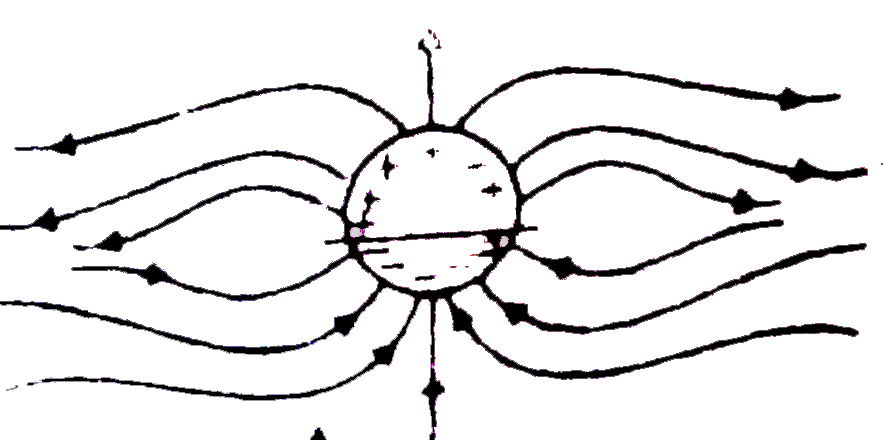
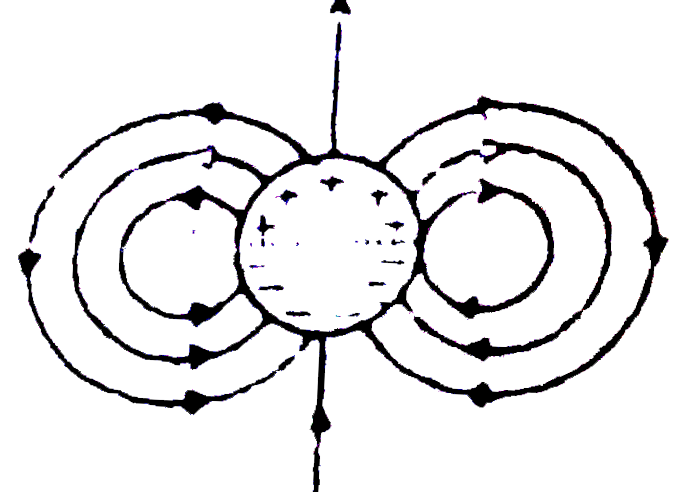
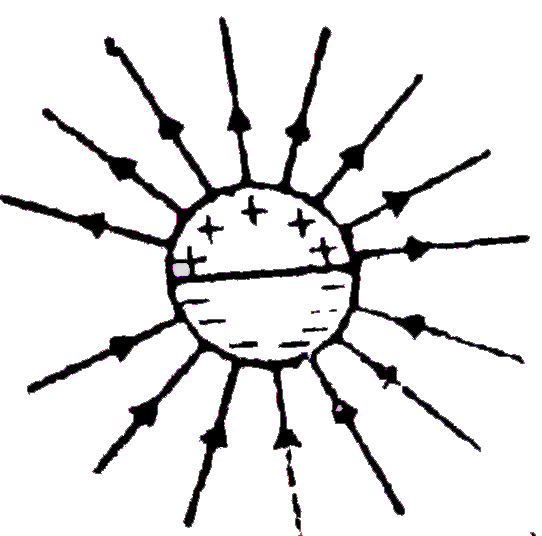
A long cylindrical shell carries positive surface charge a in the upper half and negative surface charge -a in the lower half. The electric field lines around the cylinder will look like figure given in :
(Figures are schematic and not drawn to scale)

A

B

C

D

Text Solution

Verified by Experts

The correct Answer is:
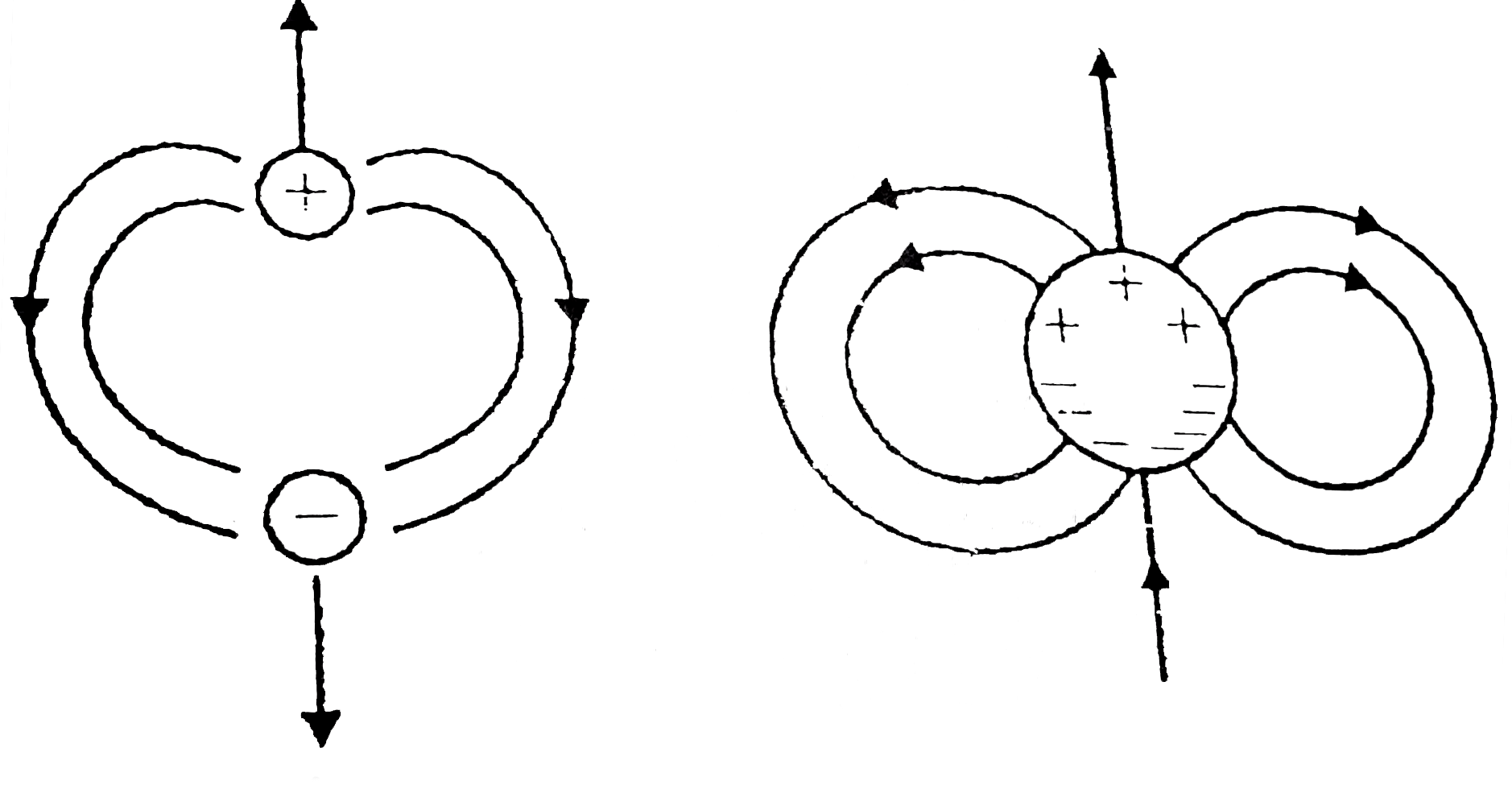
C

It behaves as a dipole
Promotional Banner

Topper's Solved these Questions

  • MISCELLANEOUS

    ALLEN |Exercise Exercise-05(B)|19 Videos
  • MISCELLANEOUS

    ALLEN |Exercise MCQ s WITH ONE OR MORE THAN ONE CORRECT ANSWER|6 Videos
  • MISCELLANEOUS

    ALLEN |Exercise Exersice-04[B]|16 Videos
  • KINEMATICS (MOTION ALONG A STRAIGHT LINE AND MOTION IN A PLANE)

    ALLEN |Exercise BEGINNER S BOX-7|8 Videos
  • PHYSICAL WORLD, UNITS AND DIMENSIONS & ERRORS IN MEASUREMENT

    ALLEN |Exercise EXERCISE-IV|7 Videos

Similar Questions

Explore conceptually related problems

Sketch the electric field lines for a uniformly charged hollow cylinder shown in figure.

As shown in figure a closed surface intersects a spherical conductor. If a negative charge is placed at point P. What is the nature of the electric flux coming out of the closed surface?

A point positive charge is brought near an isolated conducting sphere as shown in figures. The electric field is best given by: (i) (ii) (iii) (iv)

Two fixed, identical conducting plates (a and (3), each of surface area S are charged to - Q and q, respectively, where Q > q > 0. A third identical plate ( lambda ), free to move Is located on the other side of the plate with charge q at a distance d as per figure. The third plate is released and collides with the plate f_3 . Assume the collision is elastic and the time of collision is sufficient to redistribute charge amongst beta and gamma . (a) Find the electric field acting on the plate gamma before collision. (b) Find the charges on beta and gamma after the collision. (c) Find the velocity of the plate gamma after the collision and at a distance d from the plate beta

Figure shows the electric field lines around three point charges A, B and C. (a) Which charges are positive ? (b) Which charge has the largest magnitude ? Why ? In which region or regions of the picture could the electric field be zero ? Justify your answer. (i) Near A, (ii) Near B (iii) Near C, (iv) Nowhere

Flow cytometry, illustrated in the figure, is a technique used to sort cells by type. The cells are placed in a conducting saline solution which is then forced from a nozzle. The stream breaks up into small droplets, each containing one cell. A metal collar surrounds the stream right at the point where the droplets seprate from the stream. Charging the collar polarizes the conducting liquid, causing the droplets to become charged as they break off from the steam. A leser beam probes the solution just upstream from the charging collar, looking for the presence of certain types of cells. All droplets containing one particular type of cell are given the same charge by the charging collar. Droplets with other desired types of cells receive a different charge, and droplats with no desired cell receive no charge. The charged. The charges droplets then pass between two parallel charged electrodes where they receive a horizontal force that directs force that directs them into different collection tubes, depending on air charge. Another way to sort the droplets would be to given each droplet the same charge, then vary the electric field between the deflection plates. For the apparatus as sketched, this technique will not work because

The figure shows a particle (carrying charge +q) at the orgin. A uniform magnetic field is directed into the plane of the paper. The particle can be projected only in the plane of paper and along positive or negative x- or y-axis. The particle moves with constant speed and has to hit a target located in the third quadrant. There are two direction of projections, which can make it possible, these are

In the figure shown S is a large nonconducting sheet of uniform charge density sigma . A rod R of length l and mass 'm' is parallel to the sheet and hinged at its mid point. The linear charge densities on the upper and lower half of the rod are shown in the figure. Find the angular acceleration of the rod just after it is released.

(a) A conductor A with a cavity as shown in figure (a) is given a charge Q. Show that the entire charge must appear on the outer surface of the conductor. (b) Another conductor B with charge q is inserted into the cavity keeping B insulated from A. Show that the total charge on the outside surface of A is Q + q figure (b) ( C) A sensitive instruments is to be shielded from the strong electrostatic fields in its environment. Suggest a possible way.

A simple pendulum of length l and bob mass m is hanging in front of a large nonconducting sheet having surface charge density sigma . If suddenly a charge +q is given to the bob & it is released from the position shown in figure. Find the maximum angle through which the string is deflected from vertical . .

ALLEN -MISCELLANEOUS-Exercise-05(A)
  1. A charge Q is place at each of the opposite corners of a square. A cha...

    Text Solution

    |

  2. Statement-1. For a charged particle moving from point P to point Q, t...

    Text Solution

    |

  3. Potenlials of points P and Q are 10V and -4 V respectively. Work done...

    Text Solution

    |

  4. Let P(r)=(Q)/(piR^4)r be the charge density distribution for a solid s...

    Text Solution

    |

  5. Charges q is uniformly distributed over a thin half ring of radius R. ...

    Text Solution

    |

  6. Let there be a spherically symmetric charge distribution with charge d...

    Text Solution

    |

  7. Two identically charged spheres are suspended by strings of equal leng...

    Text Solution

    |

  8. Two identical charged spheres suspended from a common point by two mas...

    Text Solution

    |

  9. The electrostatic potential inside a charged spherical ball is given b...

    Text Solution

    |

  10. Two positive charges of magnitude q are placed at the ends of a side (...

    Text Solution

    |

  11. An insulating solid sphere of radius R has a uniformaly positive charg...

    Text Solution

    |

  12. In a uniformly charges sphere of total charge Q and radius R, the elec...

    Text Solution

    |

  13. Two charges, each equal to q, aer kept at x=-a and x=a on the x-axis. ...

    Text Solution

    |

  14. A charge Q is uniformly distributed over a long rod AB of length L as ...

    Text Solution

    |

  15. Assum that an electric field vecE = 30 x^(2) hati exists in space. The...

    Text Solution

    |

  16. A uniformly charged solid shpere fo radius R has potential V(0) (meas...

    Text Solution

    |

  17. A long cylindrical shell carries positive surface charge a in the uppe...

    Text Solution

    |

  18. The region between two concentric spheres of radii 'a' and 'b', respec...

    Text Solution

    |

  19. The potential (in volts) of a charge distribution is given by V(z)=3...

    Text Solution

    |

  20. Within a spherical charge distribution of charge density rho(r), N equ...

    Text Solution

    |

