Home
Class 11
PHYSICS
For the velocity -time graph shown in fi...

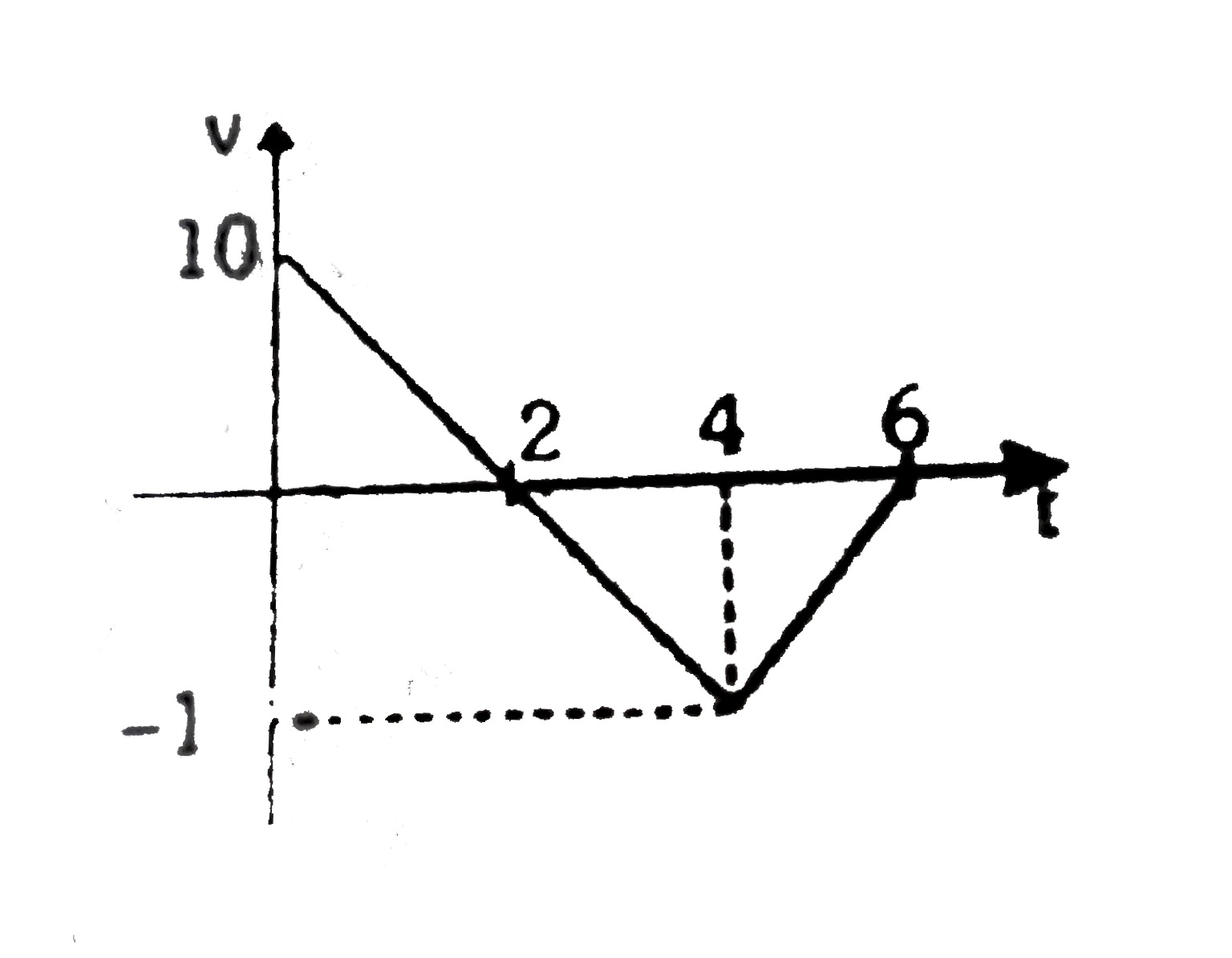
For the velocity -time graph shown in figure, in a time interval from `t=0` to `t=6 s`, match the following:

`{:(,"Column I",,,"Column II"),((A),"Change in velocity",,(p),-5//3 SI "unit"),((B),"Average acceleration",,(q),-20 SI "unit"),((C),"Total displacement",,(r),-10 SI "unit"),((D),"Acceleration ay t=3s",,(s),-5 SI "unit"):}`

Text Solution

Verified by Experts

The correct Answer is:
(A)-r, (B)-p, (C)-r (D)-s

At `t=0, v(0)=10 m//s, t=0, v(6)=0`
Change `v(6)-v(0), Deltav=0-10=-10 m//s`

Average acceleration
`=("charge in velocity")/("time")=(-10)/6=(-5)/3 m//s^(2)`
Average velocity `=("Displacement")/("time interval")`
Total displacement = Area of `Delta's` (with +ve or -ve)
`=1/2xx2xx10-1/2xx4xx10=-10 m` (units)
`:.` Average velocity `=(-10)/6=-(-5)/3 m//s`
`a(3)=` slope of line which exist at `t=0 I_(0) t=4`
`a= tan theta=(-10)/2 =-5`
Promotional Banner

Topper's Solved these Questions

  • KINEMATICS

    ALLEN |Exercise Assertion-Reason|20 Videos
  • KINEMATICS

    ALLEN |Exercise Comprehension#1|3 Videos
  • KINEMATICS

    ALLEN |Exercise EXERCISE-02|57 Videos
  • ERROR AND MEASUREMENT

    ALLEN |Exercise Part-2(Exercise-2)(B)|22 Videos
  • KINEMATICS (MOTION ALONG A STRAIGHT LINE AND MOTION IN A PLANE)

    ALLEN |Exercise BEGINNER S BOX-7|8 Videos

Similar Questions

Explore conceptually related problems

A balloon rises up with constant net acceleration of 10 m//s^(2) . After 2 s a particle drops from the balloon. After further 2 s match the following : ("Take" g=10 m//s^(2)) {:(,"Column I",,,"Column II"),((A),"Height of perticle from ground",,(p),"Zero"),((B),"Speed of particle",,(q),10 SI "units"),((C),"Displacement of Particle",,(r),40 SI "units"),((D),"Acceleration of particle",,(s),20 SI "units"):}

A particle is rotating in a circle of radius 1m with constant speed 4 m//s . In time 1s, match the following (in SI units) {:(,"Column I",,,"Column II"),((A),"Displacement",,(p),8 sin 2),((B),"Distance",,(q),4),((C),"Average velocity",,(r),2sin 2),((D),"Average acceleration",,(s),4 sin 2):}

For component of vector vec(A)=(3hat(i)+4hat(j)-5hat(k)) , match the following table: {:(,"Column I",,,"Column II"),((A),"Along y-axis",,(p),5 "unit"),((B),"Along another vector"(2hat(i)+hat(j)+2hat(k)),,(q),4 "unit"),((C),"Along another vector" (6hat(i)+8hat(j)-10hat(k)),,(r),"Zero"),((D),"Along another vector" (-3hat(i)-4hat(j)+5hat(k)),,(s),"None"):}

sqrtv versus Z graph for characteristic X-rays is as shown in figure. Match the following : {:(,"Column I",,"Column II"),((A),"Line-1",(p),L_(alpha)),((B),"Line-2",(q),L_(beta)),((C),"Line-3",(r),K_(alpha)),((D),"Line-4",(s),K_(beta)):} .

Match Column-I with Column-II : {:("Column-I","Column-II"),("(1) SI unit of torque",(a)m),("(2) SI unit of radius of gyration",(b) Nm),(,(C) Js^-2):}

A particle of mass 1 kg has velocity vec(v)_(1) = (2t)hat(i) and another particle of mass 2 kg has velocity vec(v)_(2) = (t^(2))hat(j) {:(,"Column I",,"Column II",),((A),"Netforce on centre of mass at 2 s",(p),(20)/(9) unit,),((B),"Velocity of centre of mass at 2 s",(q),sqrt68 " unit",),((C ),"Displacement of centre of mass in 2s",(r ),(sqrt80)/(3) "unit",),(,,(s),"None",):}

In y = Asinomegat + Asin(omegat + (2pi)/(3)) |{:(,"Column-I",,"Column-II"),((A),"Motion",(p),"is periodic but no SHM"),((B),"Amplitude",(q),"is SHM"),((C),"Initial phase",(r),A),((D),"Maximum velocity",(s),pi//3),(,,(t),omegaA//2),(,,(u),"None"):}|

If net force on a system of particles is zero. Then {:(,"Column I",,"Column II",),((A),"Acceleration of centre of mass",(p),"Constant",),((B),"Velocity of centre of mass",(q),"Zero",),((C ),"Momentum of centre of mass",(r ),"May br zero",),((D),"Velocity of an individual particle of the system",(s),"May be constant",):}

Trajectory of particle in a projectile motion is given as y=x- x^(2)/80 . Here, x and y are in meters. For this projectile motion, match the following with g=10 m//s^(2) . {:(,"Column-I",,"Column-II"),((A),"Angle of projection (in degrees)",(P),20),((B),"Angle of velocity with horizontal after 4s (in degrees)",(Q),80),((C),"Maximum height (in meters)",(R),45),((D),"Horizontal range (in meters)",(S),30),(,,(T),60):}

In a new system (say TK system) of measurement, the fundamental quantities length, mass and time are measured in Akshay, Shahrukh and Aamir respectively. 1 Akshay =1 km 1 Shahrukh =1 Quintal (100 kg) 1 Aamir =1 minute {:("Column I",,,"Column II"),((A) "One unit of acceleration in TK system.",,,(P) 5/18xx10^(-4) SI "unit"),((B) "One unit of kinetic energy in TK system",,,(Q) 5/18xx10^(-3) MKS "unit"),((C) "One unit of pressure in TK system",,,(R)5/18xx10^(0) MKS "unit"),((D) "One unit of work in TK system",,,(S) 5/18xx10^(4) MKS "unit"),(,,,(T) 5/18xx10^(5) SI "unit"):}

