Home
Class 11
PHYSICS
In figure shown, acceleration of 1 is x ...

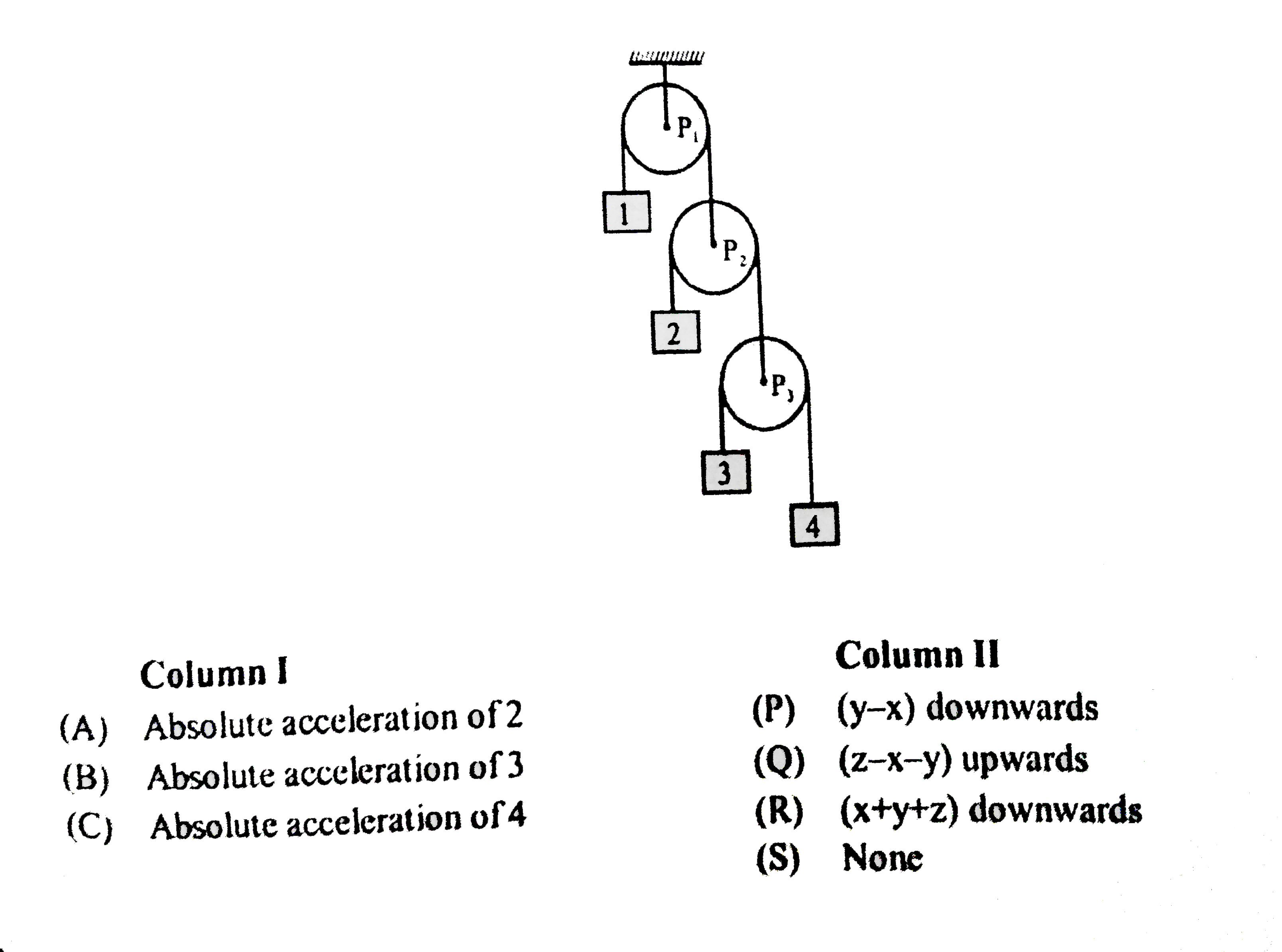
In figure shown, acceleration of 1 is x (upwards). Acceleration of pulley `P_(3),` w.r.t. pullye `P_(2)` is y (downwards) and acceleration of 4 w.r.t. to pulley `P_(3)` is z (upwards). Then

Text Solution

Verified by Experts

The correct Answer is:

(A)-s, (B)-r, (C)-q
Promotional Banner

Topper's Solved these Questions

  • KINEMATICS

    ALLEN |Exercise Assertion-Reason|20 Videos
  • KINEMATICS

    ALLEN |Exercise Comprehension#1|3 Videos
  • KINEMATICS

    ALLEN |Exercise EXERCISE-02|57 Videos
  • ERROR AND MEASUREMENT

    ALLEN |Exercise Part-2(Exercise-2)(B)|22 Videos
  • KINEMATICS (MOTION ALONG A STRAIGHT LINE AND MOTION IN A PLANE)

    ALLEN |Exercise BEGINNER S BOX-7|8 Videos

Similar Questions

Explore conceptually related problems

In the figure shown ,acceraltion of is x (upwards ) Acceleration o fpulleys p_(3) with respect to pulley p_(2) is y (downwards) and accelarataion of f4 wioth respect to pul,ley p_(3) is z (upwards). Then match the following

In the figure acceleration of A is 1m//s^(2) upward, acceleration of B is 7m//s^(2) upward acceleration of C is 2m//s^(2) upward. The acceleration of D will be.

If acceleration of block B is 4 m//s^(2) upward & that of C is 6 m//s^(2) downward. Find acceleration of A :-

If block A is moving with an acceleration of 5ms^(-2) , the acceleration of B w.r.t. ground is

Calculate the relative acceleration of A w.r.t. B if B is moving with acceleration a_(0) towards right.

A player throws a ball upwards with an initial speed of 29.4 ms^(-1) (a) What is the direction of acceleration during the upward motion of the ball ? (b) What are the velocity and acceleration of the ball at the highest point of its motion ? (c) Choose the x = 0 m and t=0 s to be the location and time of the ball at its highest point vertically downward direction to be the positive direction of x-axis and give the signs of position, velocity and acceleration of the ball during its upward and downward motion. (d) To what height does the ball rise and after how long does the ball return to the player's hands ? (Take g = 9.8 ms^(-2) and neglect air resistance).

Derivative of x^(2) w.r.t x^(3) is……

Find first derivation of y w.r.t. x. (i) y=x^(2) sin x , (ii) y=4(e^(x))cos x

Two weights w_(1) and w_(2) are suspended from the ends of a light string passing over a smooth fixed pulley. If the pulley is pulled up at an acceleration g , the tension in the string will be

A 40 kg boy climbs a rope that passes over an ideal pulley. The other end of the rope is attached to a 60 kg weight placed on the ground. What is the maximum upward acceleration the boy can have without lifting the weight ? If he climbs the rope with upward acceleration 2 g, with what acceleration the weight will rise up ?
