Home
Class 12
PHYSICS
Three identical rods of length 1 m each,...


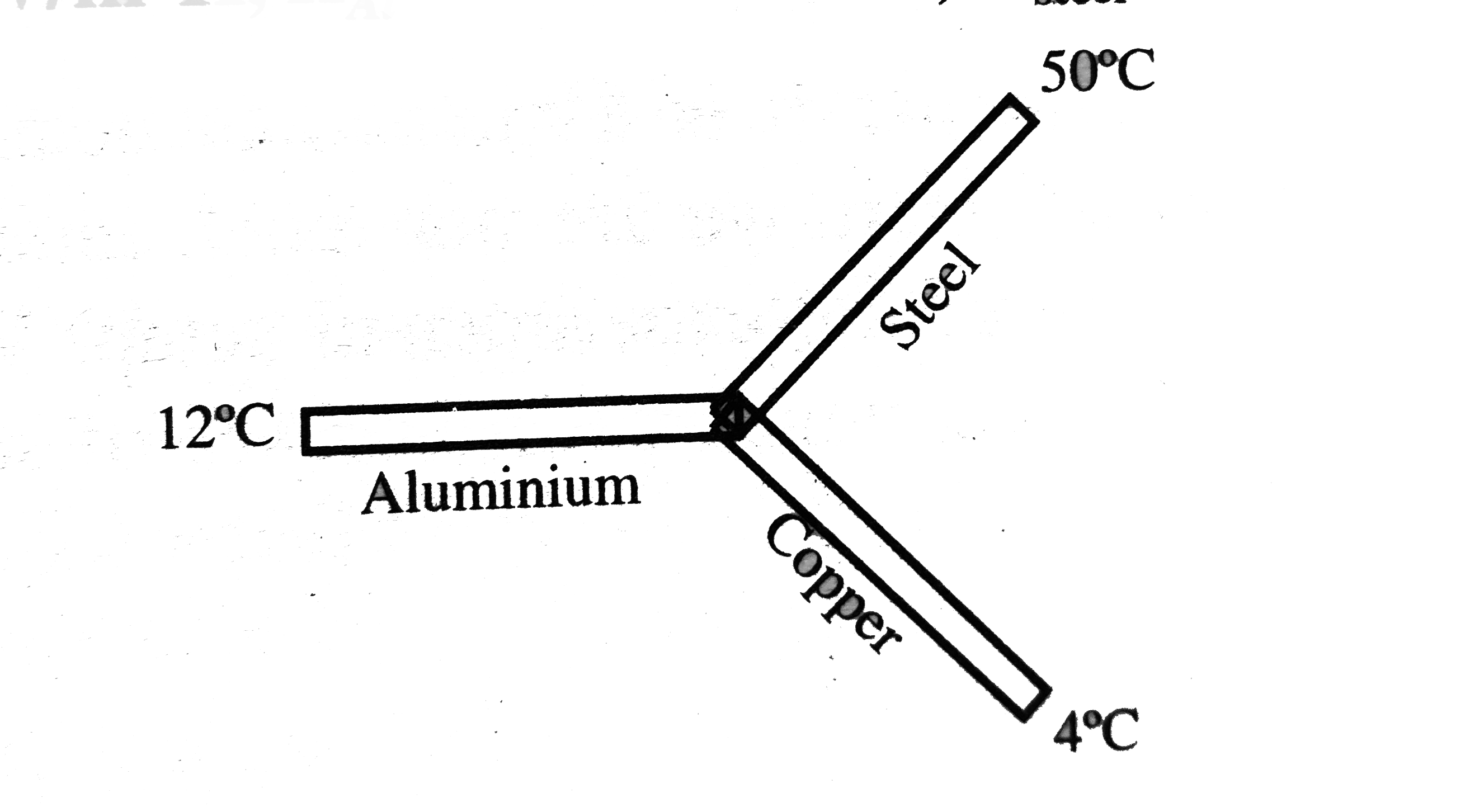
Three identical rods of length 1 m each, having cross-sectional area of `1cm^2` each and made of aluminium, copper and steel, respectively, are maintained at temperatures of `12^@C`,`4^@C` and `50^@C`, respectively, at their separate ends. Find the teperature of their common junction.
`[K_(Cu)=400 W//m-K,K_(Al)=200 W//m-K,K_("steel")=50 W//m-K]`

Text Solution

Verified by Experts

` R_(Al) = (L)/(KA)=(1)/(200xx10^(-4)) = 10^(4)/200`
Similarly `R_(steel) = 10^(4)/50` and ` R_(copper)= (10^(4))/(400)`
Let temperature of common junction = `T`
then from Kirchoff,s current laws, `i_(Al) + i_(steel) +i_(Cu) =0`
` implies (T-12)/(R_(Al)) + (T-51)/R_(steel) + (T-4)/R_(Cu)=0`
` implies (T-12)200+(T-50)50 +(T-4)400=0`
`implies 4(T-12)+ (T-50) + 8(T-4)=0`
` implies 13T=48+52+32=130`
` implies T=10^(@)C`
` (##ALN_PHY_C07(I)_S01_010_S01.png" width="80%">
Promotional Banner

Topper's Solved these Questions

  • GEOMETRICAL OPTICS

    ALLEN |Exercise SOME WORKED OUT EXAMPLES|84 Videos
  • GEOMETRICAL OPTICS

    ALLEN |Exercise EXERCISE -01|65 Videos
  • CURRENT ELECTRICITY

    ALLEN |Exercise EX.II|66 Videos
  • GRAVITATION

    ALLEN |Exercise EXERCISE 4|9 Videos

Similar Questions

Explore conceptually related problems

Two spheres of the same material have radii 1 m and 4 m and temperature 4000 K and 2000 K respectively. Ratio of the energy radiated per second by the first sphere to that by the second is . . . . . .

Two spheres of the same material have radii 1m and 4m and temperatures 4000K and 2000K respectively. The ratio of the energy radiated per second by the first sphere to that by the second is

n_(1) and n_(2) moles of two ideal gases (mo1 wt m_(1) and m_(2)) respectively at temperature T_(1)K and T_(2)K are mixed Assuming that no loss of energy the temperature of mixture becomes .

Three rods of the same dimensions have thermal conductivities 3 k , 2 k and k . They are arranged as shown, with their ends at 100^(@)C, 50^(@)C and 0^(@)C . The temperature of their junction is :-

In above diagram, a combined rod is formed by connecting two rods of length l_(1) and l_(2) respectively and thermal conductivity k_(1) and k_(2) respectively. Temperature of ends of rods are T_(1) and T_(2) constant, then find the temperature of their contact surface ?

Three rods made of the same material and having the same cross-section have been joined as shown in the figure. Each rod is of the same length. The left and right ends are kept at 0^@C and 90^@C , respectively. The temperature of junction of the three rods will be (a) 45^@C (b) 60^@C (c) 30^@C (d) 20^@C .

A steel wire of length 1 m and mass 0.1 kg and having a uniform cross-sectional area of 10^(-6) m^(2) is rigidly fixed at both ends. The temperature of the wire is lowered by 20^(@)C . If the wire is vibrating in fundamental mode, find the frequency (in Hz). (Y_(steel)=2xx 10^(11) N//m^(2),alpha_(steel)=1.21 xx 10^(-5)//.^(@)C) .

A cylindrical block of length 0.4 m and area of cross-section 0.04 m^2 is placed coaxially on a thin metal disc of mass 0.4 kg and of the same cross - section. The upper face of the cylinder is maintained at a constant temperature of 400 K and the initial temperature of the disc is 300K . if the thermal conductivity of the material of the cylinder is 10 "watt"// m.K and the specific heat of the material of the disc is 600J//kg.K , how long will it take for the temperature of the disc to increase to 350 K ? Assume for purpose of calculation the thermal conductivity of the disc to be very high and the system to be thermally insulated except for the upper face of the cylinder.

Figure shows two flasks connected to each other. The volume of the flask 1 is twice that of flask 2 . The system is filled with an ideal gas at temperature 100 K and 200 K respectively. If the mass of the gas in 1 be m then what is the mass of the gas in flask 2

For the reaction A+BhArr3C at 25^(@)C , a 3 litre volume reaction vessel contains 1,2 and 4 moles of A,B and C respectively at equilibrium, calculate the equilibrium constant K_(c) of the reaction at 25^(@)C .
