Home
Class 12
PHYSICS
The figure shows the cross-section of th...

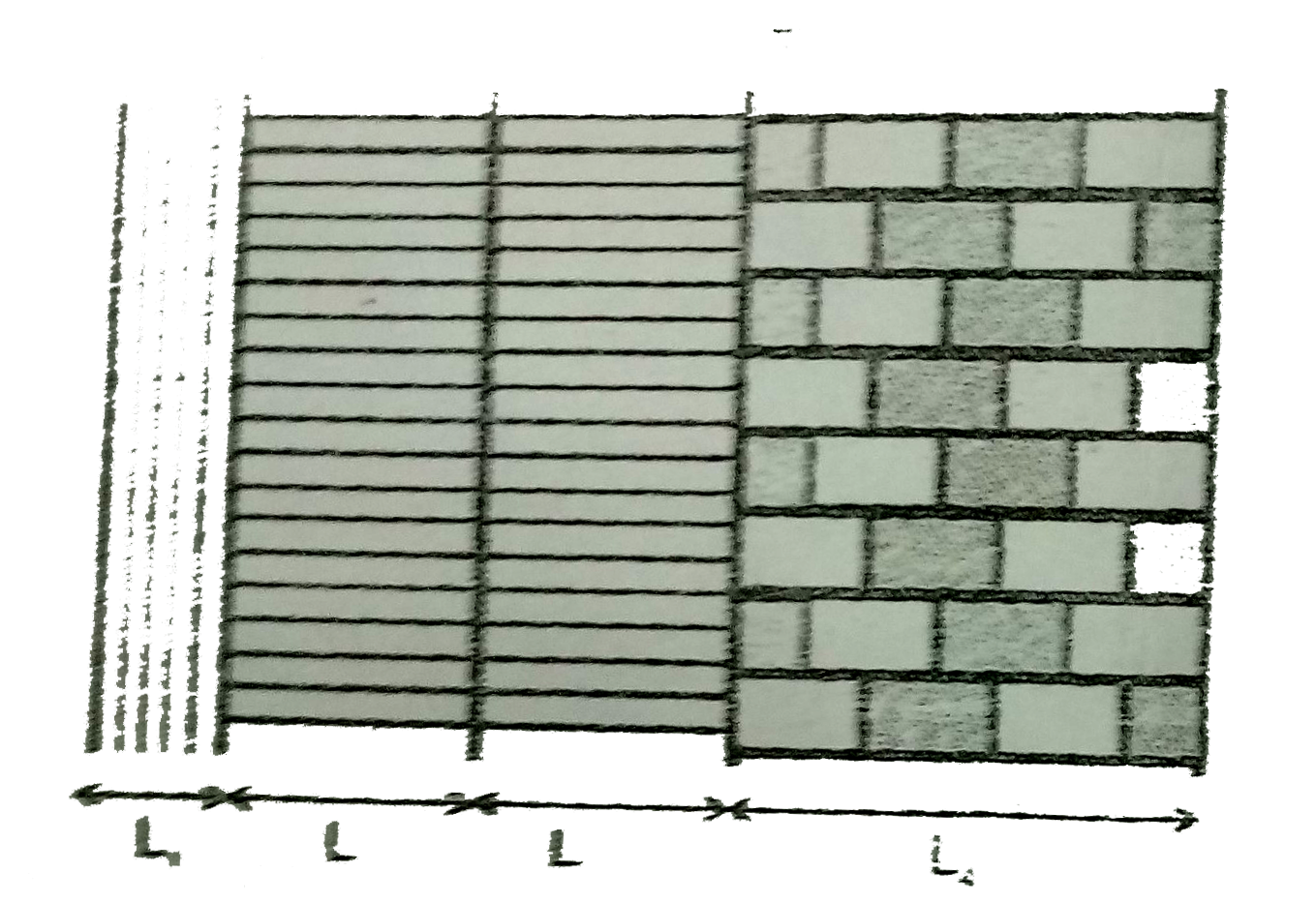
The figure shows the cross-section of the outer wall of a house buit in a hill-resort to keep the house insulated from the freezing temperature of outside. The wall consists of teak wood of thickness `L_(1)` and brick of thickness `(L_(2) = 5L_(1))`, sandwitching two layers of an unknown material with identical thermal conductivites and thickness. The thermal conductivity of teak wood is `K_(1)` and that of brick is `(K_(2) = 5K)`. Heat conducion through the wall has reached a steady state with the temperature of three surfaces being known. `(T_(1) = 25^(@)C, T_(2) = 20^(@)C` and `T_(5) = - 20^(@)C)`. Find the interface temperature `T_(4)` and `T_(3)`.

Text Solution

Verified by Experts

Let interface area be `A`. Then thermal resistance of wood,`R_(1)=(L_(1))/(K_(1)A)` and that of brick wall `R_(2)=(L_(2))/(K_(2)A)=(5L_(1))/(5K_(1)A)=R_(1)`
Let thermal resistance of the each sand witch layer= `R`. Then the above wall can be visualised as a circuit
Thermal current through each wall is same.
Hence `(25-20)/(R_(1))= (20-T_(2))/R= (T_(3)-T_(4))/R=(T_(4)+20)/R_(1)`
`implies 25-20 = T_(4) +24 implies T_(4)=-15^(@)C`
also, `20-T_(3)=T_(3)-T_(4) implies T_(3)= (20+T_(4))/(2) =2.5^(@)C`
` (##ALN_PHY_C07(I)_S01_011_S01.png" width="80%">
Promotional Banner

Topper's Solved these Questions

  • GEOMETRICAL OPTICS

    ALLEN |Exercise SOME WORKED OUT EXAMPLES|84 Videos
  • GEOMETRICAL OPTICS

    ALLEN |Exercise EXERCISE -01|65 Videos
  • CURRENT ELECTRICITY

    ALLEN |Exercise EX.II|66 Videos
  • GRAVITATION

    ALLEN |Exercise EXERCISE 4|9 Videos

Similar Questions

Explore conceptually related problems

The thermal conductivity of brick is 1.7 W m^(-1) K^(-1) , and that of cement is 2.9 W m^(-1) K^(-1) .What thickness of cement will have same insulation as the brick of thickness 20 cm .

Consider a compound slab consisting of two different materials having equal thicknesses and thermal conductivities K and 2K respectively. The equivalent thermal conductivity of the slab is . . . . . .. .

In above diagram, a combined rod is formed by connecting two rods of length l_(1) and l_(2) respectively and thermal conductivity k_(1) and k_(2) respectively. Temperature of ends of rods are T_(1) and T_(2) constant, then find the temperature of their contact surface ?

The temperature of the two outer surfaces of a composite slab, consisting of two materials having coefficients of thermal conductivity K and 2K and thickness x and 4x respectively. Temperatures on the opposite faces of composite slab are T_(1) and T_(2) where T_(2)gtT_(1) , as shown in fig. what is the rate of flow of heat through the slab in a steady state?

A wall consists of alternating blocks of length 'd' and coefficient of thermal conductivity k_(1) and k_(2) respectively as shown in figure. The cross sectional area of the blocks are the same. The equivalent coefficient of thermal conductivity of the wall between left and right is . . . . .

The temperature of the two outer surfaces of a composite slab, consisting of two materials having coefficients of thermal conductivity K and 2K and thicknesses x and 4x, respectively are T_(2) and T_(1)(T_(2)gtT_(1)) . The rate of heat of heat transfer through the slab, in ? steady state is [(A(T_(2)-T_(1))/(x)]f , with f equal to :-

One end of thermally insulated rod is kept at a temperature T_(1) and the other at T_(2) . The rod is composed of two section of length l_(1) and l_(2) thermal conductivities k_(1) and k_(2) respectively. The temerature at the interface of two section is

A compound slab is made up two slabs. If thermal conductivity of their material are k_(1) and k_(2) respectively of their cross-sectional areas are the same, the equivalent thermal conductivity of the slab is . . . . . (consider series connection)

The figure shows the face and interface temperature of a composite slab containing of four layers of two materials having identical thickness. Under steady state condition, find the value of temperature theta .
