Home
Class 12
PHYSICS
Three rods of material x and three of ma...

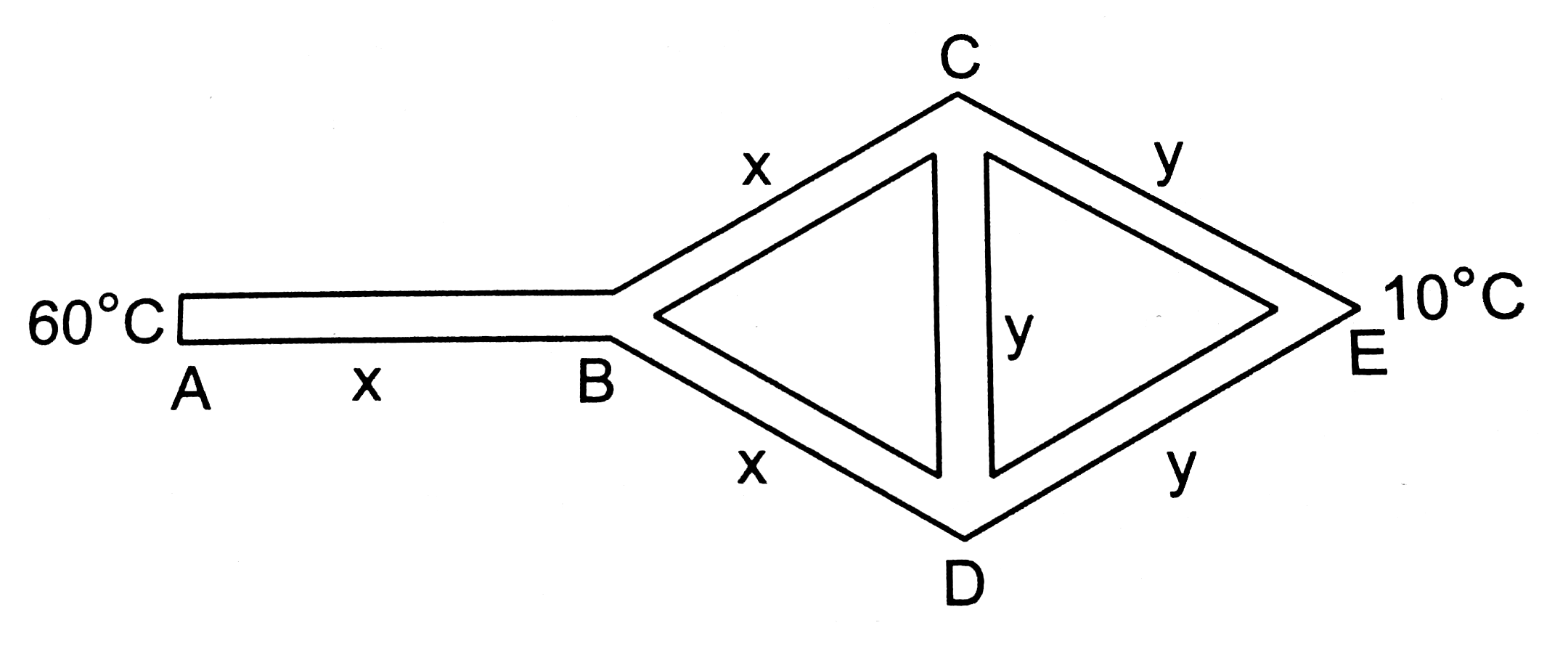
Three rods of material `x` and three of material `y` are connected as shown in figure. All the rods are identical in length and cross sectional area. If the end `A` is maintained at `60^(@)C` and the junction `E` at `10^(@)C` , calculate the temperature of the junction `B`. The thermal conductivity of `x` is `800Wm^(-1).^(@)C^(-1)` and that of `y` is `400Wm^(-1).^(@)C^(-1)` .

Text Solution

Verified by Experts

` R_(X)prop1/K_(X), R_(Y)prop 1/K_(Y) implies R_(X)/R_(Y) = K_(Y)/K_(X)=0.46/0.92=1/2`
Let ` R_(X)=R therefore R_(Y)=2R`
The total resistance `sumR = R_(Y)` + effective resistance in the bridge
`sumR=2R+(2Rxx4R)/(2Rxx4R) = 2R + 4/3 R =10/3R & because Deltatheta = lxxR`
Further ` I_(BCE) (2R)=I_(BDE)(4R)` and `I_(BCE)+ I_(BDE) = I implies I_(BCE) = 2/3I` and`I_(BDE)= 1/3I`
For `A` and `B` ` theta_(A) - theta_(B)= 60^(@) - theta_(B) = 2RxxI ...(i)`
For `A` and `C` ` theta_(B) - theta_(C) =2/3(IxxR) ... (ii) theta_(C) -theta_(E)= 2/3 xx RxxI`
For `A` and `E` `theta_(A) -theta_(E) = 60-10 =50 implies10/3(RxxI)=50` ..(iii)` therefore RxxI=15`
` therefore theta_(A)-theta_(B)- 2xx15=30, theta_(B)=60-30=30^(@)C, theta_(B)-theta_(C) = ((2)/(3)) xx 15 =10`
`therefore theta_(C)=30-10=20^(@)C` Obviously, ` theta_(C)=theta_(D) = 20^(@)C`
Promotional Banner

Topper's Solved these Questions

  • GEOMETRICAL OPTICS

    ALLEN |Exercise SOME WORKED OUT EXAMPLES|84 Videos
  • GEOMETRICAL OPTICS

    ALLEN |Exercise EXERCISE -01|65 Videos
  • CURRENT ELECTRICITY

    ALLEN |Exercise EX.II|66 Videos
  • GRAVITATION

    ALLEN |Exercise EXERCISE 4|9 Videos

Similar Questions

Explore conceptually related problems

Four rods of material X and three rods of material Y are connected as shown in figure. All the rods are of identical lengths and cross-sectional area. Given thermal resistance of rod of material X, R_(x) = R and thermal conductivities of materials are related by relation K_(Y) = 2K_(X) . {:(,"Column-I",,"Column-II"),((A),"Thermal resistance between B and E" ,(p),(500)/(13).^(@)C ),((B),"Thermal resistance between A and F" ,(q),(700)/(13).^(@)C ),((C),"Temperature of junction B" ,(r),(2R)/(3)), ((D),"Temperature of junction D" ,(s),(13R)/(6)):}

Three rods made of the same material and having the same cross-section have been joined as shown in the figure. Each rod is of the same length. The left and right ends are kept at 0^@C and 90^@C , respectively. The temperature of junction of the three rods will be (a) 45^@C (b) 60^@C (c) 30^@C (d) 20^@C .

Twelve conducting rods from the sides of a uniform cube of side l. If in steady state, B and H ends of the cube are at 100^(@)C and 0^(@)C respectively. Find the temperature of the junction 'A' :-

Three rods of the same dimensions have thermal conductivities 3 k , 2 k and k . They are arranged as shown, with their ends at 100^(@)C, 50^(@)C and 0^(@)C . The temperature of their junction is :-

A double pan window used for insulating a room thermally from outside consists of two glass sheets each of area 1 m^(2) and thickness 0.01m separated by 0.05 m thick stagnant air space. In the steady state, the room-glass interface and the glass-outdoor interface are at constant temperatures of 27^(@)C and 0^(@)C respectively. The thermal conductivity of glass is 0.8 Wm^(-1)K^(-1) and of air 0.08 Wm^(-1)K^(-1) . Answer the following questions. (a) Calculate the temperature of the inner glass-air interface. (b) Calculate the temperature of the outer glass-air interface. (c) Calculate the rate of flow of heat through the window pane.

What is the temperature of the steel-copper junction is the steady state of the system shown in figure. Length of the steel rod = 15.0 cm, length of the copper rod = 10.0 cm, temperature of the furnace =300^(@)C , temperature of the other end =0^(@)C . The area of cross section of the steel rod is twice that of the copper rod. (Thermal conductivity of steel =50.2" Js"^(-1)m^(-1)K^(-1) , and copper =385" Js"^(-1)m^(-1)KJ^(-1) ).

The two ends of a metal rod are maintained at temperatures 100^(@)C and 110^(@)C . The rate of heat flow in the rod is found to be 4.0" Js"^(-1) . If the ends are maintained at temperatures 200^(@)C and 210^(@)C , the rate of heat flow will be :

One end of a brass rod 2m long and having 1cm radius is maintained at 250^(@)C . When a steady state is reached , the rate of heat flow acrss any cross-section is 0.5 cal s^(-1) . What is the temperature of the other end K=0.26"cal" s^(-1) cm^(-1). ^(@)C^(-1) .

What is the temperature of the steel - copper junction in the steady state of the system shown in Fig. Length of the steel rod = 15.0 cm, length of the copper rod = 10.0 cm, temperature of the furnace =400" "^(@)C , temperature of the other end =0" "^(@)C . The area of cross section of the steel rod is twice that of the copper rod. (Thermal conductivity of steel =50.2" J s"^(-1)m^(-1)K^(-1), and of copper =385" J s"^(-1)m-1" "K^(-1) ).

What is the temperature of the aluminium junction in the steady state of the system shown in Fig. Length of the load =15.0 cm, length of the aluminium rod =10.0 cm temperature of the furnace = 400" "^(@)C , temperature of the other end =0" "^(@)C . The area of cross section of the lead rod is twice that of the aluminium rod. (Thermal conductivity of steel =34.9" J s"^(-1)m^(-1)K^(-1), and copper =205" J s"^(-1)m-1" "K^(-1) )

