Home
Class 12
PHYSICS
n moles of a diatomic gas has undergone ...

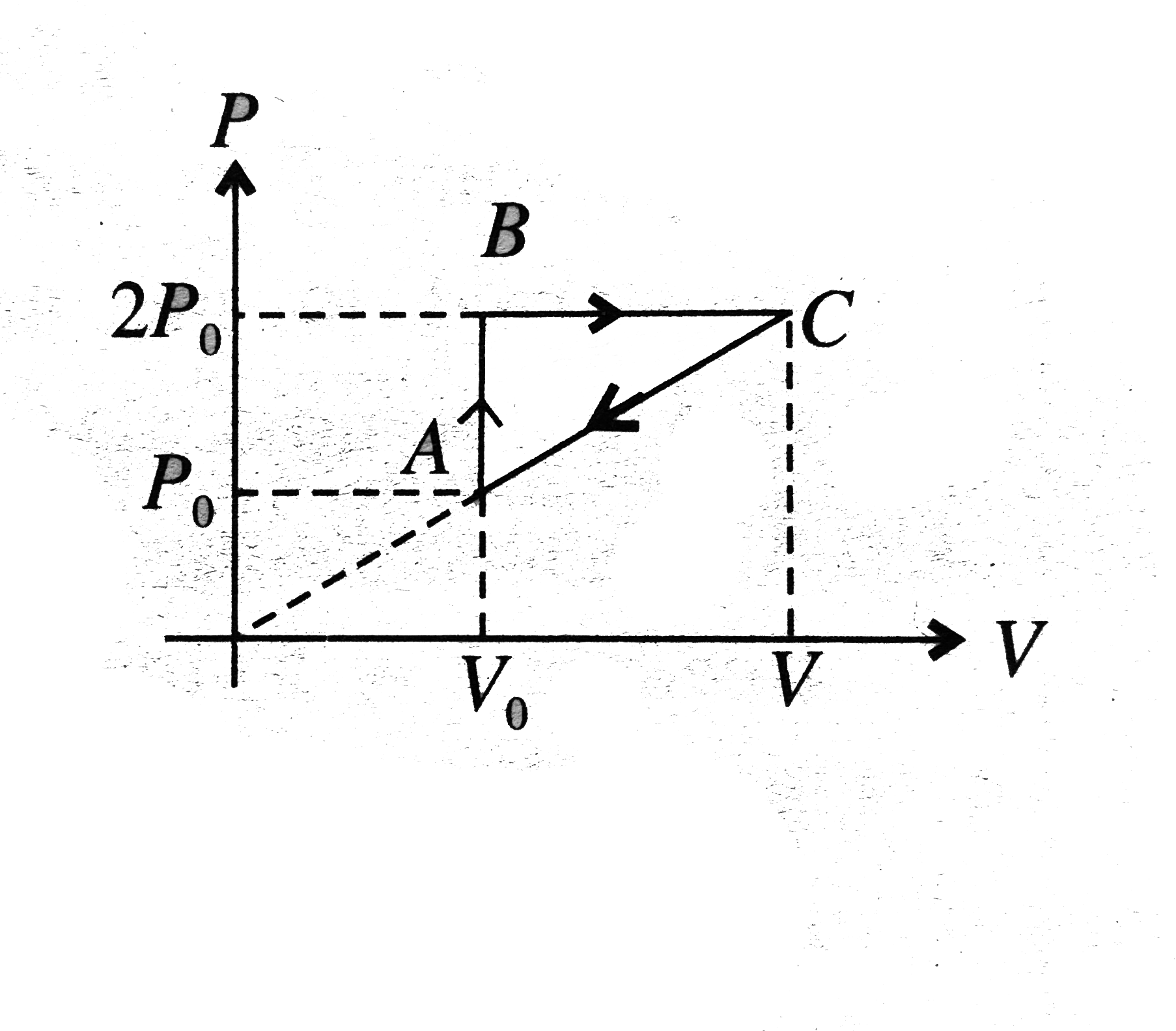
n moles of a diatomic gas has undergone a cyclic process ABC as shown in figure. Temperature at A is `T_(0)`. Find
a. Volume at C ?
b. Maximum temperature ?
c. Total heat given to gas ?
d. Is heat rejected by the gas, if yes how much heat is rejected ?
e. Find out the efficiency

Text Solution

Verified by Experts

(i) Since triangle `OAV_(0)` and `OCA` are similar therefore `" "` `(2P)/(V)=(P_(0))/(V_(0)) implies V = 2V_(0)`
Since process `AB` is isochoric hence `" "` `(P_(A))/(T_(A)) = (P_(B))/(T_(B)) implies T_(B) = 2T_(0)`
Since process `BC` is isobaric therefore `" "` `(T_(B))/(V_(B)) = (T_(C))/(V_(C)) implies T_(C) = 2T_(B) = 4T_(0)`
(iii) Since process is cyclic therefore `Q=W` = area under the cycle = `(1)/(2)P_(0)V_(0)`
(iv) Since `U` and `W` both are negative in process `CA`
`therefore Q` is negative in process `CA` and heat is rejected in process `CA`
`Q_(CA) = W_(CA) + U_(CA)`
=`-(1)/(2)[P_(0) + 2P_(0)]V_(0)- (5)/(2)nR(T_(c)-T_(a))`
`= -(1)/(2)[P_(0) + 2P_(0)]V_(0)- (5)/(2)nR ((4P_(0)V_(0))/(nR) - (P_(0)V_(0))/(nR))`
=`9P_(0)V_(0)` = Heat injected .
(v) `eta = "efficieny of the cycle" = ("work done by the gas ")/("heat injected ") = (P_(0)V_(0)//2)/(Q_("injected")) xx100`
where `Q_("inj") = Q_(AB) + Q_(BC) = [(5)/(2 )nR(2T_(0)-T_(0))] + [(5)/(2)nR(2T_(0)) + 2P_(0) (2V_(0) - V_(0)] = (19)/(2)P_(0)V_(0)`.
Therefore `eta = (100)/(19)%`
Promotional Banner

Topper's Solved these Questions

  • GEOMETRICAL OPTICS

    ALLEN |Exercise SOME WORKED OUT EXAMPLES|84 Videos
  • GEOMETRICAL OPTICS

    ALLEN |Exercise EXERCISE -01|65 Videos
  • CURRENT ELECTRICITY

    ALLEN |Exercise EX.II|66 Videos
  • GRAVITATION

    ALLEN |Exercise EXERCISE 4|9 Videos

Similar Questions

Explore conceptually related problems

n' moles of an ideal gas undergoes a process AtoB as shown in the figure. The maximum temperature of the gas during the process will be:

One mole of an ideal monoatomic gas undergoes a cyclic process as shown in figure . Temperature at point 1 = 300K and process 2-3 is isothermal . The efficiency of cycle is

One mole of an ideal monoatomic gas undergoes a cyclic process as shown in figure . Temperature at point 1 = 300K and process 2-3 is isothermal . Heat capacity of process 1rarr 2 is

One mole of a diatomic ideal gas undergoes a cyclic process ABC as shown in figure. The process BC is adiabatic. The temperature at A,B and C are 400K, 800K and 600K respectively. Choose the correct statement:

One mole of a diatomic ideal gas undergoes a cyclic process ABC as shown in figure. The process BC is adiabatic. The temperature at A,B and C are 400K, 800K and 600K respectively. Choose the correct statement:

One mole of diatomic ideal gas undergoes a cyclic process ABC as shown in figure. The process BC is adiatomic. The temperature of A, B and C are 400 K, 800 K and 600 K respectively. Choose the correct statement ____

One mole of monoatomic ideal gas undergoes a process ABC as shown in figure. The maximum temperature of the gas during the process ABC is in the form (xPV)/(R) . Find x .

One mole of an ideal monatomic gas is taken round the cyclic process ABCA as shown in figure. Calculate (a) the work done by the gas. (b) the heat rejected by the gas in the path CA and the heat absorbed by the gas in the path AB, (c) the net heat absorbed by the gas in the path BC, (d) the maximum temperature attained by the gas during the cycle.

n moles of a monoatomic gas is carried round the reversible rectangular cycle ABCDA as shown in the diagram. The temperature at A is T_0 . The thermodynamics efficiency of the cycle ____

One mole of an ideal monoatomaic gas is taken from A to C along the path ABC . The temperature of the gas at A is T_(0) . For the process ABC :
