Home
Class 12
PHYSICS
The temperature of the two outer surface...

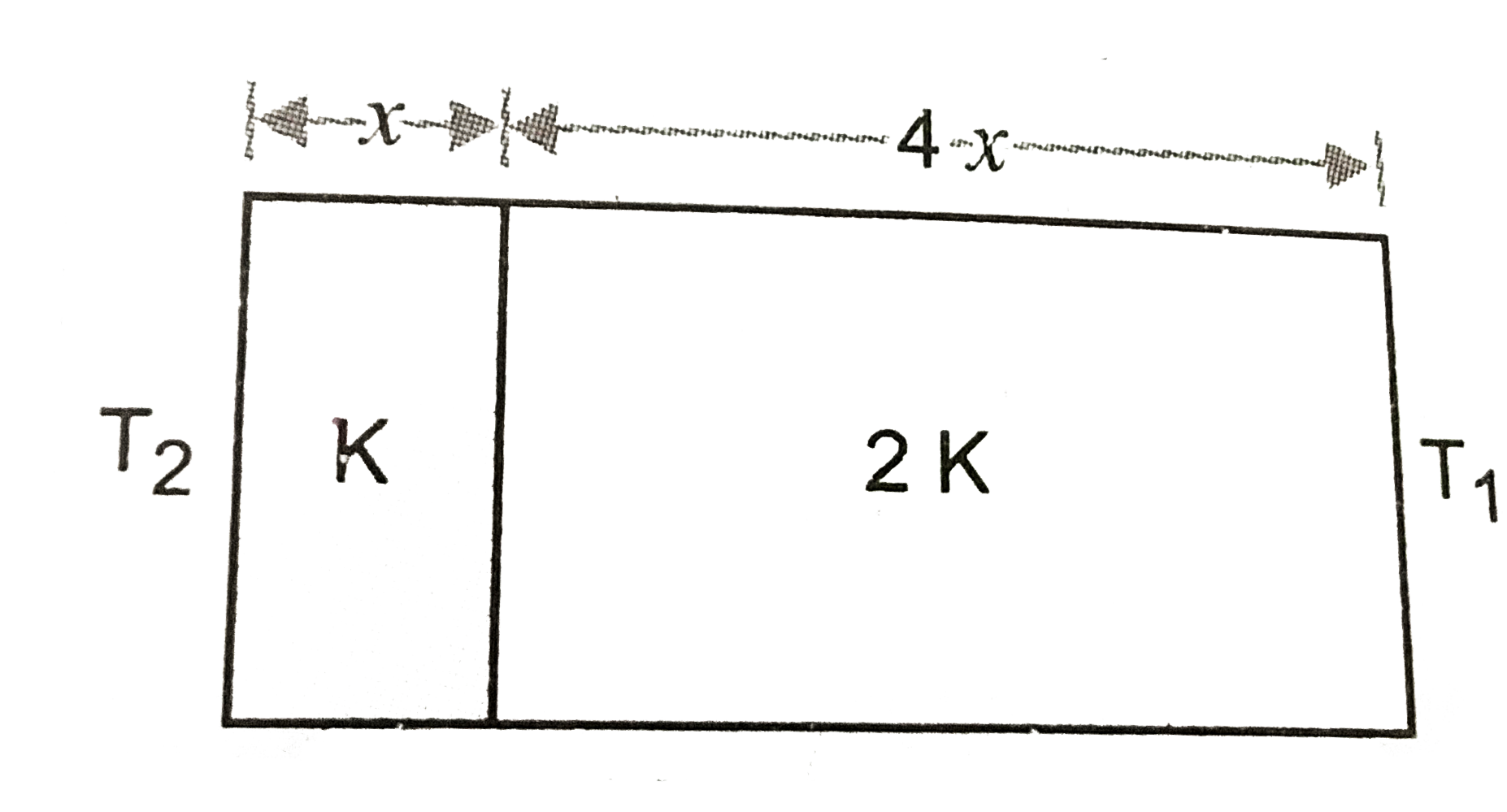
The temperature of the two outer surfaces of a composite slab, consisting of two materials having coefficients of thermal conductivity K and 2K and thickness x and 4x respectively. Temperatures on the opposite faces of composite slab are `T_(1) and T_(2)` where `T_(2)gtT_(1)`, as shown in fig. what is the rate of flow of heat through the slab in a steady state?

Text Solution

Verified by Experts

The correct Answer is:

D

`overset(**)(Q)=(T_(2) - T_(1))/((x)/(KA) + (4x)/(2KA)) = (KA(T_(2)-T_(1)))/(3x) = [(KA(T_(2)-T_(1)))/(x)]f`
then f = `1//3`
Promotional Banner

Topper's Solved these Questions

  • GEOMETRICAL OPTICS

    ALLEN |Exercise EXERCISE -03|11 Videos
  • GEOMETRICAL OPTICS

    ALLEN |Exercise ASSERTION-REASON|40 Videos
  • GEOMETRICAL OPTICS

    ALLEN |Exercise EXERCISE -01|65 Videos
  • CURRENT ELECTRICITY

    ALLEN |Exercise EX.II|66 Videos
  • GRAVITATION

    ALLEN |Exercise EXERCISE 4|9 Videos

Similar Questions

Explore conceptually related problems

The temperature of the two outer surfaces of a composite slab, consisting of two materials having coefficients of thermal conductivity K and 2K and thicknesses x and 4x, respectively are T_(2) and T_(1)(T_(2)gtT_(1)) . The rate of heat of heat transfer through the slab, in ? steady state is [(A(T_(2)-T_(1))/(x)]f , with f equal to :-

Consider a compound slab consisting of two different materials having equal thicknesses and thermal conductivities K and 2K respectively. The equivalent thermal conductivity of the slab is . . . . . .. .

The figure shows the face and interface temperature of a composite slab containing of four layers of two materials having identical thickness. Under steady state condition, find the value of temperature theta .

Constant temperature of ends are T_(1) and T_(2) (where T_(1)gtT_(2) ) for a conducting rod of 'L' length and cross-sectional area A. What would be the rate of heat transfer in thermal steady state ?

A rod of length L with sides fully insulated is made of a material whose thermal conductivity K varies with temperature as K=(alpha)/(T) where alpha is constant. The ends of rod are at temperature T_(1) and T_(2)(T_(2)gtT_(1)) Find the rate of heat flow per unit area of rod .

In above diagram, a combined rod is formed by connecting two rods of length l_(1) and l_(2) respectively and thermal conductivity k_(1) and k_(2) respectively. Temperature of ends of rods are T_(1) and T_(2) constant, then find the temperature of their contact surface ?

One end of thermally insulated rod is kept at a temperature T_(1) and the other at T_(2) . The rod is composed of two section of length l_(1) and l_(2) thermal conductivities k_(1) and k_(2) respectively. The temerature at the interface of two section is

A wall consists of alternating blocks of length 'd' and coefficient of thermal conductivity k_(1) and k_(2) respectively as shown in figure. The cross sectional area of the blocks are the same. The equivalent coefficient of thermal conductivity of the wall between left and right is . . . . .

The figure shows the cross-section of the outer wall of a house buit in a hill-resort to keep the house insulated from the freezing temperature of outside. The wall consists of teak wood of thickness L_(1) and brick of thickness (L_(2) = 5L_(1)) , sandwitching two layers of an unknown material with identical thermal conductivites and thickness. The thermal conductivity of teak wood is K_(1) and that of brick is (K_(2) = 5K) . Heat conducion through the wall has reached a steady state with the temperature of three surfaces being known. (T_(1) = 25^(@)C, T_(2) = 20^(@)C and T_(5) = - 20^(@)C) . Find the interface temperature T_(4) and T_(3) .

ALLEN -GEOMETRICAL OPTICS-EXERCISE -02
  1. Two plates of equal areas are placed in contact with each other . Thei...

    Text Solution

    |

  2. Two identical square rods of metal are welded end to end as shown in f...

    Text Solution

    |

  3. Three rods of same dimensions are arranged as shown in Fig. They have ...

    Text Solution

    |

  4. The temperature of the two outer surfaces of a composite slab, consist...

    Text Solution

    |

  5. The figure shows a system of two concentric spheres of radii r1 and r2...

    Text Solution

    |

  6. The pressure of an ideal gas varies according to the law P = P(0) - AV...

    Text Solution

    |

  7. A thermal insulated vessel contains some water at 0^(@)C. The vessel i...

    Text Solution

    |

  8. A closed cubical box is made of perfectly insulating material and the ...

    Text Solution

    |

  9. Three identical adiabatic containers A, B and C Contain helium, neon a...

    Text Solution

    |

  10. Suppose 0.5 moles of an ideal gas undergoes an isothermal expansion as...

    Text Solution

    |

  11. Graph shows a hypothetical speed distribution for a sample of N gas pa...

    Text Solution

    |

  12. The temperature of an isotropic cubical solid of length l(0), density ...

    Text Solution

    |

  13. A glass rod when measured with a zinc scale, both being at 30^(@)C, ap...

    Text Solution

    |

  14. Two fines steel wires , fastened between the projectors of a heavy bra...

    Text Solution

    |

  15. In a mercury-glass thermometer the cross-section of the capillary port...

    Text Solution

    |

  16. 5 kg of steam at 100^(@)C is mixed with 10 kg of ice at 0^(@)C. Choose...

    Text Solution

    |

  17. n moles of an ideal triatomic linear gas undergoes a process in which ...

    Text Solution

    |

  18. A sample of gas follow process represented by PV^(2) = constant . Bulk...

    Text Solution

    |

  19. Four moles of hydrogen , two moles of helium and one mole of water vap...

    Text Solution

    |

  20. A diatomic gas obeys the law pV^x= constant. For what value of x, it h...

    Text Solution

    |
