Home
Class 12
PHYSICS
A rectangulat block of refractive index ...

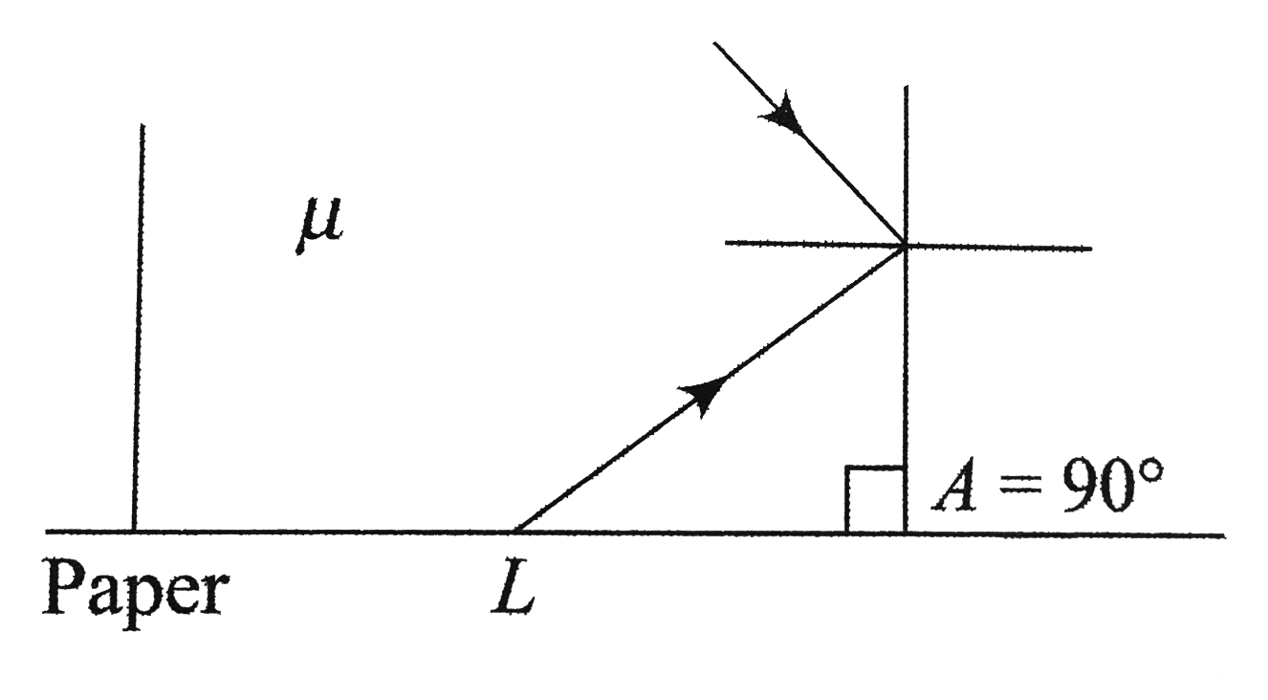
A rectangulat block of refractive index `mu` is placed on a printed page lying on a horizontal surface as shown in Fig. , Find the minimum value of `mu` so that the letter L on the page is not visible from any of the vertical sides.

Text Solution

Verified by Experts

The situation is depicted in figure. Light will not emerge out from the vertical face `BC` if at it `I gt theta_(C) "or" "sin"I gt "sin" theta_(C) implies "sin"I gt (1)/(mu) [ "as sin theta_(C)= (1)/(mu)] … (i)`
But from Snell's law at `O 1 xx "sin" theta= mu "sinr`
And in `DeltaOPR , r + 90 + i = 180 implies r + i = 90^(@) implies r = 90 - i`

So `"sin"theta = mu "sin"(90-i) = mu"cos"i implies "cos"i = ("sin"theta)/(mu)`
so `"sin"i = sqrt(1-cos^(2)i) = sqrt(1-[("sin"theta)/(mu)]^(2)) .... (ii)`
so substituting the value of sin i from equation (ii) in (i),
`sqrt(1- (sin^(2)theta)/(mu^(2))) gt (1)/(mu)` i.e., `mu^(2) gt 1 + sin^(2)theta`
`because (sin^(2)theta)_(max) = 1 therefore mu^(2) gt 2 sqrt(2) therefore mu_(min) = sqrt(2)`
Promotional Banner

Topper's Solved these Questions

  • GEOMETRICAL OPTICS

    ALLEN |Exercise SOME WORKED OUT EXAMPLES|84 Videos
  • GEOMETRICAL OPTICS

    ALLEN |Exercise EXERCISE -01|65 Videos
  • CURRENT ELECTRICITY

    ALLEN |Exercise EX.II|66 Videos
  • GRAVITATION

    ALLEN |Exercise EXERCISE 4|9 Videos

Similar Questions

Explore conceptually related problems

Infinite numbers of bloks are placed on a table on a edge as shown in the diagram. What is the minimum value of L so that the blocks are just going to topple over the table ?

A jar of height h is filled with a transparent liquid of refractive index mu (See figure). At the centre of the jar on the bottom surface is a dot. Find the minimum diameter of a disc, such that when placed on the top surface symmertically aobut the centre , the dot is invisible

A quarter cylinder of radius R and refractive index 1.5 is placed on a table.A point object P is kept at a distance of mR from it. Find the value of m for whicha ray from P will emerge parallel to the table as shown in the figure.

A right angled prism of refractive index mu_(1) is placed in a rectangular block of refractive index mu_(2) , which is surrounded by a medium of refractive index mu_(3) ,as shown in the figure . A ray of light 'e' enters the rectangular block at normal incidence . depending upon the relationship between mu_(1) , mu_(2) "and" mu_(3) , it takes one of the four possible paths 'ef' , 'eg' , 'eh' or 'ef' Match the paths in List I with conditions of refractive indices in List II and select the correct answer using the codes given below the lists: {:("List" I , "List" II) , ( P. e rarr f , 1. mu_(1)gt sqrt(2mu_(2))) , ( Q. e rarr g , 2. mu_(2) gt mu_(1) "and" mu_(2) gt mu_(3)), ( R. e rarr f , 3. mu_(1) = mu_(2)), ( S. e rarr f , 4. mu_(2) lt mu_(1) lt sqrt(2mu_(2)) "and" mu_(2) gt mu_(3)):} Codes : {:( P , Q , R , S) , ((A) 2 , 3 , 1 , 4), ((B) 1 , 2 , 4 , 3) , ((C) 4 , 1 , 2 , 3) , ((D) 2, 3 , 4 , 1):}

There is a spherical glass ball of refractive index mu_(1) and another glass ball of refractive index mu_(2) inside as shown in figure . The radius of the outer ball is R_(1) and that of inner ball is R_(2) . A ray is incident on outer surface of the ball at an angle i_(1) , Find the value of r_(1)

There is a spherical glass ball of refractive index mu_(1) and another glass ball of refractive index mu_(2) inside as shown in figure . The radius of the outer ball is R_(1) and that of inner ball is R_(2) . A ray is incident on outer surface of the ball at an angle i_(1) , Find the value of i_(2)

There is a spherical glass ball of refractive index mu_(1) and another glass ball of refractive index mu_(2) inside as shown in figure . The radius of the outer ball is R_(1) and that of inner ball is R_(2) . A ray is incident on outer surface of the ball at an angle i_(1) , Find the value of r_(2)

One side of radius of curvature R_2=120 cm of a convexo-convex lens of material of refractive index mu=1.5 and focal length f_1=40 cm is slivered. It is placed on a horizontal surface with silvered surface in contact with it. Another convex lens of focal length f_2=20 cm is fixed coaxially d=10 cm above the first lens. A luminous point object O on the axis gives rise to an image coincide with it. Find its height above the upper lens.

A glass wedge with a small angle of refraction theta is placed at a certain distance from a converging lens with a focal length f ,one surface of the wedge being perpendicular to the optical axis of the lens. A point sources S of light is on the other side of the lens at its focus. The rays reflected from the wedge (not from base) produce, after refraction in the lens , two images of the source displaced with respect to each other by d. Find the refractive index of the wedge glass. [Consider only paraxial rays.]

A cubical block of glass of refractive index n_1 is in contact with the surface of water of refractive index n_2. A beam of light is incident on vertical face of the block. After refraction a total internal reflection at the base and refraction at the opposite face take place. The ray emerges at angle theta as shown. The value of theta is given by

