Home
Class 12
PHYSICS
Assume that the nuclear binding energy p...

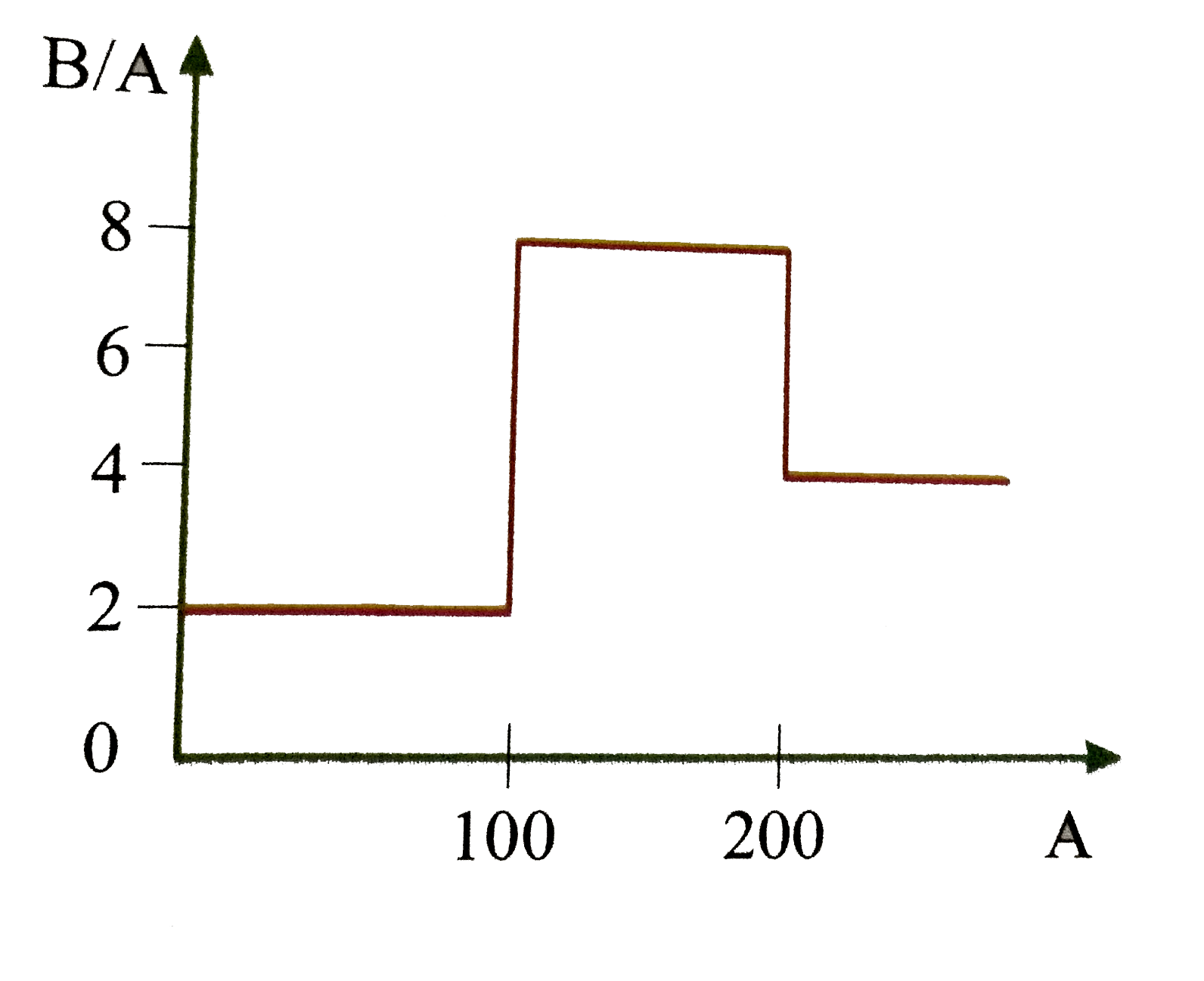
Assume that the nuclear binding energy per uncleon `(B//A)` versus mass number `(A)` is as shwon in Fig. Use this plot to choose the correct choice `(s)` given below:

A

Fusion of two nuclei with mass numbers lying in the range of `1 lt A lt 50` will release energy

B

Fusion of two nuclei with mass numbers lying in the range of `51 lt A lt 100` will release energy

C

Fission of a nucleus lying in the the mass range of `100 lt A lt 200` will release energy when broken into two equal fragments

D

Fission of a nucleus lying in the mass range of `200 lt A lt 260` will release energy when broken into two equal fragments

Text Solution

Verified by Experts

The correct Answer is:

B, D

(A) for `1 lt A lt 50`, on fusion mass number for compound nucleus is less than `100`
`implies` Binding energy nucleon remains same
`implies` No energy is released
(B) For `51 lt A lt 100` on fusion mass number for compound nucleus is between `100` & `200`
`implies` binding energy per nucleon increases
`implies` Energy is released.
(C) For `100 lt A lt 200`, on fission, the mass number of product nuclei will be between `50` & `100`
`implies` Binding energy per nucleon decreases
`implies` No energy is released
(D) For `200 lt A lt 260`, on fission, the mass number of product nuclei will be between `100` & `130`
`implies` Binding energy per nucleon increases
`implies` Energy is released.
Promotional Banner

Topper's Solved these Questions

  • SIMPLE HARMONIC MOTION

    ALLEN |Exercise Match The Column|9 Videos
  • SIMPLE HARMONIC MOTION

    ALLEN |Exercise Comprehension #1|3 Videos
  • SIMPLE HARMONIC MOTION

    ALLEN |Exercise Exercise-05(B)|46 Videos
  • RACE

    ALLEN |Exercise Basic Maths (Wave Motion & Dopplers Effect) (Stationary waves & doppler effect, beats)|25 Videos
  • TEST PAPER

    ALLEN |Exercise PHYSICS|4 Videos

Similar Questions

Explore conceptually related problems

A person trying to lose weight (dieter ) lifts a 10 kg mass , one thousand times , to a height of 0.5 m each time .Assume that the potential energy lost each time she lowers the mass is dissipated . (a) How much work does she do against the gravitational force ? (b) Fat supplies 3.8 xx10^(7) J of energy per kilogram which is converted to mechanical energy with a 20 % efficiency rate . How much fat will the dieter use up ?

The mass of nucleus ._(z)X^(A) is less than the sum of the masses of (A-Z) number of neutrons and Z number of protons in the nucleus. The energy equivalent to the corresponding mass difference is known as the binding energy of the nucleus. A heavy nucleus of mass M can break into two light nuclei of mass m_(1) and m_(2) only if (m_(1)+m_(2)) lt M . Also two light nuclei of massws m_(3) and m_(4) can undergo complete fusion and form a heavy nucleus of mass M ''only if (m_(3)+m_(4)) gt M ''. The masses of some neutral atoms are given in the table below. |{:(._(1)^(1)H,1.007825u,._(1)^(2)H,2.014102u,),(._(1)^(3)H,3.016050u,._(2)^(4)H,4.002603u,),(._(3)^(6)Li,6.015123u,._(3)^(7)Li,7.016004u,),(._(30)^(70)Zn,69.925325u,._(34)^(82)Se,81.916709u,),(._(64)^(152)Gd,151.91980u,._(82)^(206)Pb,205.97445u,),(._(83)^(209)Bi,208.980388u,._(84)^(210)Po,209.982876u,):}| The correct statement is

The mass of a nucleus ._(Z)^(A)X is less that the sum of the masses of (A-Z) number of neutrons and Z number of protons in the nucleus.The energy equivalent to the corresponding mass difference is known as the binding energy of the nucleus. A heavy nucleus of mass M can break into two light nuclei of masses m_(1) and m_(2) only if (m_(1)+m_(2)) lt M . Also two light nuclei of masses m_(3) and m_(4) can undergo complete fusion and form a heavy nucleus of mass M'. only if (m_(3)+m_(4)) gt M' . The masses of some neutral atoms are given in the table below: |{:(._(1)^(1)H ,1.007825u , ._(1)^(2)H,2.014102u,._(1)^(3)H,3.016050u,._(2)^(4)He,4.002603u),(._(3)^(6)Li,6.015123u,._(3)^(7)Li,7.016004u,._(30)^(70)Zn,69.925325u, ._(34)^(82)Se,81.916709u),(._(64)^(152)Gd,151.91980u,._(82)^(206)Pb,205.974455u,._(83)^(209)Bi,208.980388u,._(84)^(210)Po,209.982876u):}| Taking kinetic energy ( in KeV ) of the alpha particle, when the nucleus ._(84)^(210)P_(0) at rest undergoes alpha decay, is:

Four charges Q_(1), Q_(2), Q_(3) and Q_(4) oof same magnitude are fixed along the x axis at x=-2a, -a, +a and +2a , respectively. A positive charge q is placed on the positive y axis at a distance b gt 0 . Four options of the signs of these charges are given in List I. The direction of the forces on the charge q is given in List II. Match List I with List II and select the correct answer using the code given below the lists. {:(,"List-I",,,"List-II"),((P),Q_(1)","Q_(2)","Q_(3)","Q_(4) "all positive",,(1),+x),((Q),Q_(1)","Q_(2) " positive, "Q_(3)","Q_(4)" negative",,(2),-x),((R),Q_(1)","Q_(4)" positive ,"Q_(2)","Q_(3)" negative",,(3),+y),((S),Q_(1)","Q_(3)" positive , "Q_(2)","Q_(4)" negative",,(4),-y):}

A block A is placed over a long rough plank B same mass as shown below. The plank is placed over a smooth horizontal surface. At time t = 0 , block A is given a velocity v_(0) in horizontal direction. Let v_(1) and v_(2) be the velocity of A & B at time 't'. Then choose the correct graph between v_(1) or v_(2) and t.

Four combinations of two thin lenses are given in List I . The radius of curvature of all curved surfaces is r and the refractive index of all the lenses is 1.5 Match lens combinations in List I with their focal length in List II and select the correct answer using the code given below the lists. (A) (p) 2 r (B) (q) ( r)/(2) ( C) (r) - r (D) (s) r . Code :

Two metallic plate A and B , each of area 5 xx 10^(-4)m^(2) , are placed parallel to each at a separation of 1 cm plate B carries a positive charge of 33.7 xx 10^(-12) C A monocharonatic beam of light , with photoes of energy 5 eV each , starts falling on plate A at t = 0 so that 10^(16) photons fall on it per square meter per second. Assume that one photoelectron is emitted for every 10^(6) incident photons fall on it per square meter per second. Also assume that all the emitted photoelectrons are collected by plate B and the work function of plate A remain constant at the value 2 eV Determine (a) the number of photoelectrons emitted up to i = 10s, (b) the magnitude of the electron field between the plate A and B at i = 10 s, and (c ) the kinetic energy of the most energotic photoelectrons emitted at i = 10 s whenit reaches plate B Negilect the time taken by the photoelectrons to reach plate B Take epsilon_(0) = 8.85 xx 10^(-12)C^(2)N- m^(2)

A right angled prism of refractive index mu_(1) is placed in a rectangular block of refractive index mu_(2) , which is surrounded by a medium of refractive index mu_(3) ,as shown in the figure . A ray of light 'e' enters the rectangular block at normal incidence . depending upon the relationship between mu_(1) , mu_(2) "and" mu_(3) , it takes one of the four possible paths 'ef' , 'eg' , 'eh' or 'ef' Match the paths in List I with conditions of refractive indices in List II and select the correct answer using the codes given below the lists: {:("List" I , "List" II) , ( P. e rarr f , 1. mu_(1)gt sqrt(2mu_(2))) , ( Q. e rarr g , 2. mu_(2) gt mu_(1) "and" mu_(2) gt mu_(3)), ( R. e rarr f , 3. mu_(1) = mu_(2)), ( S. e rarr f , 4. mu_(2) lt mu_(1) lt sqrt(2mu_(2)) "and" mu_(2) gt mu_(3)):} Codes : {:( P , Q , R , S) , ((A) 2 , 3 , 1 , 4), ((B) 1 , 2 , 4 , 3) , ((C) 4 , 1 , 2 , 3) , ((D) 2, 3 , 4 , 1):}
