Home
Class 12
MATHS
In an arcade game, the "monster" is the ...

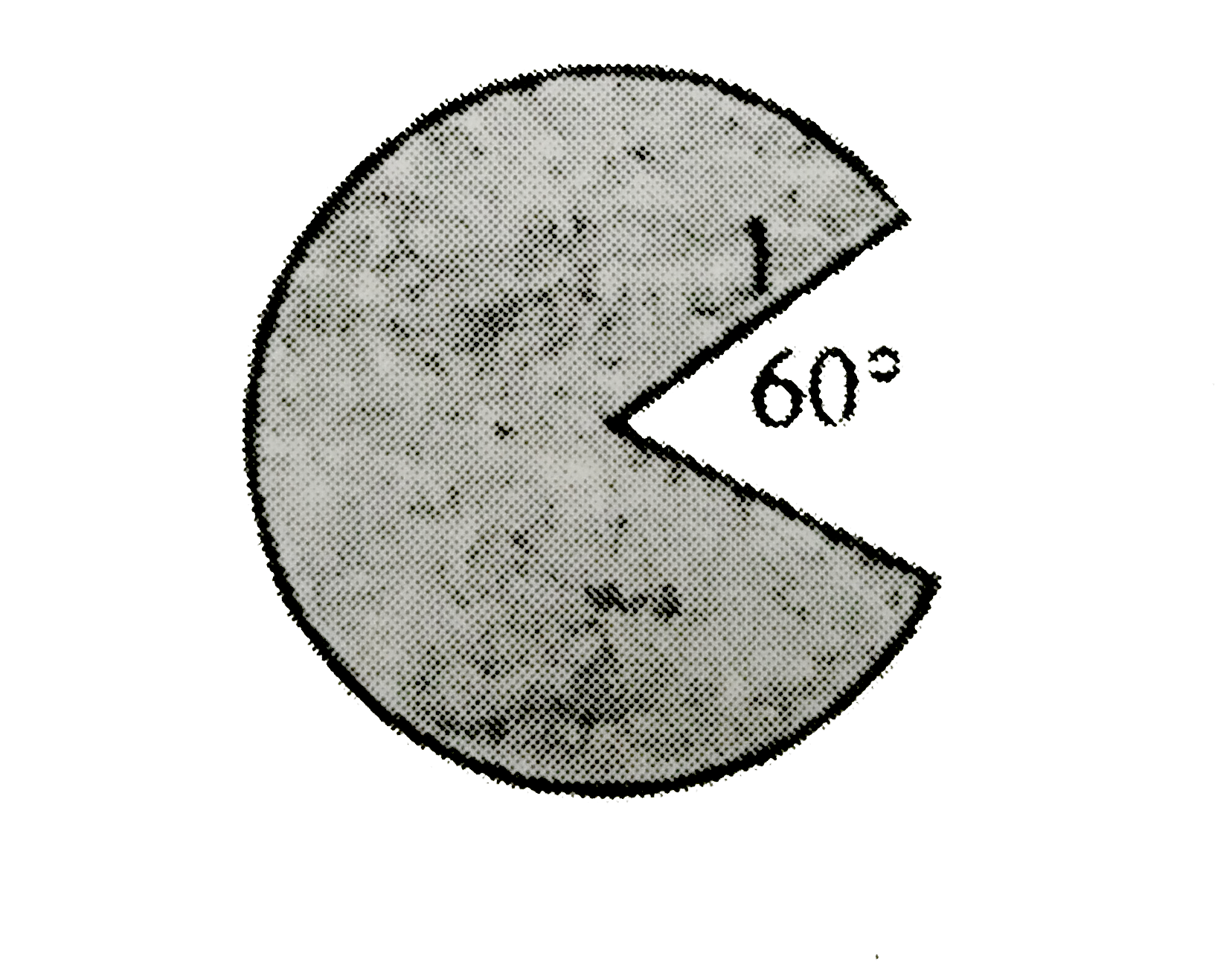
In an arcade game, the "monster" is the shaded sector of a circle of radius 1 cm, as shown in the figure. The missing piece (the mouth) has central angle `60^(@)`. What is the perimeter of the monster in cm?

A

`pi +2`

B

`2pi`

C

`(5)/(3)pi`

D

`(5)/(3)pi+2`

Text Solution

Verified by Experts

The correct Answer is:

D
Promotional Banner

Topper's Solved these Questions

Similar Questions

Explore conceptually related problems

Find the area of a sector of a circle of radius 28 cm and central angle 45^(@) .

Find the area of a sector of a circle with radius 6 cm if angle of the sector is 60^(@) .

Find the area of the minor segment of a circle of radius 14 cm. When the angle of the corresponding sector is 60^(@) .

Find the length of arc of a circle of radius 5 cm subtending a central angle measuring 15^(@) .

Draw a pair of tangents to a circle of radius 5 cm which are incloined to each other at an angle of 60^(@).

A chord of a circle of radius 6cm is making an angle 60 ^(@) at the centre.Find the length of the chord.

A straight wire carrying a current of 12 A is bent into a semicircular arc of radius 2.0 cm as shown in figure (a). Consider the magnetic field vecB at the centre of the arc. (a) What is the magnetic field due to the straight segments ? (b) In what way the contribution to vecB from the semicircle differs from that of a circular loop and in what way does it resemble ? ( c) Would your answer be different if the wire were bent into a semicircular arc of the same radius but in the opposite way as shown in figure (b) ?

A sector cut from a uniform disk of radius 12cm and a uniform rod of the same mass bent into shape of an arc are arranged facing each other as shown in the figure. If center of mass of the combination is at the origin, what is the radius of the arc?

A small object is placed 50 cm to the left of a thin convex lens of focal length 30 cm. A convex spherical mirror of radius of curvature 100 cm is placed to the right of the lens at a distance of 50 cm. The mirror is tilted such that the axis of the mirror is at an angle theta =30degree to the axis of the lens, as shown in the figure If the origin of the coordinate system is taken to be at the centre of the lens, the coordinates (in cm) of the point (x,y) at which the image is formed are
