Home
Class 12
MATHS
A man can just push a box on 37^(@) conc...

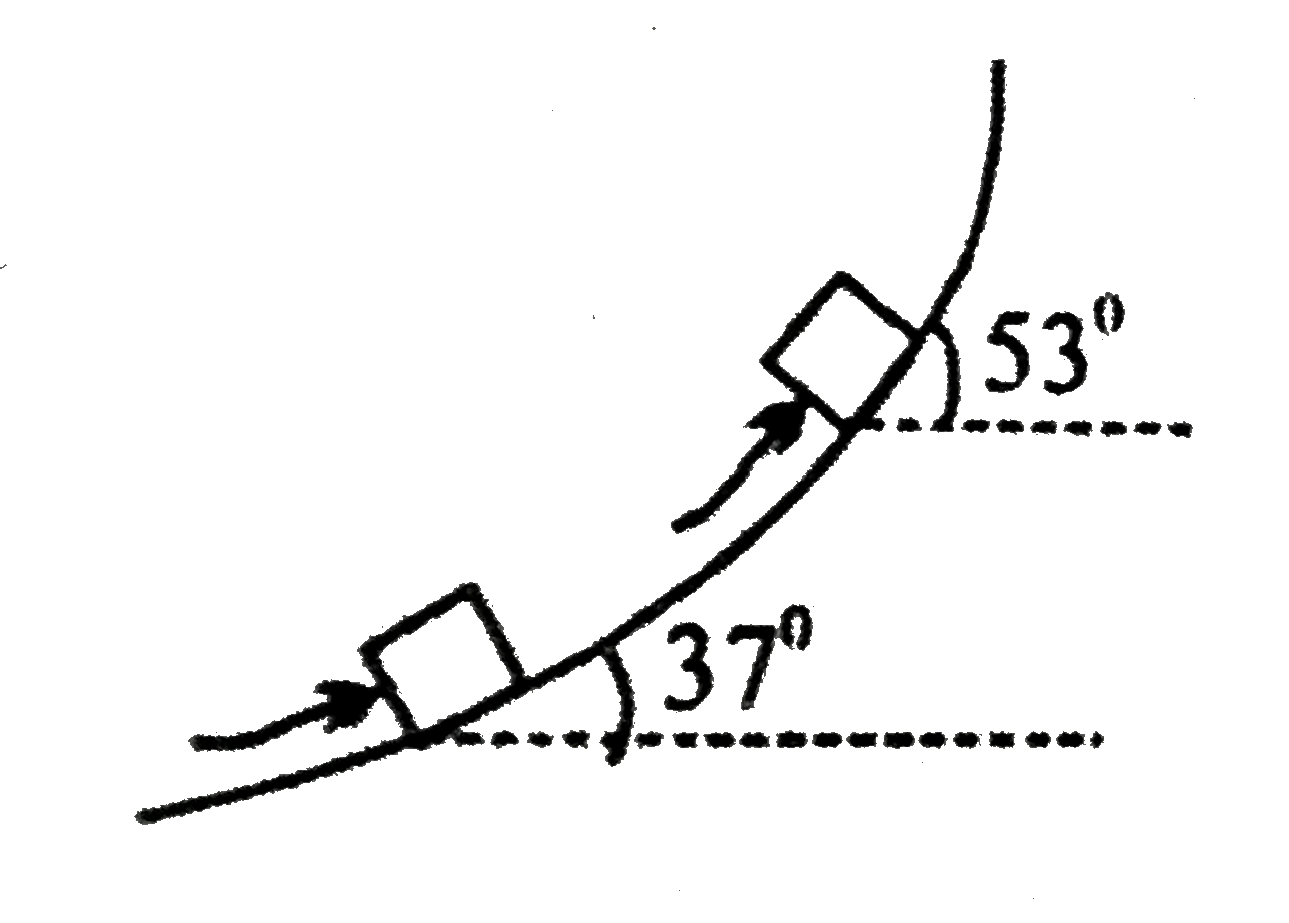
A man can just push a box on `37^(@)` concreate slope. When he keeps it at the point where the angle is `53^(@)`, he can just hold it from sliding black. If the coeffieceint of friction between the box and the concreate slope is `mu find (1)/(mu)`. Assume that the man is applying same magnitude of force along the tangent to the curve only .

Text Solution

Verified by Experts

The correct Answer is:

`7.00`
Promotional Banner

Topper's Solved these Questions

Similar Questions

Explore conceptually related problems

A car is moving along a banked road laid out as a circle of radius r . (a) What should be the banking angle theta so that the car travelling at speed v needs no frictional force from tyres to negotiate the turn ? (b) The coefficient of friction between tyres and road are mu_(s) = 0.9 and mu_(k) = 0.8 . At what maximum speed can a car enter the curve without sliding toward the top edge of the banked turn ?

A rectangular box lies on a rough inclined surface. The coefficient of friction between the surface and the box is mu . Let the mass of the box be m. (a) At what angle of inclination 0 of the plane to the horizontal will the box just start to slide down the plane ? (b) What is the force acting on the box down the plane, if the angle of inclination of the plane is increased to a gt theta (c) What is the force needed to be applied upwards along the plane to make the box either remain stationary or just move up with uniform speed ? (d) What is the force needed to be applied upwards along the plane to make the box move up the plane with acceleration a ?

A large , heavy box is sliding without friction down a smooth plane of inclination theta . From a point P on the bottom of the box , a particle is projected inside the box . The initial speed of the particle with respect to the box is u , and the direction of projection makes an angle alpha with the bottom as shown in Figure . (a) Find the distance along the bottom of the box between the point of projection p and the point Q where the particle lands . ( Assume that the particle does not hit any other surface of the box . Neglect air resistance .) (b) If the horizontal displacement of the particle as seen by an observer on the ground is zero , find the speed of the box with respect to the ground at the instant when particle was projected .

A circus wishes to develop a new clown act. Fig. (1) shows a diagram of the proposed setup. A clown will be shot out of a cannot with velocity v_(0) at a trajectory that makes an angle theta=45^(@) with the ground. At this angile, the clown will travell a maximum horizontal distance. The cannot will accelerate the clown by applying a constant force of 10, 000N over a very short time of 0.24s . The height above the ground at which the clown begins his trajectory is 10m . A large hoop is to be suspended from the celling by a massless cable at just the right place so that the clown will be able to dive through it when he reaches a maximum height above the ground. After passing through the hoop he will then continue on his trajectory until arriving at the safety net. Fig (2) shows a graph of the vertical component of the clown's velocity as a function of time between the cannon and the hoop. Since the velocity depends on the mass of the particular clown performing the act, the graph shows data for serveral different masses. The slope of the line segments plotted in figure 2 is a figure constant. Which one of the following physical quantities does this slope represent?

A circus wishes to develop a new clown act. Fig. (1) shows a diagram of the proposed setup. A clown will be shot out of a cannot with velocity v_(0) at a trajectory that makes an angle theta=45^(@) with the ground. At this angile, the clown will travell a maximum horizontal distance. The cannot will accelerate the clown by applying a constant force of 10, 000N over a very short time of 0.24s . The height above the ground at which the clown begins his trajectory is 10m . A large hoop is to be suspended from the celling by a massless cable at just the right place so that the clown will be able to dive through it when he reaches a maximum height above the ground. After passing through the hoop he will then continue on his trajectory until arriving at the safety net. Fig (2) shows a graph of the vertical component of the clown's velocity as a function of time between the cannon and the hoop. Since the velocity depends on the mass of the particular clown performing the act, the graph shows data for serveral different masses. If a clown holds on to hoop instead of passing through it, what is the position of the cable so that he doesn't hit his head on the ceiling as he swings upward?

A heavy and a light cylindrical rollers of diameter D and d respectively rest on a horizontal plane as shown. The larger roller has a string wound around it to which a horizontal force 'P' can be applied as shown. Assuming 'mu' (coefficient of friction) is same at all surfaces of contact, find the critical value of 'mu' such that larger roller can be just pulled over smaller one.

A man of height H is standing in front of an inclined plane mirror at an angle theta from horizontal. The vertical separation between man and inclined plane is x. Man can see its complete image in length (H(H+x)"sin"theta)/(H +2x) of mirror . (Given : x = H = 1m and theta = 45^(@) ) If man starts moving with velocity 1 ms^(-1) along vertical, find out length of mirror at t = 1s in which he can see his complete image.

A man of height H is standing in front of an inclined plane mirror at an angle theta from horizontal. The vertical separation between man and inclined plane is x. Man can see its complete image in length (H(H+x)"sin"theta)/(H +2x) of mirror . (Given : x = H = 1m and theta = 45^(@) ) If man starts moving with velocity sqrt(2)ms^(-1) along inclined plane, find out length of mirror at t = 1s in which he can see his complete image,
