Home
Class 12
MATHS
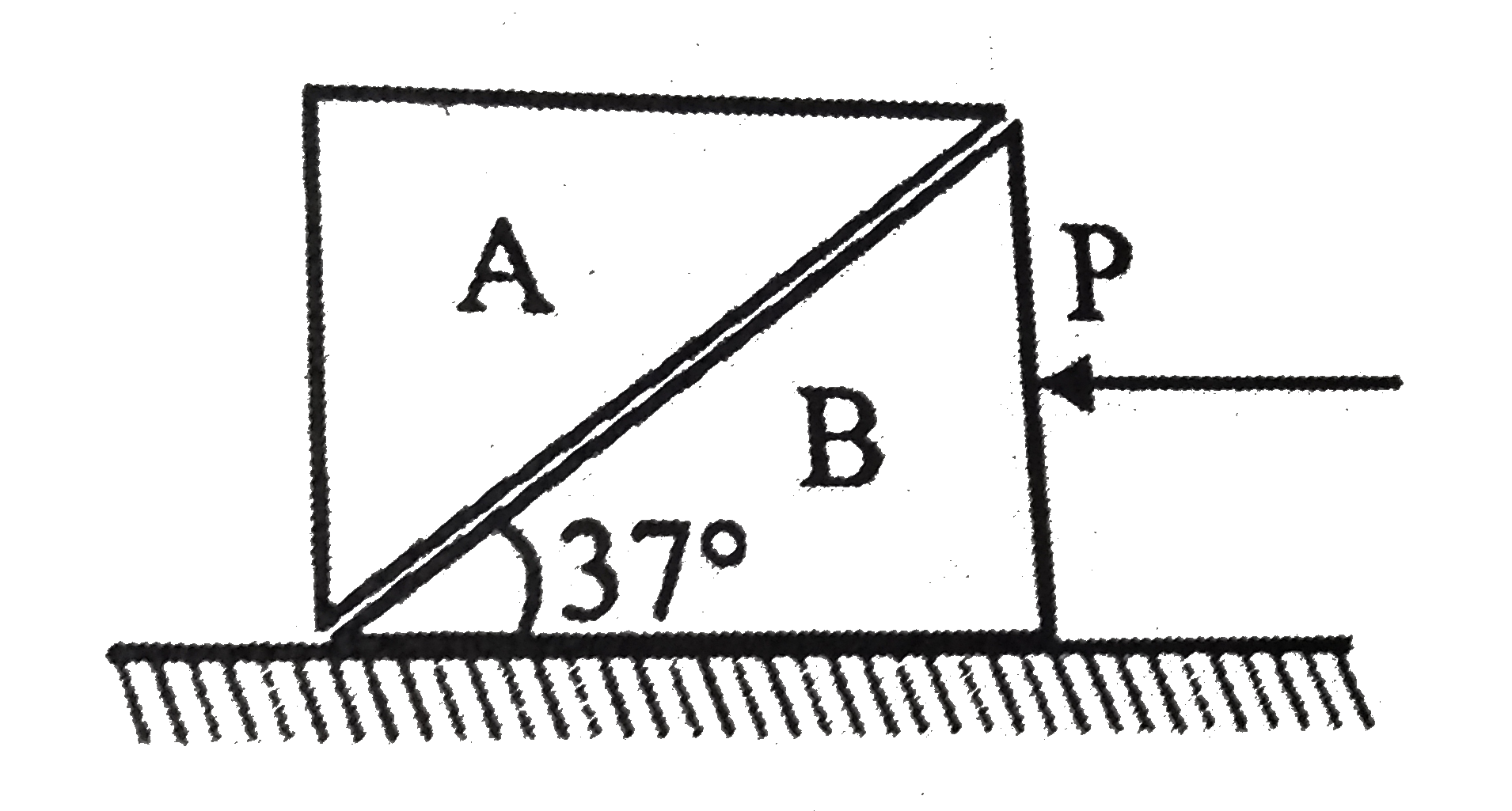
Blocks A and B each have same mass m=1 k...

Blocks A and B each have same mass m=1 kg determine the largest horizontal force P(in newton) which can be appied to B so that A wil not slip up on B . Neglect any friction.

Text Solution

Verified by Experts

The correct Answer is:

`15.00`
Promotional Banner

Topper's Solved these Questions

Similar Questions

Explore conceptually related problems

Two block (A) 2kg and (B) 5kg rest one over the other on a smooth horizontal plane. The cofficient of static and dynamic friction between (A) and (B) is the sae and equal to 0.60. The maximum horizontal force that can be applied to (B) in order that both (A) and (B) do not have any relative motion:

A block of mass 4 kg is placed on another block of mass 5 kg and the block B rests on a smooth horizontal table. If the maximum force that can be applied on A so that both the blocks move together is 12N, find the maximum force that can be applied on B for the blocks to move together.

A 4.0 kg block is put on top of a 5.0kg block. In order to cause the top block to slip on the bottom one, a horizontal force of 12N must be applied to the top block. Assuming a friction less table the maximum horizontal force F which can be applied to the lower block so that the blocks, will move together should be

Two small balls having the same mass and charge and located on the same vertical at heights h_(1) and h_(2) are thrown in the same direction along the horizontal at the same velocity v. The first ball touches the ground at a horizontal distance R from the initial vertical position. At what height h_(2) will the second ball be at this instant? Neglect any frictional resistance of air and the effect of any induced charge on the ground.

A small ball if mass 2 xx 10^(-3) Kg having a charges of 1 mu C is suspended by a string of length 0. 8 m Another identical ball having the same charge is kept at the point of suspension . Determine the minimum horizontal velocity which should be imparted to the lower ball so that it can make complete revolution .

A block A of mass 2 kg rests on another block B of mass 8 kg which rests on a horizontal floor. The coefficient of friction between A and B is 0.2 while that between B and floor is 0.5. when a horizontal force of 25 N is applied on the block B. the force of friction between A and B is

A block of mass m lying on a rough horizontal plane is acted upon by a horizontal force P and another force Q inclined at an angle theta to the vertical. The minimum value of coefficient of friction of friction between the block and the surface for which the block will remain in equilibrium is

Two bodies of masses 10 kg and 20 kg respectively kept on a smooth, horizontal surface are tied to the ends of a light string. A horizontal force F = 600 N is applied to (i) A, (ii) B along the direction of string. What is the tension in the string in each case?

Two blocks each of mass m, connected by an un-stretched spring are kept at rest on a frictionless horizontal surface. A constant force F is applied on one of the blocks pulling it away from the other as shown in figure. (a)Find accelaration of the mass center. (b) Find the displacement of the centre of mass as function of time t. (c) If the extension of the spring is X_(0) at an instant t, find the displacements of the two blocks relative to the ground at this instant.
