Home
Class 12
MATHS
The velocity time graph shown, match the...

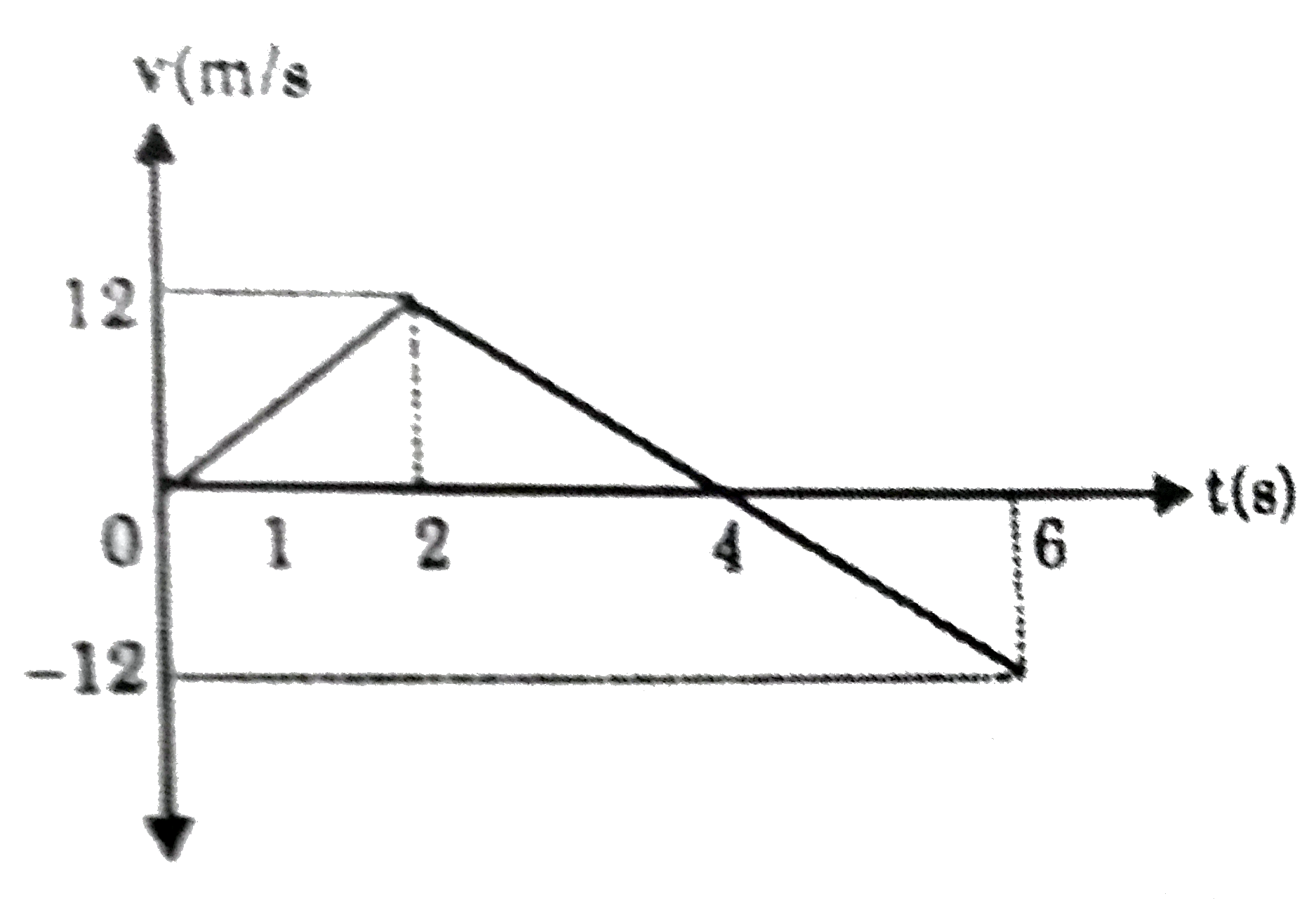
The velocity time graph shown, match the articles in List-I with articles in List-II for an interval t = 0 to t = 6 second.

`|{:(,"List-I",,"List-II"),((P),"Change in velocity in m/s",(1),-6),((Q),"Average velocity in m/s",(2),-12),((R ),"Total displacement in m.",(3),2),((S),"Acceleration at t = 3 s in "m//s^(2),(4),12):}|`

A

12 gm of `O_(3)`

B

1 gm molecule `O_(3)`

C

4gm atom of hydrogen

D

`6.02xx10^(24) "molecuel" CO_(2)`

Text Solution

Verified by Experts

The correct Answer is:

B, D
Promotional Banner

Topper's Solved these Questions

Similar Questions

Explore conceptually related problems

For the velocity -time graph shown in figure, in a time interval from t=0 to t=6 s , match the following: {:(,"Column I",,,"Column II"),((A),"Change in velocity",,(p),-5//3 SI "unit"),((B),"Average acceleration",,(q),-20 SI "unit"),((C),"Total displacement",,(r),-10 SI "unit"),((D),"Acceleration ay t=3s",,(s),-5 SI "unit"):}

The velocity of a particle is given by v=(2t^(2)-4t+3)m//s where t is time in seconds. Find its acceleration at t=2 second.

The velocity of a particle is given by v=(5t^(2)-6t+5)m//s where t is time in seconds. Find its acceleration at t=4 second.

The velocity of a particle is given by v=(5t^(2)-2t+9)m//s where t is time in seconds. Find its acceleration at t=4 second.

The velocity of a particle is given by v=(4t^(2)-4t+5)m//s where t is time in seconds. Find its acceleration at t=4 second.

If velocity (in ms^(-1) ) varies with time as V = 5t, find the distance travelled by the particle in time interval of t = 2s to t = 4 s.

If velocity of a particle is given by v=(2t+3)m//s . Then average velocity in interval 0letle1 s is :

A particle is rotating in a circle of radius 1m with constant speed 4 m//s . In time 1s, match the following (in SI units) {:(,"Column I",,,"Column II"),((A),"Displacement",,(p),8 sin 2),((B),"Distance",,(q),4),((C),"Average velocity",,(r),2sin 2),((D),"Average acceleration",,(s),4 sin 2):}

The velocity of a projectile at the initial point A is (2hati+3hatj) m//s . Its velocity (in m/s) at point B is

Match List I with List II and select the correct answer using the codes given below the lists: {:(,"List I",,,"List II"),(P.,"Boltzmann constant",,1.,[ML^(2)T^(-1)]),(Q.,"Coefficient of viscosity",,2.,[ML^(-1)T^(-1)]),(R.,"Planck constant",,3.,[MLT^(-3)K^(-1)]),(S.,"Thermal conductivity",,4.,[ML^(2)T^(-2)K^(-1)]):}

ALLEN -TEST PAPER-Chemistry
  1. If x(1),x(2) are two solutions of x^(lnx^(2) )=e^(18) then product o...

    Text Solution

    |

  2. Match the following List I to List II

    Text Solution

    |

  3. The velocity time graph shown, match the articles in List-I with artic...

    Text Solution

    |

  4. Which of the following set consists of only isoelectronic species :

    Text Solution

    |

  5. Which of the following set of quantum number is/are CORRECT for last e...

    Text Solution

    |

  6. Which of the following options is/are INCORRECT according to the given...

    Text Solution

    |

  7. Choose the CORRECT statement(s) ?

    Text Solution

    |

  8. Which of the following order is CORRECT against to indicated propertie...

    Text Solution

    |

  9. The formal charges possible on three N-atoms in N(3)^(-) ion is/are (i...

    Text Solution

    |

  10. Which of the following oxide is/are amphoteric in nature ?

    Text Solution

    |

  11. Which of the following is/are exception of Lewis octet rule ?

    Text Solution

    |

  12. Nodal plane of an orbital is the region arround the nucleus where prob...

    Text Solution

    |

  13. Nodal plane of an orbital is the region arround the nucleus where prob...

    Text Solution

    |

  14. The size of any species depends on various factors such as nature of c...

    Text Solution

    |

  15. The size of any species depends on various factors such as nature of c...

    Text Solution

    |

  16. Electron affinity and electronegativity are very closely related, yet ...

    Text Solution

    |

  17. Electron affinity and electronegativity are very closely related, yet ...

    Text Solution

    |

  18. Different types of bonds are formed in the chemical compounds. These b...

    Text Solution

    |

  19. Different types of bonds are formed in the chemical compounds. These b...

    Text Solution

    |

  20. |{:(,"List-I(Species)",,"List-II(Spin only Magnetic Moment)"),((P),Mn^...

    Text Solution

    |
