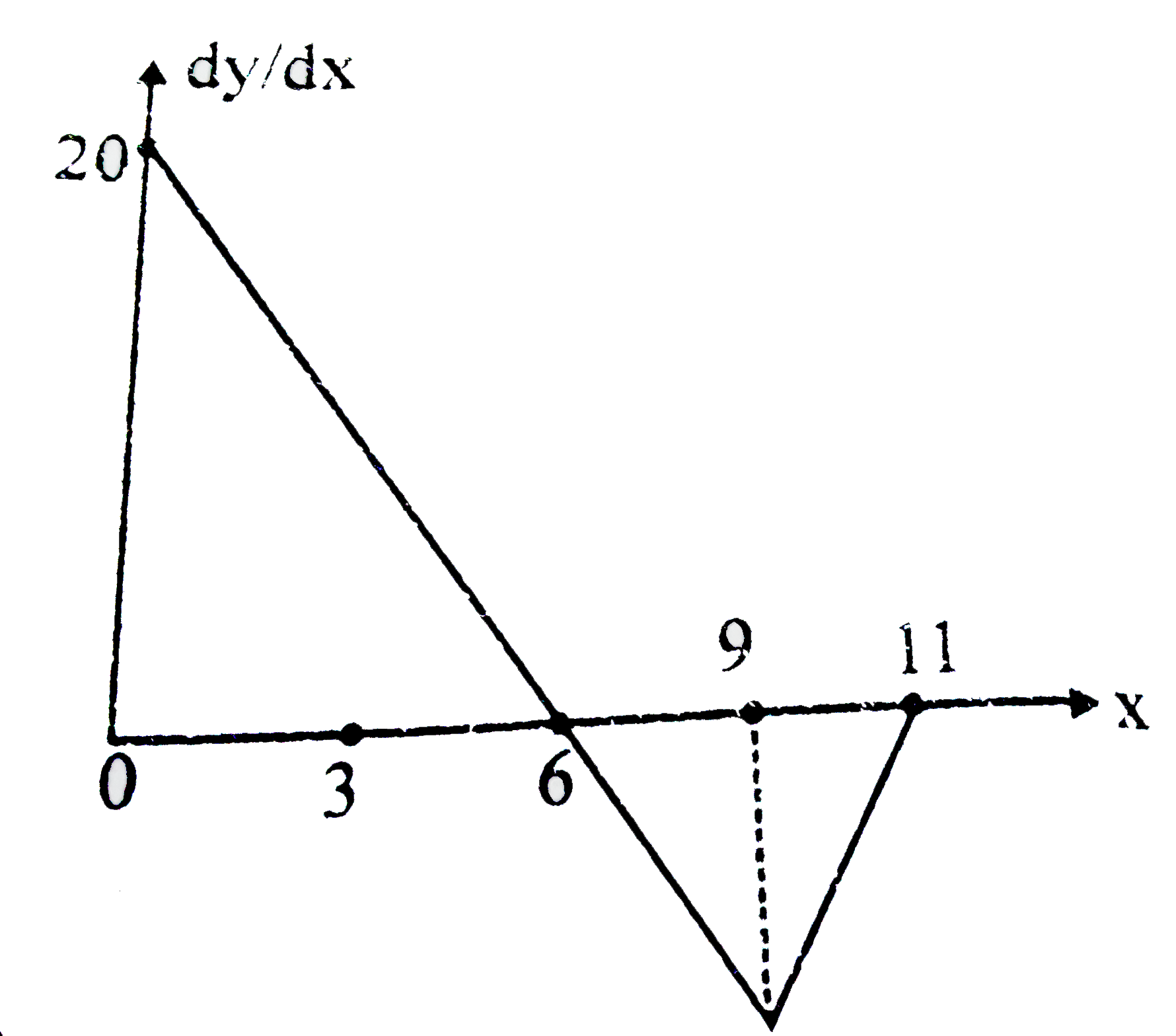
The following curve represent rate of change of a variable y w.r.t. x. The charge in the value of y when x changes from 0 to 11 is :
Text Solution
Verified by Experts
By using distance formula `d=sqrt((x_(2)-x_(1))^(2)+(y_(2)-y_(1))^(2))rArr 13=sqrt([13-(-9)]^(2)+[3-a]^(2))` `rArr 13^(2)=12^(2)+(3-a)^(2) rArr (3-a)^(2)=13^(2)-12^(2)=5^(2) rArr (3-a)=+-5 rArr a=-2` cm or `8cm`
Topper's Solved these Questions
BASIC MATHS
ALLEN |Exercise Exercise-02|53 Videos
BASIC MATHS
ALLEN |Exercise Exersice-03|7 Videos
AIIMS 2019
ALLEN |Exercise PHYSICS|39 Videos
CIRCULAR MOTION
ALLEN |Exercise EXERCISE (J-A)|6 Videos
Similar Questions
Explore conceptually related problems
The following curve represents a function y=f(x) . Find average value of y when x changes from 0 to 6
The rate of change of surface area of a sphere w.r.t. radius is ………..
Draw the graph of the equation 2x + 3y = 11. Find the value of y when x = 1 from the graph.
Which one of the following curves represents the solution of the initial value problem Dy= 100-y , where y (0) = 50
Area bounded by curve y=sinx , whit x-axis, when x varies from 0 to (pi)/(2) is :-
What is the rate of change of the volume of sphere w.r.t. its surface area when its radius is 2 units ?
The rate of change of volume of a cylinder w.r.t. radius whose radius is equal to its height is ……….
Let S be a square with sides of length x. If we approximate the change in size of the area of S by h (dA)/(dx)|_(x=x_0) , when the sides are changed from x_0 to x_0 + h , then the absolute value of the error in our approximation, is