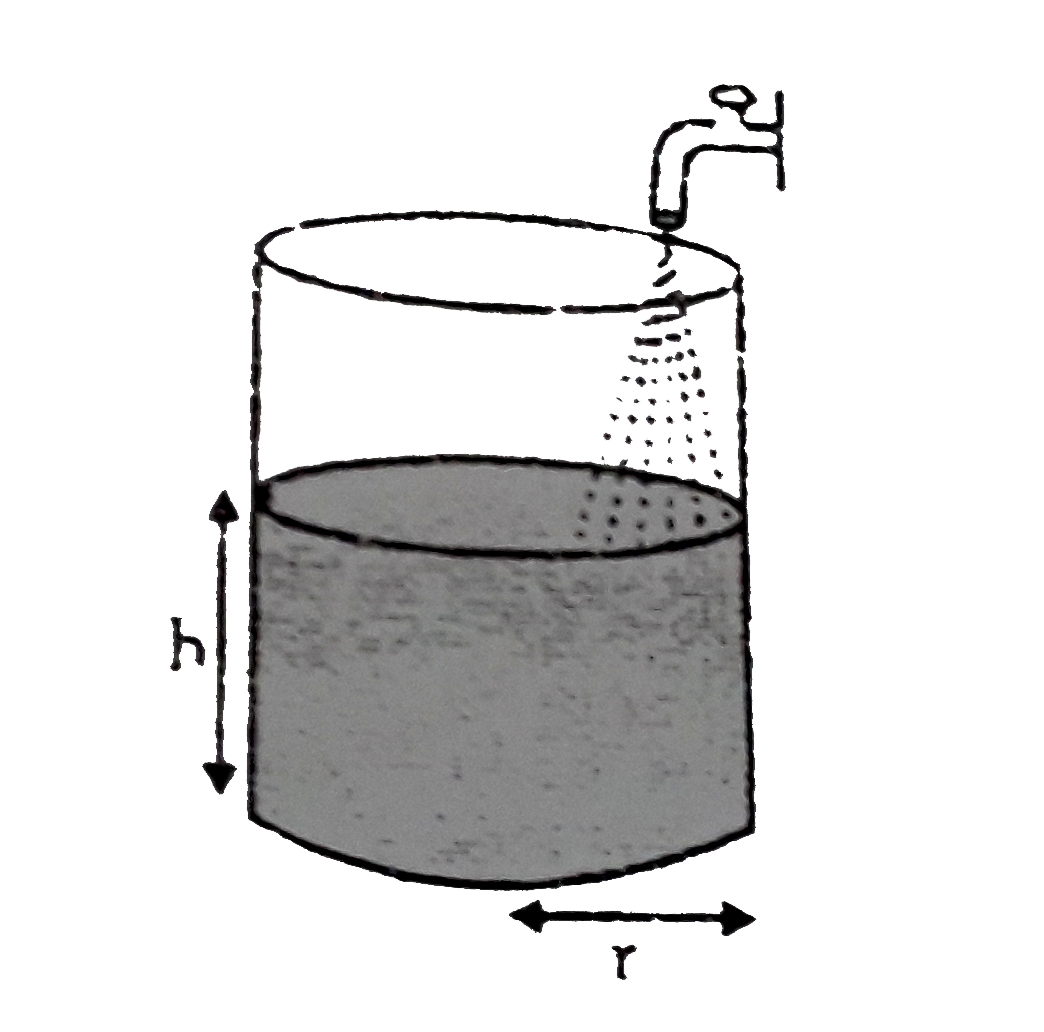
`:.` Volume: `V=pir^(2)h :. (dV)/(dt)=pir^(2)(dh)/(dt)` But `(dV)/(dt)=Q` so `(dh)/(dt)=Q/(pir^(2))`
Topper's Solved these Questions
BASIC MATHS
ALLEN |Exercise Exercise-02|53 Videos
BASIC MATHS
ALLEN |Exercise Exersice-03|7 Videos
AIIMS 2019
ALLEN |Exercise PHYSICS|39 Videos
CIRCULAR MOTION
ALLEN |Exercise EXERCISE (J-A)|6 Videos
Similar Questions
Explore conceptually related problems
Find sum of first 50 natural numbers.
The sum of first n even natural numbers is k times the sum of first n odd natural numbers then k= …….
Let S_(n) denote the sum of the cubes of the first n natural numbers and S'_(n) denote the sum of the first n natural numbers, then underset(r=1)overset(n)Sigma ((S_(r))/(S'_(r))) equals to
State whether each of the following statements is true or false : The sum of first n natural numbers is given by (n(n+1))/2
If S_1, S_2, S_3 are the sum of first n natural numbers, their squares and their cubes, respectively , show that 9 S_(2)^(2) = S_(3) (1+ 8S_1)
Find the standard deviation of the first n natural numbers.
Find the coefficient of varience of first n natural numbers.
Statement 1 The sum of first n terms of the series 1^(2)-2^(2)+3^(2)-4^(2)_5^(2)-"……" can be =+-(n(n+1))/(2) . Statement 2 Sum of first n narural numbers is (n(n+1))/(2)
If the mean of first n natural numbers is (5n)/(9) , then find n