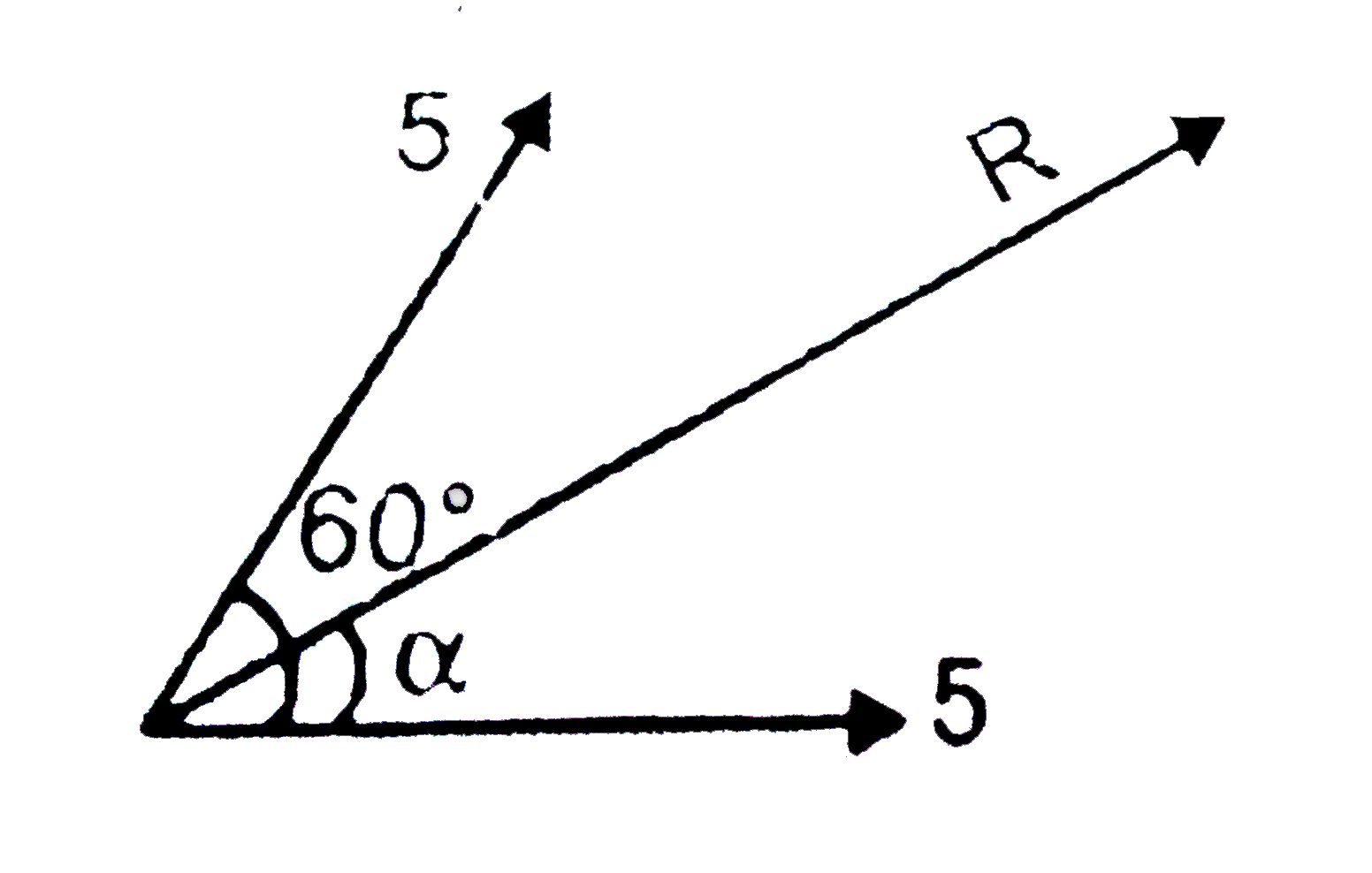
Two vectors having equal magnitude of 5 units, have an angle of `60^(@)` between them. Find the magnitude of their resultant vector and its angle from one of the vectors.
Text Solution
Verified by Experts
The correct Answer is:
A
`I_(av)=(underset(0)overset(pi//omega)intIdt)/(pi/omega-0)=omega/piunderset(0)overset(pi//omega)intI_(0) sin omegatdt=omega/pi[(I_(0)(-cos omegat))/omega]_(0)^(pi//omega)=-omega/piI_(0)/omega[cos pi-cos 0]=-I_(0)/pi[-1-1]=(2I_(0))/pi`
Topper's Solved these Questions
BASIC MATHS
ALLEN |Exercise Exercise-02|53 Videos
BASIC MATHS
ALLEN |Exercise Exersice-03|7 Videos
AIIMS 2019
ALLEN |Exercise PHYSICS|39 Videos
CIRCULAR MOTION
ALLEN |Exercise EXERCISE (J-A)|6 Videos
Similar Questions
Explore conceptually related problems
Two vectors of equal magnitude 5 unit have an angle 60^0 between them. Find the magnitude of (a) the sum of the vectors and (b) the difference of the vectors. . .
Two vectors, both equal in magnitude, have their resultant equal in magnitude of the either. Find the angle between the two vectors.
If magnitude of sum of two unit vectors is sqrt2 then find the magnitude of subtraction of these unit vectors.
The magnitude of the vector product of two vectors vecA and vecB may not be:
If the sum of two unit vectors is a unit vector,then find the magnitude of their differences.
A vector vec(A) of length 10 units makes an angle of 60^(@) with a vector vec(B) of length 6 units. Find the magnitude of the vector difference vec(A)-vec(B) & the angles with vector vec(A) .
Two equal forces are acting at a point with an angle of 60^(@) between them. If the resultant force is equal to 60sqrt(3)N , The magnitude of each force is :-
Two equal forces are acting at a point with an angle of 60^(@) between them. If the resultant force is equal to 40sqrt(3)N , The magnitude of each force is :-
Two equal forces are acting at a point with an angle of 60^(@) between them. If the resultant force is equal to 20sqrt(3)N , The magnitude of each force is :-
Define the scalar product and obtain the magnitude of a vector from it .