Find out the angle made by `vecA=hati+hatj+hatk` vector from X,Y and Z axes respectively.
Text Solution
Verified by Experts
The correct Answer is:
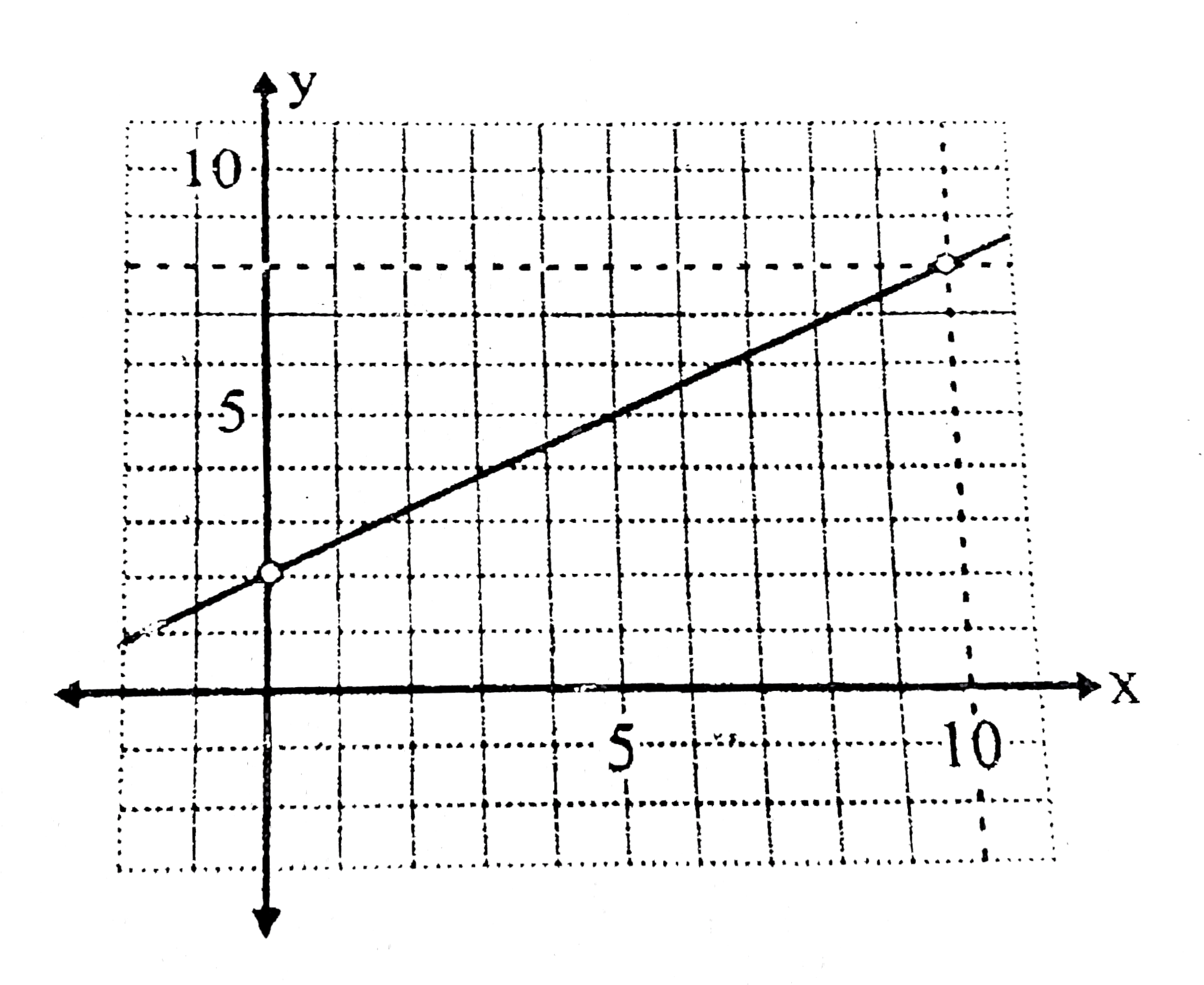
intercept is `c=2`. Now the required equation is `y=3/5x+2`
Linear variation is represented by a linear equation of the form `y=mx+c`. To repersent the function on graph we have to join two points whose coordinates are `(x_(1), y_(1))` and `(x_(2), y_(2))` i.e. `(0, 2)` and `(10, 8)`. Slope of the line is `m=(y_(2)-y_(1))/(x_(2)-x_(1))=(8-2)/(10-0)=3/5`
Topper's Solved these Questions
BASIC MATHS
ALLEN |Exercise Exercise-02|53 Videos
BASIC MATHS
ALLEN |Exercise Exersice-03|7 Videos
AIIMS 2019
ALLEN |Exercise PHYSICS|39 Videos
CIRCULAR MOTION
ALLEN |Exercise EXERCISE (J-A)|6 Videos
Similar Questions
Explore conceptually related problems
Find out the angle made by (hati+hatj) vector from X and Y axes respectively.
Find the angle made by (hati+hatj) vetor from X and Y axes respectively.
Find the angle of vector veca=6hati+2hatj-3hatk with x -axis.
The angle made by the vector vecA=hati+hatj with x-axis is
The angle made by the vector vecA=2hati+3hatj with Y-axis is
The angle made by the vector vecA=2hati+2hatj with x-axis is
Find the angle between the vector 2hati-3hatj+hatk and hati+hatj-2hatk .
If hati,hatj and hatk are unit vectors along X,Y & Z axis respectively, then tick the wrong statement:
Find the value of x for which x(hati+hatj+hatk) is a unit vector.
If hati+hatj+hatk,2hati+5hatj,3hati+2hatj-3hatk and hati-6hatj-hatk are the position vectors of points A, B, C and D respectively, then find the angle between vec(AB) and vec(CD) . Deduce that vec(AB) and vec(CD) are collinear.