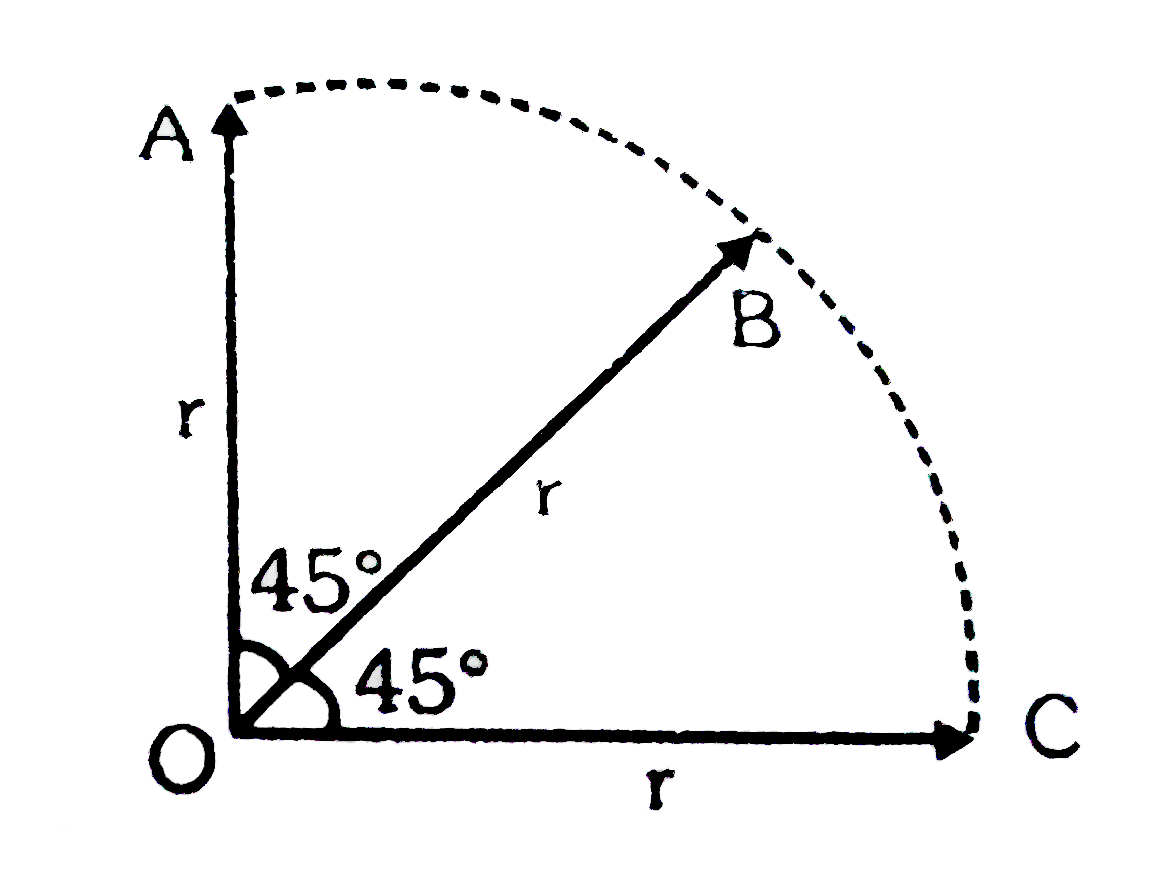
The resultant of the three vectors bar(OA),bar(OB) and bar(OC) shown in figure :- ltimg src="https://d10lpgp6xz60nq.cloudfront.net/physics_images/ALN_PHY_R01_E02_023_Q01.png" width="80%"gt
The resultant of two vectors vecP andvecQ is vecR . If the magnitude of vecQ is doudled, the new resultant becomes perpendicuar to vecP . Then the magnitude of vecR is :
Write the vector representation of the vectors A and B with respect to the frame of reference shown in the figure.
Find the magnitude of two vectors vecaandvecb , having the same magnitude and such that the angle between them is 60^(@) and their scalar product is (1)/(2) .
Assertion: A vector quantity is a quantity that has both magnitude and a direction and obeys the triangle law of addition or equivalent the parallelogram law of addition. Reason: The magnitude of the resultant vector of two given vectors can never be less than the magnitude of any of the given vector.
The ratio of maximum and minimum magnitude of the resultant of two vectors vecA and vecB is 3:2. The relation between A and B is
Find the centre of mass of uniform thin sheet as shown in figure.
Find the electric field at centre of semicircular ring shown in figure . .
Three points charges are placed at the corners of an equilateral triangle of side L as shown in the figure: find the resultant dipole moment
Two vectors vec(P) " and "vec(Q) are added, the magnitude of resultant is 15 units. If vec(Q) is reversed and added to vec(P) resultant has a magnitude sqrt(113) units. The resultant of vec(P) and a vector perpendicular vec(P) and equal in magnitude to vec(Q) has a magnitude