Home
Class 12
PHYSICS
Given s=t^(2)+5t+3, find (ds)/(dt)...

Given `s=t^(2)+5t+3`, find `(ds)/(dt)`

Text Solution

Verified by Experts

The correct Answer is:
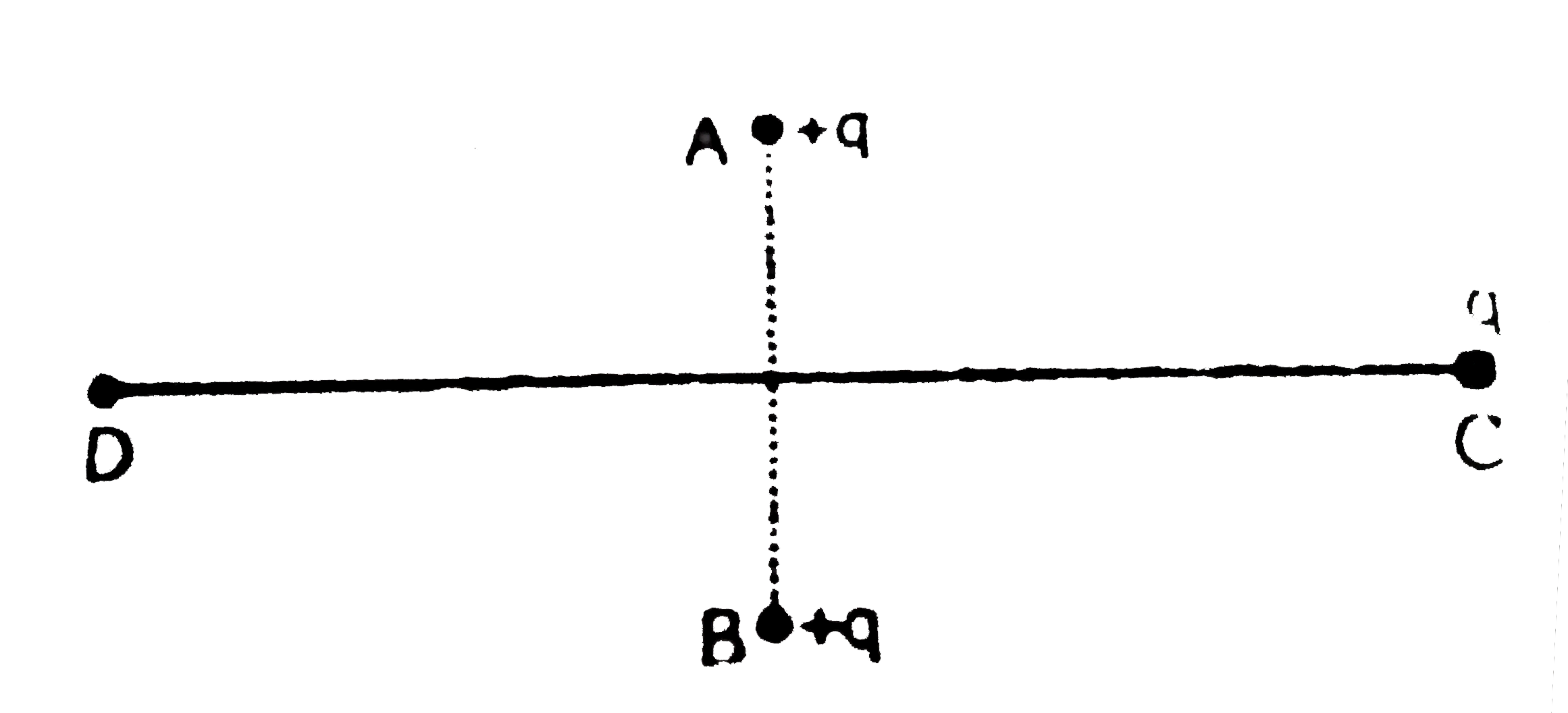
`8.48 m` from O


COME: `K_(C)+U_(C)=K_(D)+U_(D)`
`4+2[(Kqxx(-q))/5]=0+((Kqxx-2)/r)`
`4-(2xx9xx10^(9)xx25xx10^(-10))/5`
`=(-2xx9xx10^(9)xx25xx10^(-10))/(r), r=9 m`
`OD=sqrt(AC^(2)-OA^(2))=sqrt(9^(2)-3^(2))=8.48m`
Promotional Banner

Topper's Solved these Questions

Similar Questions

Explore conceptually related problems

Find the first derivatives (i) If y=x^(-1//3)," find "(dy)/(dx) (ii) If x=t^(6)," find "(dx)/(dt) (iii) If z=u^(3)," find "(dz)/(du) (iv) If f=r^(2)+r^(1//3)," find "(df)/(dr) (v) If x=2t^(3)-3t^(2)+5t-6," find "(dx)/(dt) (vi) If y=3x^(2) (vii) If y=xlnx (viii) If y=xsinx (ix) If y=sinx cosx (x) If y=sin^(2)x+cos^(2)x (xi) If y=cos2x (xii) If v=(4)/(3)pir^(3)," find "(dv)/(dr) (xiii) If s=4pir^(2)," find "(ds)/(dr)

If 2t= v^(2) then (dv)/(dt) = …….

If x= 3 sin t- sin (3t), y= 3 cos t- cos 3t , then find ((dy)/(dx)) " at " t= (pi)/(3)

Velocity of a particle is given by v = (3t ^(2) +2t) m/s. Find its average velocity between t = 0 to t=3s and also find its acceleration at t = 3s. Motion of the particle is in one dimension.

If x=f(t)cost-f^(prime)(t)sint and y=f(t)sint+f^(prime)(t)cost , then ((dx)/(dt))^2+((dy)/(dt))^2= f(t)-f"(t) (b) {f(t)-f"(t)}^2 (c) {f(t)+f"(t)}^2 (d) none of these

The displacement of a point moving along a straight line is given by s= 4t^(2) + 5t-6 Here s is in cm and t is in seconds calculate (i) Initial speed of particle (ii) Speed at t = 4s

Find Order and Degree of given differential equation ((ds)/(dt))^(4) + 3s(d^(2)s)/(dt^(2)) = 0

The position of a particle moving along a straight line is given by x =2 - 5t + t ^(3). Find the acceleration of the particle at t =2 s. (x is metere).

If velocity (in ms^(-1) ) varies with time as V = 5t, find the distance travelled by the particle in time interval of t = 2s to t = 4 s.

A particle moves along a staight line such that its displacement at any time t is given by s=t^3-6t^2+3t+4m . Find the velocity when the acceleration is 0.

ALLEN -BASIC MATHS-Exersice-04[A]
  1. The period of oscillation of a simple pendulum in the experiment is re...

    Text Solution

    |

  2. Find the dimensional formula of kinetic energy.

    Text Solution

    |

  3. The length, breadth and thickness of a strip are given by l = (10.0 +-...

    Text Solution

    |

  4. If error in measuring diameter of a circle is 4 %, the error in circum...

    Text Solution

    |

  5. The external and internal diameters of a hollow cylinder are measured ...

    Text Solution

    |

  6. Percentage error in measuring the radius and mass of a solid sphere a...

    Text Solution

    |

  7. In a vernier calliper, N divisions of vernier scale coincide with (N-1...

    Text Solution

    |

  8. The length of a cylinder is measured with a meter rod having least cou...

    Text Solution

    |

  9. what is the value of boltzmann constant?

    Text Solution

    |

  10. The heat generated in a cirucit is dependent upon the resstance, curre...

    Text Solution

    |

  11. Percentage erros in the measurement of mass and speed are 2% and 3% re...

    Text Solution

    |

  12. One centimetre on the main scale of vernier callipers is divided into ...

    Text Solution

    |

  13. While measuring the acceleration due to gravity by a simple pendulum ,...

    Text Solution

    |

  14. A student measured the diameter of a wire using a screw gauge with lea...

    Text Solution

    |

  15. Find (dy)/(dx) for the following : (i) y=x^(7//2) (ii) y=x^(-3) ...

    Text Solution

    |

  16. Given s=t^(2)+5t+3, find (ds)/(dt)

    Text Solution

    |

  17. If s= ut +(1)/(2) at^(2), where u and a are constants. Obtain the valu...

    Text Solution

    |

  18. The area of blot of link is growing such that after t seconds, its are...

    Text Solution

    |

  19. The area of a circle is given by A=pir^(2), where r is the radius . Ca...

    Text Solution

    |

  20. Obtain the differential of the following : (i) (x-1) (2x+5) (ii) (9...

    Text Solution

    |

