Home
Class 12
PHYSICS
A particle is moving in a circle of radi...

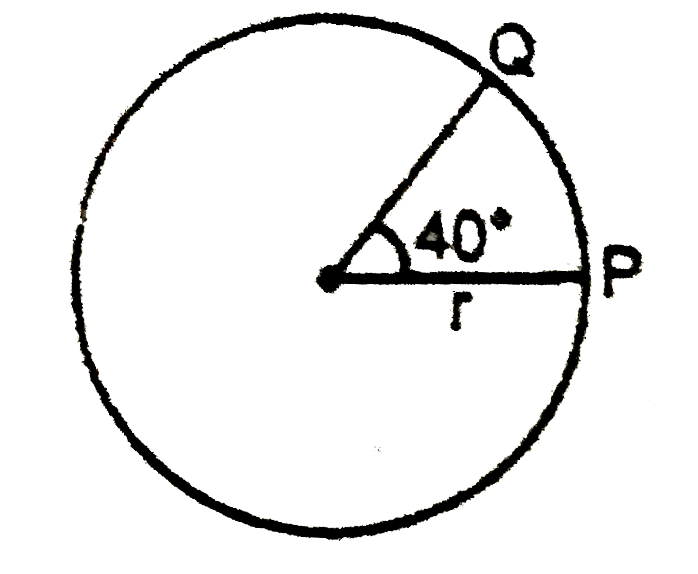
A particle is moving in a circle of radius `r` with speed `v` as shown in the figure. The magnitude of change in velocity in moving from `P` to `Q` is

Text Solution

Verified by Experts

The correct Answer is:
C

Promotional Banner

Topper's Solved these Questions

  • MOTION IN A PALNE

    ALLEN |Exercise Comprehension#6|4 Videos
  • MOTION IN A PALNE

    ALLEN |Exercise Comprehension#7|3 Videos
  • MOTION IN A PALNE

    ALLEN |Exercise Comprehension#4|3 Videos
  • KINEMATICS-2D

    ALLEN |Exercise Exercise (O-2)|47 Videos
  • NEWTON'S LAWS OF MOTION & FRICTION

    ALLEN |Exercise EXERCISE (JA)|4 Videos

Similar Questions

Explore conceptually related problems

A particle is moving on a circle of radius r. The displacement at the end of half revolution would be …

A particle P is moving in a circle of radius 'a' with a uniform speed v. C is the centre of the circle and AB is a diameter. When passing through B the angular velocity of P about A and C are in the ratio

A particle goes from point A to point B, moving in a semicircle of radius 1 m in 1 second. Find the magnitude of its average velocity.

A particle of mass 2 kg moves on a circular path with constant speed 10 m // s . Find change in speed and magnitude of change in velocity. Whan particle completes half revolution.

In 1.0 s , a particle goes from point A to point B , moving in a semicircle of radius 1.0 m (see figure ). The magnitude of the average velocity

A particle moves with constant speed v along a regular hexagon ABCDEF in the same order. Then the magnitude of the avergae velocity for its motion form A to

A particle is moving with constant speed v along the line y = a in positive x -direction. Find magnitude of its angular velocity about orgine when its position makes an angle theta with x-axis.

a particle is moving in a circle of radius R in such a way that at any instant the normal and the tangential component of its acceleration are equal. If its speed at t=0 is v_(0) then time it takes to complete the first revolution is R/(alphav_(0))(1-e^(-betapi)) . Find the value of (alpha+beta) .

The linear speed of the tip of second arm of a clock is v. The magnitude of change in its velocity in 30 second is ......

