Home
Class 12
PHYSICS
Two inclined planes OA and OB having inc...

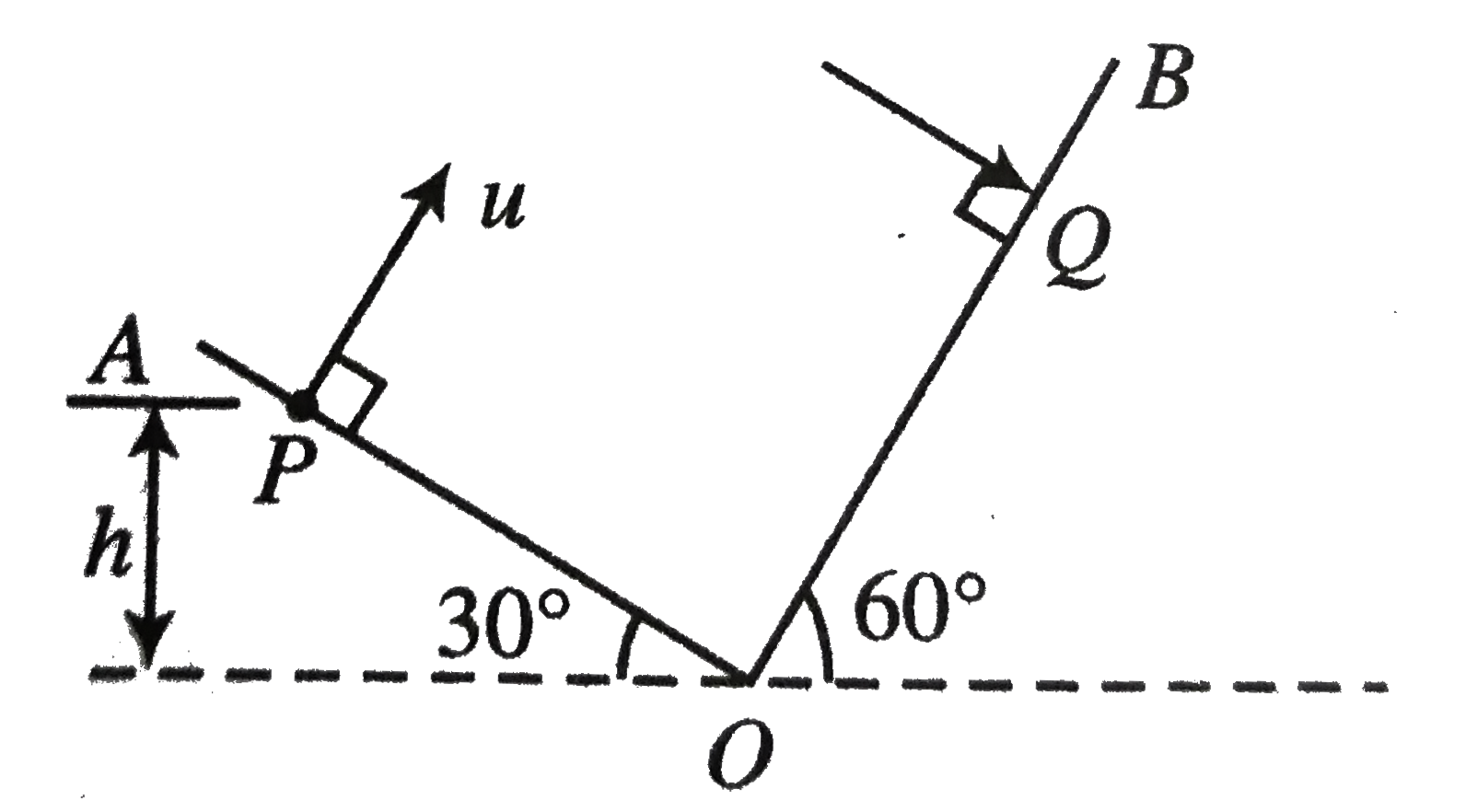
Two inclined planes OA and OB having inclination (with horizontal) `30^(@)` and `60^@()`, respectively, intersect each other at O as shown in figure. A particle is projected from point P with velocity `u = 10sqrt3 ms^(-1)` along a direction perpendicular to plane OA. If the particle strikes plane OB perpendicularly at Q, calculate

The maximum height attained by the particle (from the line O)

Text Solution

Verified by Experts

The correct Answer is:

(i) 2s (ii) 10 m/s (iii) 5m (iv) 16.25 m (v) 20 m
Promotional Banner

Topper's Solved these Questions

  • KINEMATICS-2D

    ALLEN |Exercise Exercise (O-1)|40 Videos
  • KINEMATICS-2D

    ALLEN |Exercise Exercise (O-2)|47 Videos
  • KINEMATICS-2D

    ALLEN |Exercise Exercise (S-1)|30 Videos
  • GRAVITATION

    ALLEN |Exercise EXERCISE 4|9 Videos
  • MOTION IN A PALNE

    ALLEN |Exercise SOLVED EXAMPLE|28 Videos

Similar Questions

Explore conceptually related problems

A stone is projected from point P on the inclined plane with velocity v_(0) = 10 m//sec directed perpendicular to the plane. The time taken (in second) by the stone to strike the horizontal ground S is (Given PO = l = 10 meter)(Take g = 10m//s^(2) )

Two particles are thrown simultaneously from points A and B with velocities u_1 = 2ms^(-1) and u_2 - 14 ms^(-1) , respectively, as shown in figure. Minimum separation between A and B is

A small ball of mass m and charge q is attached to the bottom end of a piece of negligible mass thread of length l, whose top end is fixed. The system formed by the thread and ball is in vertical plane and is in uniform horizontal magnetic field B, which is perpendicular to the plane of figure and points into the paper The ball is started with a velocity v_(0) from lower most point of circle in a direction perpendicular both to the magnetic induction and to direction of thread. The ball moves along a circular path such that thread remains tight during the whole motion. Neglect any loss of enery. What is the magnitude of magnetic induction B, if the minimum initial speed at which the described motion of ball (complete vertical circular motion) occurs is V_(0)=(1)/(2)sqrt(17gL)

A particle is projected horizontally with speed u from the top of a plane inclined at an angle theta with the horizontal. How far from the point of projection will the particle strike the plane?

A particle P is projected from a point on the surface of smooth inclined plane (see figure). Simultaneously another particle Q is released on the smooth inclined plane from the same position. P and Q collide after t=4 . The speed of projection of P is

A particle is projected from a point O with an initial speed of 30 ms^(-1) to pass through a point which is 40 m from O horizontally and 10 m above O. There are two angles of projection for which this is possible. These angles are alpha and beta . The value of |tan (alpha+beta)| is

Two particles, each of mass m, are connected by a light inextensible string of lenthe 2l . Initially they lie on a smooth horizontal table at points A and B distant l apart. The particle at A is projected across the table with velocity u. Find the speed with which the second particle begins to move if the direction of u is :- (i) along BA. (ii) at an angle of 120^(@) with AB (iii) perpendicular to AB. In each case calculate (in teerms of m and u) the impulsive tension in the string.

Airplanes A and B are flying with constant velocity in the same vertical plane at angles 30^(@) and 60^(@) with respect to the horizontal respectively as shown in figure . The speed of A is 100sqrt(3) m//s . At time t = 0 s , an observer in A finds B at a distance of 500 m . The observer sees B moving with a constant velocity perpendicular to the line of motion of A . If at t = t_(0) , A just escapes being hit by B ,t_(0) , A just escapes being hit by B , t_(0) in seconds is

A wedge of mass M = 2m rests on a smooth horizontal plane. A small block of mass m rests over it at left end A as shown in figure. A sharp impulse is applied on the block, due to which it starts moving to the right with velocity v_(0) = 6 ms^(-1) . At highest point of its trajectory, the block collides with a particle of same mass m moving vertically downwards with velocity v = 2 ms^(-1) and gets stuck with it. If the combined body lands at the end point A of body of mass M, calculate length l . Neglect friction (g = 10 ms^(-2)) .

A particle is projected from a point P (2,0,0)m with a velocity 10(m)/(s) making an angle 45^@ with the horizontal. The plane of projectile motion passes through a horizontal line PQ which makes an angle of 37^@ with positive x-axis, xy plane is horizontal. The coordinates of the point where the particle will strike the line PQ is
