Home
Class 11
PHYSICS
s-t graph of two particles A and B are s...

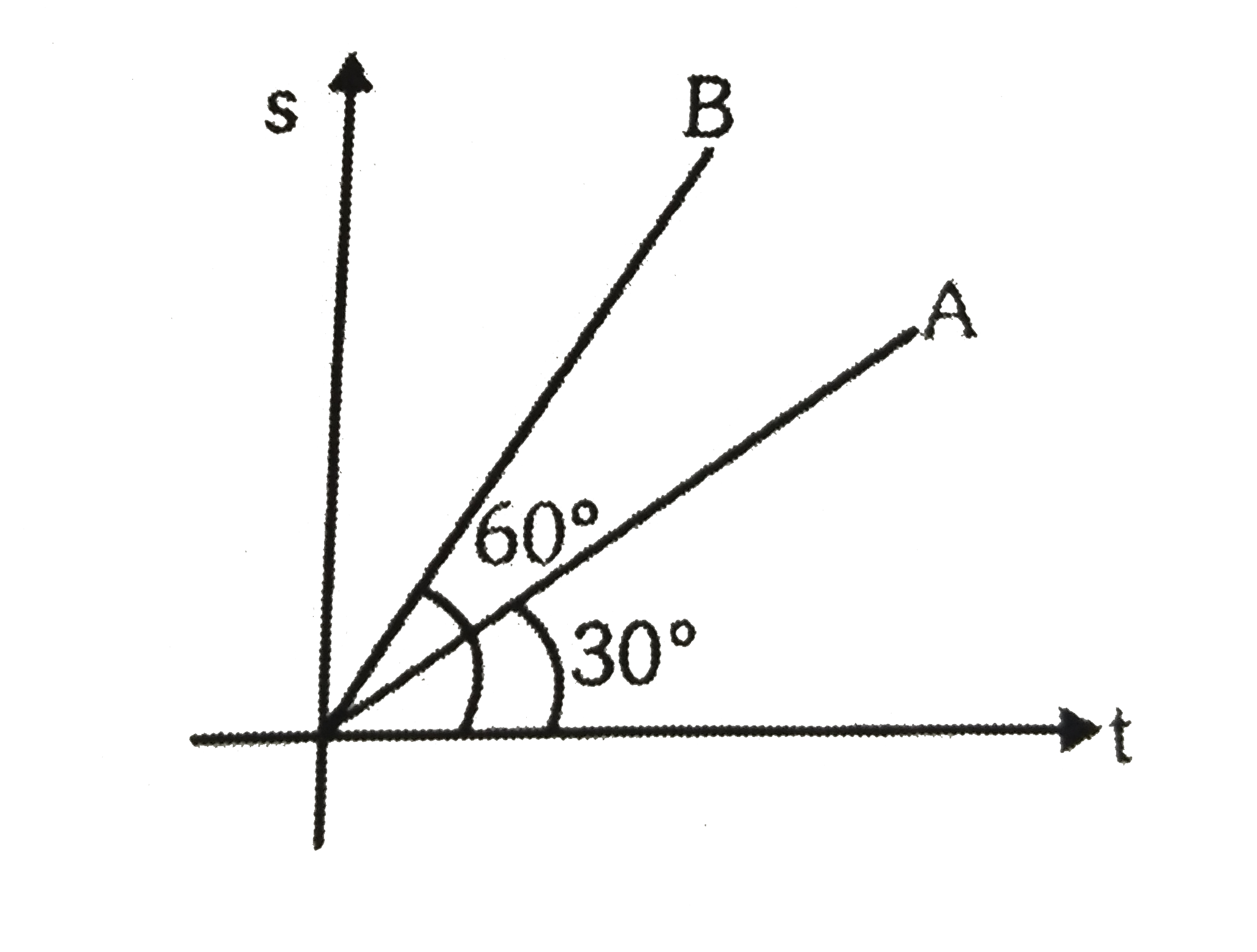
s-t graph of two particles A and B are shown in fig. Find the ratio of velocity of A to velocity of B.

Text Solution

Verified by Experts

Velocity = Slope of s - t curve
So ` (v_A)/(v_B) = ("Slope of A")/("Slope of B") = (tan 30^(@))/(tan 60^(@)) = (1)/(3)`
Promotional Banner

Topper's Solved these Questions

  • KINEMATICS (MOTION ALONG A STRAIGHT LINE AND MOTION IN A PLANE)

    ALLEN |Exercise BEGINNER S BOX-6|9 Videos
  • KINEMATICS (MOTION ALONG A STRAIGHT LINE AND MOTION IN A PLANE)

    ALLEN |Exercise BEGINNER S BOX-7|8 Videos
  • KINEMATICS (MOTION ALONG A STRAIGHT LINE AND MOTION IN A PLANE)

    ALLEN |Exercise BEGINNER S BOX-4|6 Videos
  • KINEMATICS

    ALLEN |Exercise EXERCISE-2|89 Videos
  • MISCELLANEOUS

    ALLEN |Exercise Question|1 Videos

Similar Questions

Explore conceptually related problems

The fig. shows the displacement time graph of a particle moving on a straight line path. What is the magnitude of average velocity of the particle over 10 seconds?

Velocity-time graphs vehicle A for vehicles A and B are shown in figure Which vehicle has accelerated motion vehicle B and which vehicle has retarded motion ?

The velocity-time graph of a car moving along a straight road is shown in figure. The average velocity of the car in first 25 seconds is

The velocity-time graph of a car moving along a straight road is shown in figure. The average velocity of the car is first 25 seconds is

For a moving paritcle, the relation between time and position is given by t = Ax ^(2) + Bx. Where A and B are contants. Find the acceleration of the particle as a function of velocity.

Acceleration-velocity graph of a moving particle is shown in figure. The particle is

The positon of an object moving along x-axis is given by x(t) = (4.2 t ^(2) + 2.6) m, then find the velocity of particle at t =0s and t =3s, then find the average velocity of particle at t =0 s to t =3s.

Two particles A and B are projected simultaneously in the directins shown in figure with velocities v_(A) = 20 m//s and v_(B) = 10 m//s respectively. They collide in air after 1/2 s. Find (a) the angle theta (b) the distance x.

Two particles A and B are moving on a straight line and B is ahead of A. Their velocities are constant, then what will be effect on their relative velocities when A is ahead of B ?
