Home
Class 12
CHEMISTRY
The following rate data were obtained at...

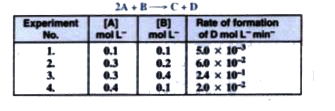
The following rate data were obtained at 300 K for the reaction
` 2A +B to C +D `

Calculate the rate of formation of D when : [A]=0.5 mol `L^(-)` and [B]=0.2 mol `L^(-)`

Text Solution

Verified by Experts

The correct Answer is:

Rate ` =k [A][B]^2; 0.1 mol L^(-) min^(-)`

Rate of reaction is given as: Rate `= k[A]^x [B]^y` Rates of reaction in experiments 1 to 4 are:
`(i) 5.0 xx 10^(-3) =k (0.1)^x (0.1)^y`
`(ii) 6.0 xx 10^(-2) =k(0.3)^x (0.2)^y`
` (iii) 2.4 xx 10^(-1) =k (0.3)^x (0.4)^y`
`(iv) 2 xx 10^(-2) =k(0.4)^x (0.1)^y`
Dividing eq. (i) by (iv), we get,
` ( 5.0 xx 10^(-3))/( 2.0 xx 10^(-2)) = (k (0.1 )^x ( 0.1 )^y )/( k( 0.4 )^x (0.1 )^y) or (1/4)^1 = (1/4)^x` ,
hence ` x=1`
Dividing equation (ii) by (iii), we get :
` ( 6 xx 10^(-2))/( 2.4 xx 10^(-1)) = (k ( 0.3 )^x (0.2 )^y)/(k ( 0.3 )^x ( 0.4 )^y) or 1/4 = (1/2)^2 = (1/2)^y` ,
hence `y=2`
Rate equation `=k[A][B]^2`
from experiment (i) ` 5 xx 10^(-3) = k ( 0.1 )^1 ( 0.1 )^2`
thus ` ,k =( 5 xx 10^(-3))/((0.1 ) (0.1 )^2) = 5 `
hence, rate ` = 5 xx ( 0.5 )^1 ( 0.2 )^2 = 0.1 mol L^(-) min""^(-1)`
Promotional Banner

Topper's Solved these Questions

  • CHEMICAL KINETICS

    ICSE|Exercise INTEXT QUESRTIONS|81 Videos
  • CHEMICAL KINETICS

    ICSE|Exercise EXERCISE (PART- I (OBJECTIVE QUESRTIONS)A.FILL IN THE BLANKS) |54 Videos
  • CHEMICAL KINETICS

    ICSE|Exercise ISC EXAMINATION QUESTIONS (NUMERICAL PROBLEMS )|57 Videos
  • BIOMOLECULES

    ICSE|Exercise ISC EXAMINATION QUSTIONS (PART-I)(DESCRIPTIVE QUESTIONS)|21 Videos
  • CHEMISTRY IN EVERYDAY LIFE

    ICSE|Exercise EXERCISE (PART - II (DESCRIPTIVE QUESTIONS) (LONG ANSWER QUESTIONS))|19 Videos

Similar Questions

Explore conceptually related problems

form the gaseous reaction 2A + B_(2) rarr 2AB , the following rate data were obtained at 300 K . Calculate the rate constant for the reaction and the rate of formation of AB when [A] is 0.02 and [B_(2)] is 0.04 mol L^(-1) at 300K .

form the gaseous reaction 2A + B_(2) rarr 2AB , the following rate data were obtained at 300 K . Calculate the rate constant for the reaction and the rate of formation of AB when [A] is 0.02 and [B_(2)] is 0.04 mol L^(-1) at 300K .

The following rate data were obtained at 303 K for the following reaction : 2A +B to C+D What is the rate law? What is the order with respect to each reactant and the overall order? What are the units of rate constant?

The following rate data were obtained at 303 K for the following reaction : 2A +B to C+D What is the rate law? What is the order with respect to each reactant and the overall order? What are the units of rate constant?

The following rate data were obtained at 303 K for the following reaction: 2A + B rarr C + D What is the rate law? What is the order with respect to each reactant and the overall order? Also calculate the rate constant and write its units.

For the reaction : 2A+B rarr A_(2)B the rate =k[A][B]^(2) with k=2.0xx10^(-6)mol^(-2)L^(2)s^(-1) . Calculate the initial rate of the reaction when [A]=0.1 mol L^(-),[B]=0.2 mol L^(-1) . Calculate the rate of reaction after [A] is reduced to 0.06 mol L^(-1) .

For the reaction A+B rarr C . The following data were obtained. In the first experiment, when the initial concentrations of both A and B are 0.1 M , the observed initial rate of formation of C is 1xx10^(-4) mol litre^(-1) minute^(-1) . In the second experiment when the initial concentrations of A and B are 0.1 M and 0.3 M , the initial rate is 9.0xx10^(-4) mol liter^(-1) "minute"^(-1) . In the third experiment when the initial concentrations of both A and B are 0.3M the initial rate is 2.7xx10^(-3) mol litre^(-1) "minute"^(-1) . (a) Write rate law for this reaction. (b) Calculate the value of specific rate constant for this reaction.

For the reaction, 2A + B to products, when the concentrations of A and B both were doubled, the rate of the reaction increased from 0.3 mol L^(-1)s^(-1) to 2.4 mol L^(-1)s^(-1). When the concentration of A alone is doubled, the rate increased from 0.3 mol L^(-1)s^(-1) to 0.6 mol L^(-1)s^(-1) . Which one of the following statements is correct ?

For the reaction, 2A + B to products, when the concentrations of A and B both were doubled, the rate of the reaction increased from 0.3 mol L^(-1)s^(-1) to 2.4 mol L^(-1)s^(-1) . When the concentration of A alone is doubled, the rate increased from 0.3 mol L^(-1)s^(-1) to 0.6 mol L^(-1)s^(-1) . What is overall order of reaction ?

ICSE-CHEMICAL KINETICS-PROBLEM
  1. The reaction SO2 Cl2 hArr SO2 + Cl2 is a first order gas reaction with...

    Text Solution

    |

  2. Show that in case of a first order reaction, the time required for 99....

    Text Solution

    |

  3. The following rate data were obtained at 300 K for the reaction 2A ...

    Text Solution

    |

  4. The rate of reaction, 2NO + Cl2 to 2NOCI is doubled when concentrati...

    Text Solution

    |

  5. For the following reaction, 2H2 +2NO hArr 2H2 O +N2 the follow...

    Text Solution

    |

  6. The initial concentration of N2 O5 in the following first order reacti...

    Text Solution

    |

  7. For the thermal decomposition of azomethane, CH3 N2 CH3 at 600 K to N...

    Text Solution

    |

  8. The following data were obtained during the first order thermal decomp...

    Text Solution

    |

  9. Hydrolysis of methyl acetate in aqueous solution has been studied by t...

    Text Solution

    |

  10. The kinetics of hydrolysis of methyl acetate in excess of hydrochloric...

    Text Solution

    |

  11. While studying the kinetics of the reaction involving conversion of am...

    Text Solution

    |

  12. For the reaction A to B +C, the following data were obtained fi...

    Text Solution

    |

  13. The optical rotation of sucrose in 0.90 N HCl at various times is give...

    Text Solution

    |

  14. The half-life period of a substance is 50 minutes at a certain concent...

    Text Solution

    |

  15. At a certain temperature, the half-life period for the decomposition f...

    Text Solution

    |

  16. Following data were obtained for the catalytic decomposition of ammoni...

    Text Solution

    |

  17. The rate constants of a reaction at 500 K and 700 K are 0.02 s^(-1) an...

    Text Solution

    |

  18. The first order rate constant for the decomposition of ethyl iodide by...

    Text Solution

    |

  19. The value of rate constant for a second order reaction is 6.7 xx 10^(-...

    Text Solution

    |

  20. Rate constant k of a reaction varies with temperature according to equ...

    Text Solution

    |
