Text Solution
Verified by Experts



Topper's Solved these Questions
LIGHT
PEARSON IIT JEE FOUNDATION|Exercise Concept Application (Level 3)|15 VideosLIGHT
PEARSON IIT JEE FOUNDATION|Exercise SOLVED EXAMPLE|43 VideosLIGHT
PEARSON IIT JEE FOUNDATION|Exercise Concept Application (Level 1) |30 VideosKINEMATICS
PEARSON IIT JEE FOUNDATION|Exercise CONCEPT APPLICATION (Level 3) (Application Based Questions ) |5 VideosMAGNETISM
PEARSON IIT JEE FOUNDATION|Exercise CONCEPT APPLICATION (Level 3)|4 Videos
Similar Questions
Explore conceptually related problems
PEARSON IIT JEE FOUNDATION-LIGHT-Concept Application (Level 2)
- A convex mirror and a plane mirror are arranged facing an object as sh...
Text Solution
|
- If a plane mirror shifts through a distance of 5 cm towards an object ...
Text Solution
|
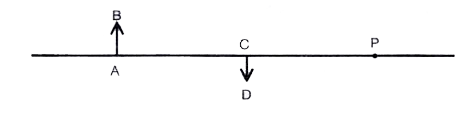
- In the given figure below, AB is the object and CD is its image. If a ...
Text Solution
|
- Two convex lenses, of focal lengths 20 cm and 10 cm, respectively are ...
Text Solution
|
- Are all animals equally sensitive to same intensity of light? Explain.
Text Solution
|
- A jar contains two immiscible liquids A and B with a coin at its botto...
Text Solution
|
- For a person sitting near a fire, why the objects like trees and house...
Text Solution
|
- An object is placed in front of a concave mirror and it produces a rea...
Text Solution
|
- A man places a rectangular glass slab of thickness 9 cm on a newspaper...
Text Solution
|
- A source of light and screen are separated by a distance of 50 cm. A s...
Text Solution
|
- Does an air bubble inside a water behave like a lens? If so, what type...
Text Solution
|
- Two plane mirrors are inclined at an angle of 50^@. A ray is incident...
Text Solution
|
- Two plane mirrors AB and CD each of length 2 m are arranged parallel t...
Text Solution
|
- A concave mirror and a plane mirror are arranged facing each other and...
Text Solution
|
- In the figure given below, OB is the object and IG is the image formed...
Text Solution
|
- If the mirror moves away from the object with speed v units, then find...
Text Solution
|
- Mahesh wanted to know whether the decrease in the number of images of ...
Text Solution
|
- Siddharth wanted to see his inverted image in a plane mirror. So, he s...
Text Solution
|
- A concave mirror of focal length 'f' forms an erect image twice the si...
Text Solution
|
- Srikar focussed separately on two objects of different sizes using a p...
Text Solution
|