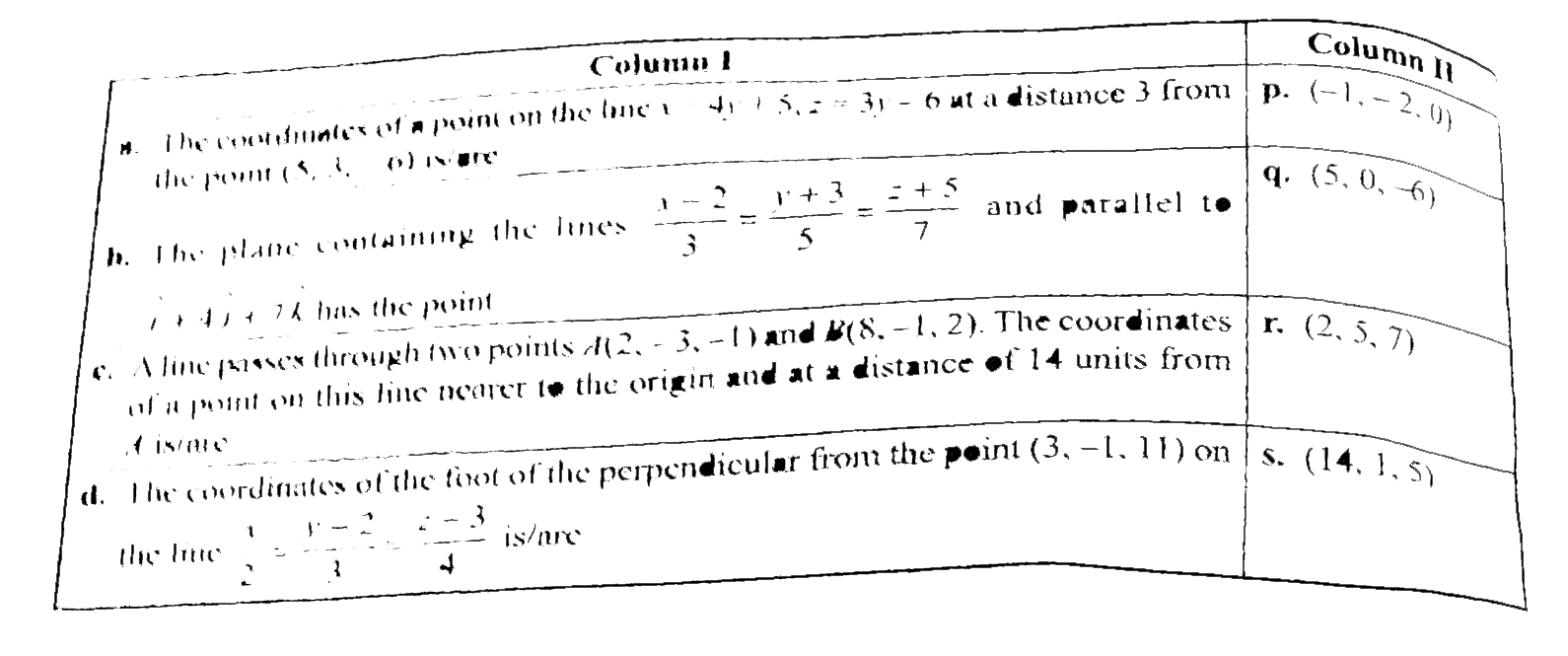
The given lines is `x=4y+5, z=3y-6`
or `" "(x-5)/(4)=y, (z+6)/(3)=y`
or `" "(x-5)/(4)= (y)/(1)= (z+6)/(3)= lamda` (say)
Any point on the line is of the form `(4lamda+5, lamda, 3lamda-6)`.
The distance between `(4lamda +5, lamda, 3lamda-6) and (5, 3, -6)` is 3 units (given). Therefore
`" "(4lamda+5-5)^(2)+ (lamda-3)^(2)+ (3lamda-6+6)^(2)=9`
or `" "16lamda^(2)+lamda^(2)+ 9- 6lamda + 9lamda^(2)=9`
or `" "26lamda^(2)- 6lamda=0`
or `" "lamda=0, 3//13`
The point is `(5, 0, -6)`.
b. The equation of the plane containing the lines `(x-2)/(3)= (y+3)/(5)= (z+5)/(7)` and parallel to `hati+4hatj+7hatk` is
`" "|{:(x-2,,y+3,,z+5),(1,,4,,7),(3,,5,,7):}|=0`
or `" "x-2y+z-3=0`
Point `(-1, -2, 0)` lies on this plane.
c. The line passing through points `A(2, -3, -1) and B(8, -1, 2)` is `(x-2)/(8-2)= (y+3)/(-1+3)= (z+1)/(2+1)`
or `(x-2)/(6)= (y+3)/(2)= (z+1)/(3)= lamda` (say).
Any point on this line is of the form `P(6lamda+2, 2lamda-3, 3lamda-1)`, whose distance from point
`A(2, -3, -1)` is 14 units. Therefore,
`" "PA= 14`
`or " "PA^(2)= (14)^(2)`
`rArr" "(6lamda)^(2)+ (2lamda)^(2)+ (3lamda)^(2)= 196`
or `" "49lamda^(2)= 196`
or `" "lamda^(2)= 4`
or `" "lamda= pm 2`
Therefore, the required points are (14, 1, 5) and `(-10, -7, -7)`. The point nearer to the origin is `(14, 1, 5)`.
d. Any point on line `AB, (x)/(2)= (y-2)/(3)= (z-3)/(4)=lamda` is `M(2lamda, 3lamda+2, 4lamda+3)`. Therefore, the direction ratios of `PM` are `2lamda-3, 3lamda+3 and 4lamda-8`.
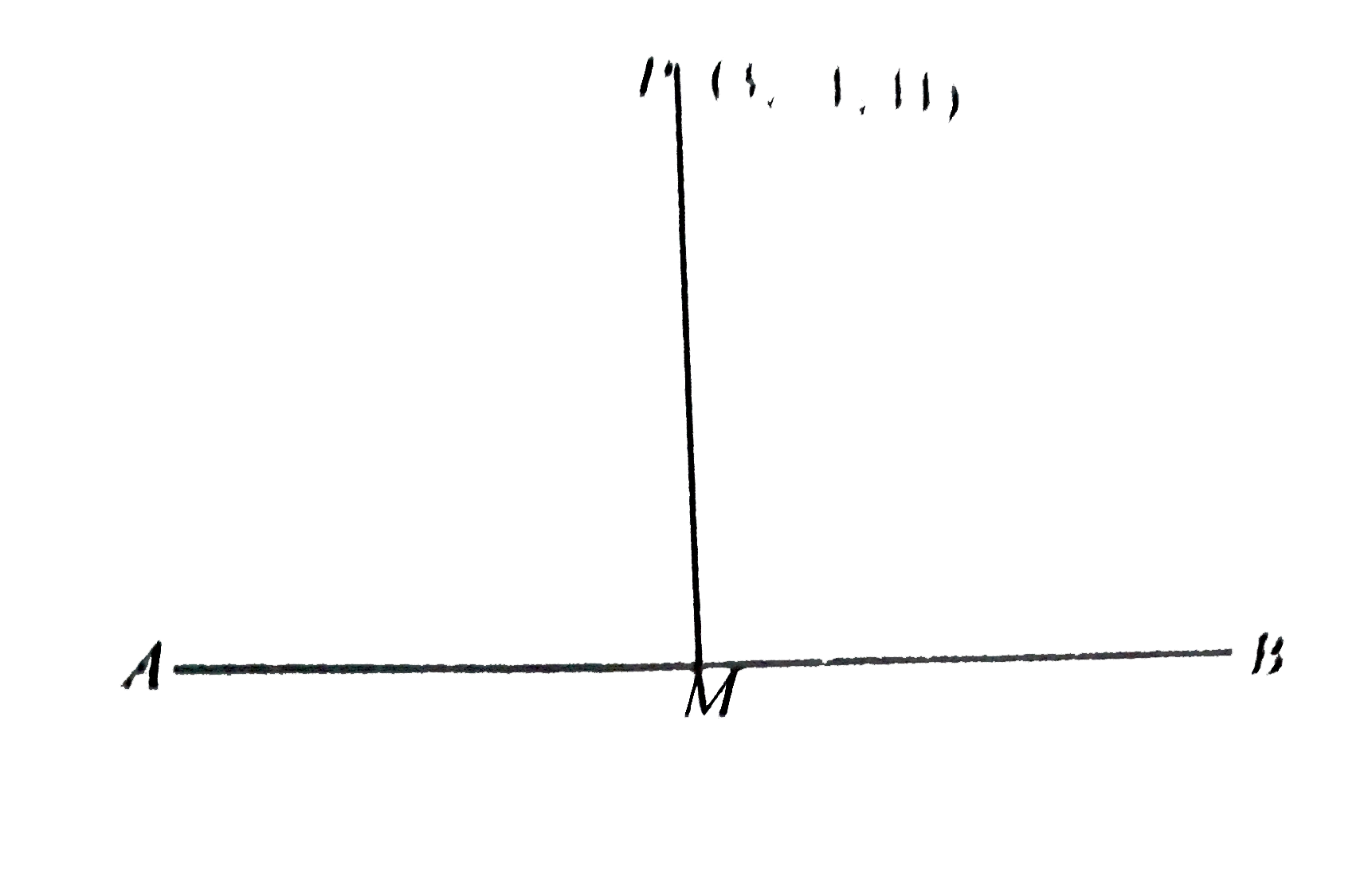
But `" " PM bot AB`
`therefore" "2(2lamda-3)+ 3(3lamda+3)+ 4(4lamda -8)=0`
`" "4lamda-6+9lamda+9+ 16lamda -32=0`
`" "29lamda-29=0`
`" "lamda=1`
Therefore, foot of the perpendicular is `M(2, 5, 7)`.