Home
Class 12
MATHS
A parallelepiped S has base points A ,B ...

A parallelepiped `S` has base points `A ,B ,Ca n dD` and upper face points `A^(prime),B^(prime),C^(prime),a n dD '` . The parallelepiped is compressed by upper face `A ' B ' C ' D '` to form a new parallepiped `T` having upper face points `A^(prime prime),B^(prime prime),C^(prime prime) and D^(prime prime)` . The volume of parallelepiped `T` is 90 percent of the volume of parallelepiped `Sdot` Prove that the locus of `A^(prime prime)` is a plane.

Text Solution

Verified by Experts
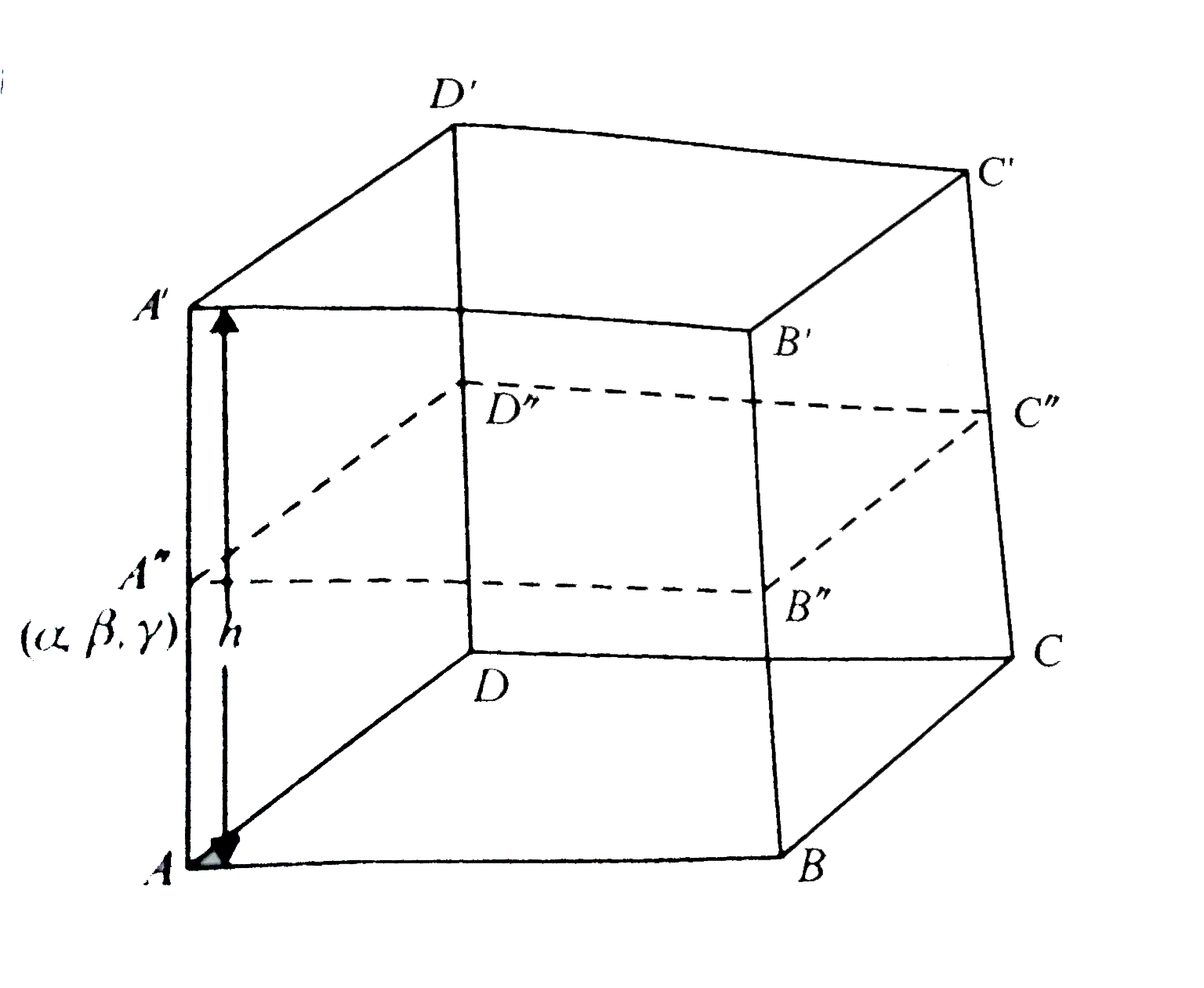
S is the parallelepiped with base point `A, B, C and D` and upper face points `A', B', C' and D'`. Let its volume ve `V_(s)`. By compressing it by upper face `A', B', C' and D'`, a new parallelepiped T is formed whose upper face points are now `A'', B'', C'' and D''`. Let its volume be `V_(T)`.
Let `h` be the height of original parallelepiped S. Then
`" "V_(S)= ("area of " ABCD)xxh" "` (i)
Let equation of plane `ABCD` be `ax+by +cz+d=0 and A''(alpha, beta, gamma)`.

Then the height of the new parallelepiped T is the length of the perpendicular from `A''` to `ABCD`, i.e., `(aalpha +bbeta+cgamma+d)/(sqrt(a^(2)+b^(2)+c^(2))`. Therefore
`" "V_(T)= ("ar "ABCD)xx((aalpha+bbeta+cgamma+d))/(sqrt(a^(2)+b^(2)+c^(2))" "` (ii)
But given that `V_(T)= (90)/(100)V_(s)" "` (iii)
From (i), (ii) and (iii), we get
`" "(aalpha+bbeta+cgamma+d)/(sqrt(a^(2)+b^(2)+c^(2))= 0.9 h`
or `" "aalpha+bbeta+cgamma+d-0.9 hsqrt(a^(2)+b^(2)+c^(2))=0`
Therefore, the locus of `A'' (alpha, beta, gamma)` is `ax+by +cz+d -0.9 h sqrt(a^(2)+b^(2)+c^(2))=0`, which is a plane parallel to `ABCD`. Hence proved.
Promotional Banner

Topper's Solved these Questions

  • THREE-DIMENSIONAL GEOMETRY

    CENGAGE PUBLICATION|Exercise ARCHIVES SINGLE CORRECT ANSWER TYPE|9 Videos
  • THREE-DIMENSIONAL GEOMETRY

    CENGAGE PUBLICATION|Exercise ARCHIVES MULTIPLE CORRECT ANSWERS TYPE|4 Videos
  • THREE-DIMENSIONAL GEOMETRY

    CENGAGE PUBLICATION|Exercise INTEGER TYPE|10 Videos
  • THREE DIMENSIONAL GEOMETRY

    CENGAGE PUBLICATION|Exercise All Questions|291 Videos
  • TRIGONOMETRIC EQUATIONS

    CENGAGE PUBLICATION|Exercise Archives (Numerical value type)|4 Videos

Similar Questions

Explore conceptually related problems

Prove that the lengths of the perpendiculars from the points (m^2,2m),(m m^(prime),m+m^(prime)), and (m^('2),2m^(prime)) to the line x+y+1=0 are in GP.

Find the condition if lines x=a y+b ,z=c y+da n dx=a^(prime)y+b^(prime), z=c^(prime)y+d ' are perpendicular.

If f(x)=xsinx, then find f^(prime)(pi/2)

Determine the median of prime numbers between 50 and 82.

If the equations x^2+p x+q=0 and x^2+p^(prime)x+q^(prime)=0 have a common root, then it must be equal to a. (p^(prime)-p ^(prime) q)/(q-q^(prime)) b. (q-q ')/(p^(prime)-p) c. (p^(prime)-p)/(q-q^(prime)) d. (p q^(prime)-p^(prime) q)/(p-p^(prime))

What is the least prime number?

Which number is neither prime nor composite?

Prove that sqrtp+sqrtq is an irrational, where p,q are primes.

Let A be the set of prime number smaller than 6 and B be the set of prime factors of 30. Check if A and B are equal.

The probability that at least one of A and B occurs is 0.6. If A and B occur simultaneously with probability 0.3, then find the value of P(A^(prime))+P(B^(prime)) .

