Home
Class 12
MATHS
Evaluate: [("lim")(xvec0)(tan^(-1)x)/x],...

Evaluate: `[("lim")_(xvec0)(tan^(-1)x)/x],` where [.]represent the greatest integer function

Text Solution

Verified by Experts
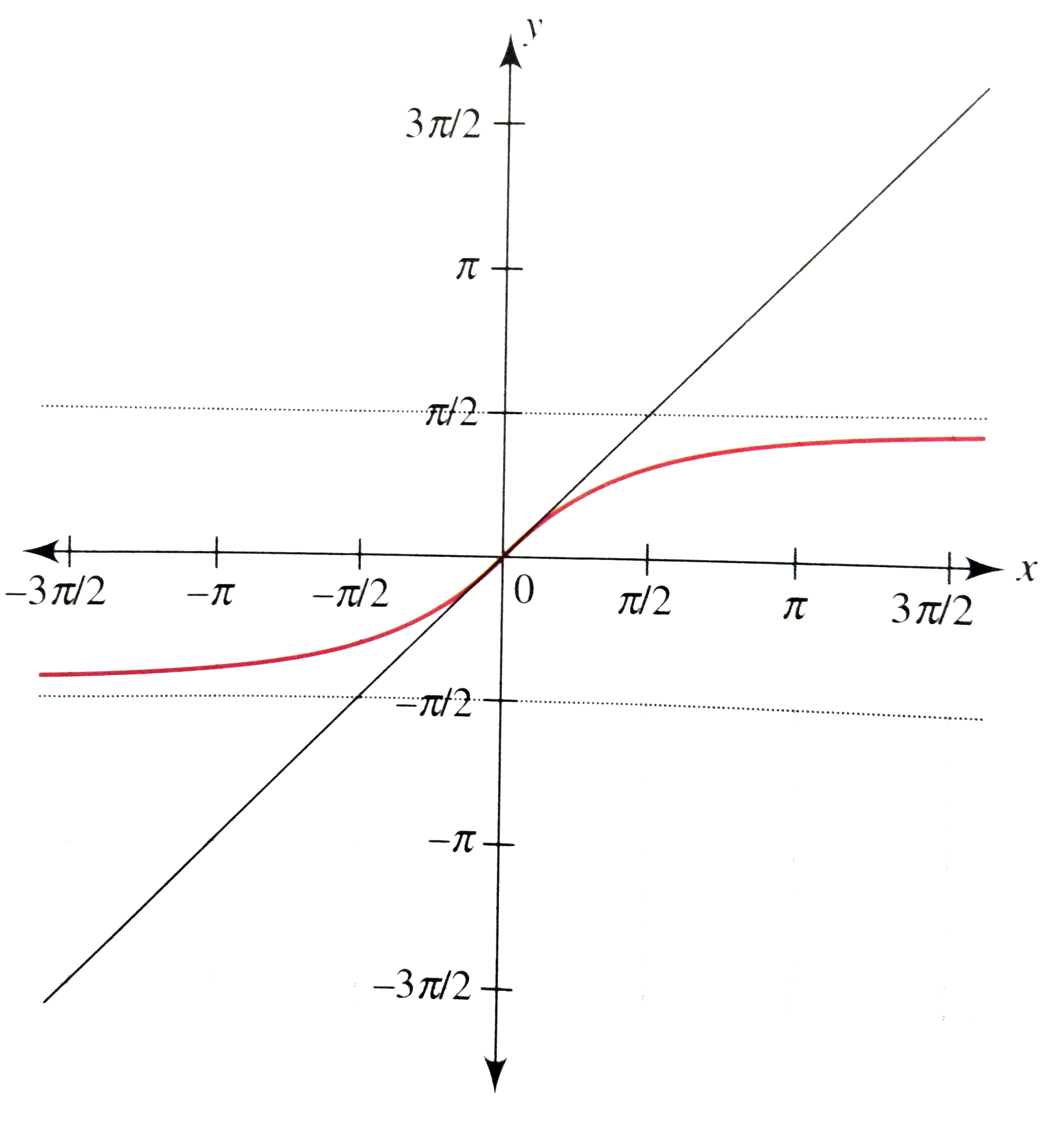
See the graphs of y=x and `tan^(-1)x` in the following figure.

For `f(x)=tan^(-1)(x)=1/(1+x^(2))`
`:." "f'(0)=1`
So the curve touches the line y = x at x = 0
For `xgt0,f'(x)lt1`
So the graph of `y=tan^(-1)x` lies below the graph of y = x.
From the graph, when `xto o^(+)`, the graph of y = x is above the graph of `y = tan^(-1)x`
`or" "tan^(-1)xltxrArr(tan^(-1)x)/xlt1rArr[underset(xto0^(+))("lim")(tanx)/x]=0`
`"Thus "[underset(xto0^(+))("lim")(tanx)/x]=0`
Promotional Banner

Topper's Solved these Questions

  • GRAPH OF INVERSE TRIGONOMETRIC FUNCTIONS

    CENGAGE PUBLICATION|Exercise Exercises|18 Videos
  • GETTING STARTED WITH GRAPHS

    CENGAGE PUBLICATION|Exercise Exercises 1.18|1 Videos
  • GRAPHICAL TRANSFORMATIONS

    CENGAGE PUBLICATION|Exercise ILLUSTRATION|78 Videos

Similar Questions

Explore conceptually related problems

Evaluate: [("lim")_(xrarr0)(tan^(-1)x)/x], where [.]represent the greatest integer function

Evaluate : [lim_(x to 0) (tan x)/(x)] , where [*] represents the greatest integer function.

Evalute [lim_(xto0) (sin^(-1)x)/(x)]=1 , where [*] represets the greatest interger function.

Evaluate : [lim_(x to 0) (sin x)/(x)] , where [*] represents the greatest integer function.

Evaluate lim_(xto2^(+)) ([x-2])/(log(x-2)), where [.] represents the greatest integer function.

lim_(xto0) [(1-e^(x))(sinx)/(|x|)] is (where [.] represents the greatest integer function )

Draw the graph of f(x)=[tan^(-1)x]," where "[*]" represents the greatest integer function".

Evaluate: int_0^(100)x-[x]dx where [dot] represents the greatest integer function).

Evaluate: int_0^(10pi)[tan^(-1)x]dx ,w h e r e[x] represents greatest integer function.

underset(xrarr0)(lim)[(sin^(-1)x)/(tan^(-1)x)]= (where [.] denotes the greatest integer function)

CENGAGE PUBLICATION-GRAPH OF INVERSE TRIGONOMETRIC FUNCTIONS-Exercises
  1. Evaluate: [("lim")(xvec0)(tan^(-1)x)/x], where [.]represent the great...

    Text Solution

    |

  2. Draw the graph of y=tan^(-1)x-cot^(-1)x.

    Text Solution

    |

  3. Find the number of real solutions to the equation 3cos^(-1)x-pix-pi/2=...

    Text Solution

    |

  4. Evalute [lim(xto0) (sin^(-1)x)/(x)]=1, where[*] represets the greatest...

    Text Solution

    |

  5. Solve tan^(-1)xgtcot^(-1)x graphically. Also find where f(x) = max. [t...

    Text Solution

    |

  6. Match the colums.

    Text Solution

    |

  7. Draw the graph of y=cos^(-1)sqrt(log([x])(|x|/x)) where [*] represents...

    Text Solution

    |

  8. Find the value of int(0)^(100pi)sin^(-1)(sin x)dx.

    Text Solution

    |

  9. Draw the graph of y=sin^(-1)((1)/(x))

    Text Solution

    |

  10. Draw the graph of y=sin^(-1)(x^(2))

    Text Solution

    |

  11. Draw the graph of y=cos^(-1)x^(3)" and compare with the graph of "y=co...

    Text Solution

    |

  12. Draw the graph of y=cos^(-1)(2^(x)).

    Text Solution

    |

  13. Draw the graph of y=cos^(-1){x}," where "{*}" represents the fractiona...

    Text Solution

    |

  14. If cos^(-1)(cos x)=(n-x)/n,xge0, has seven roots, then find values of ...

    Text Solution

    |

  15. Draw the graph of f(x)=[cot^(-1)x]," where "[*] represents the greate...

    Text Solution

    |

  16. Draw the graph of y="cosec"("cosec"^(-1)x)" or "y=sec(sec^(-1)x).

    Text Solution

    |

  17. Draw the graph of f(x) =cot^(-1)((2-|x|)/(2+|x|)).

    Text Solution

    |

  18. Draw the graph of y=sin^(-1)(2xsqrt(1-x^(2)))

    Text Solution

    |

  19. Draw the graph of y=(3x-x^(3))/(1-3x^(2)) and hence the graph of y=tan...

    Text Solution

    |

