Home
Class 12
MATHS
The sum of roots of the equation cos^(-1...

The sum of roots of the equation `cos^(-1)(cosx)=[x],[dot]` denotes the greatest integer function, is `2pi+3` (b) `pi+3` (c) `pi-3` (d) 2`pi-3`

Text Solution

Verified by Experts
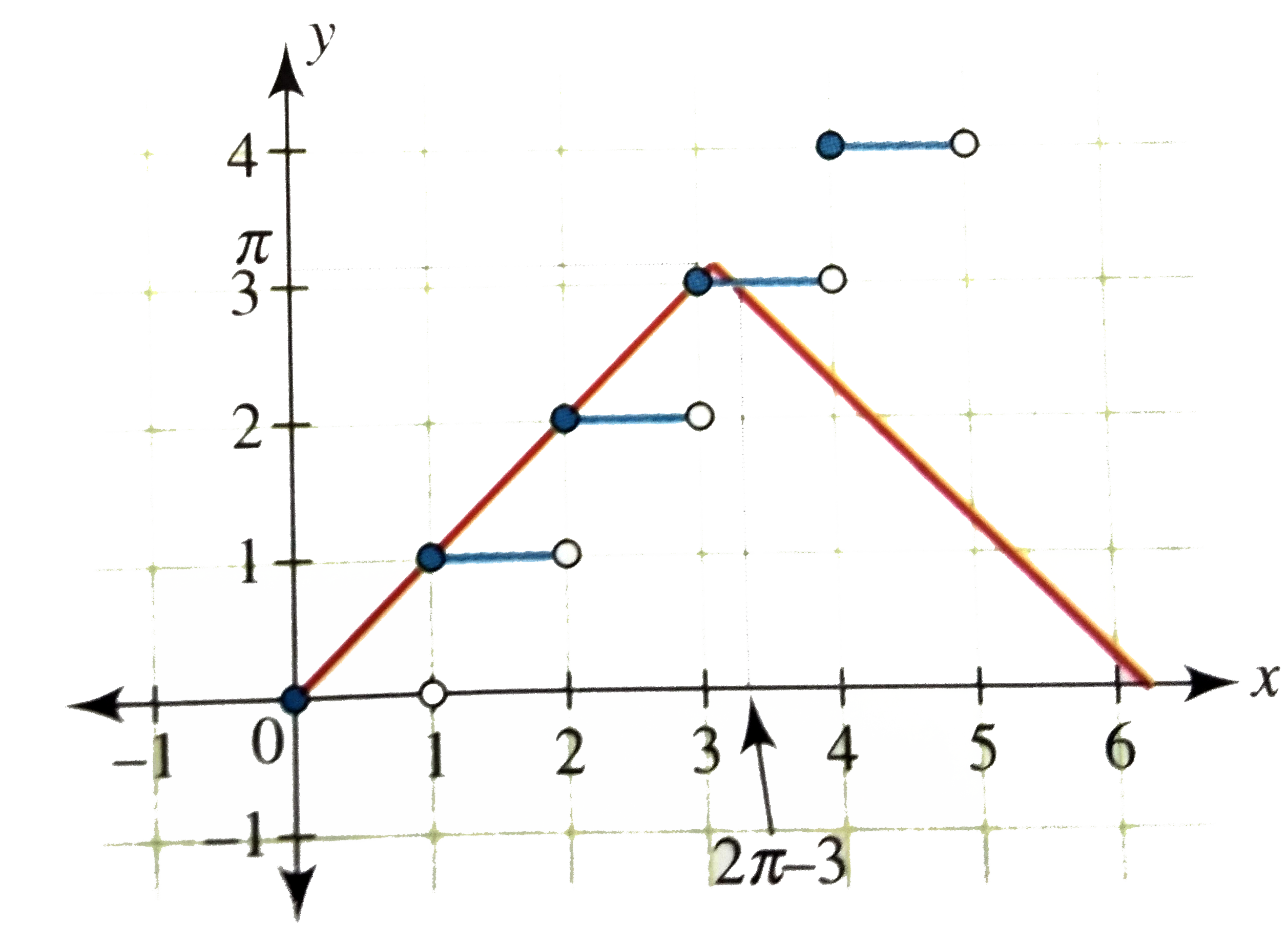
We have `cos^(-1)(cos x)=[x]`
To find the roods of the equation, we draw the graphs of `y=cos^(-1)(cos x)" and "y = [x]` and then find the points of intersection.

From the graph, roots are 0, 1, 2, 3, and the value ot x for which `3=2pi-x or x= 2 pi-3`. Hence the sum of roots is `2pi+3`
Promotional Banner

Topper's Solved these Questions

  • GRAPH OF INVERSE TRIGONOMETRIC FUNCTIONS

    CENGAGE PUBLICATION|Exercise Exercises|18 Videos
  • GETTING STARTED WITH GRAPHS

    CENGAGE PUBLICATION|Exercise Exercises 1.18|1 Videos
  • GRAPHICAL TRANSFORMATIONS

    CENGAGE PUBLICATION|Exercise ILLUSTRATION|78 Videos

Similar Questions

Explore conceptually related problems

The sum of roots of the equation cos^(-1)(cosx)=[x],[dot] denotes the greatest integer function, is (a) 2pi+3 (b) pi+3 (c) pi-3 (d) 2 pi-3

Evaluate: int_0^(2pi)[sinx]dx ,where [dot] denotes the greatest integer function.

The period of the function f(x)=[6x+7]+cospix-6x , where [dot] denotes the greatest integer function is: (a)3 (b) 2 pi (c) 2 (d) none of these

[x] denote the greatest integer function. int_(0)^(pi)[cosx]dx is equal to-

Evaluate: int_(-pi/2)^(2pi)[cot^(-1)x]dx , where [dot] denotes the greatest integer function

Evaluate: int_(-pi/2)^(2pi)[cot^(-1)x]dx , where [dot] denotes the greatest integer function

int_(pi/2)^(3pi/2) [2sinx]dx is equal to [x] denotes the greatest integer function

The number of solutions of [sinx+cosx]=3+[-sinx]+[-cosx](w h e r e[] denotes the greatest integer function), x in [0,2pi] , is 0 (b) 4 (c) infinite (d) 1

The value of int_0^(2pi)[2sinx]dx ,w h e r e[dot] represents the greatest integral function, is (a) (-5pi)/3 (b) -pi (c) (5pi)/3 (d) -2pi

Evaluate lim_(x->(5pi)/4) [sinx+cosx], where [.] denotes the greatest integer function.

CENGAGE PUBLICATION-GRAPH OF INVERSE TRIGONOMETRIC FUNCTIONS-Exercises
  1. The sum of roots of the equation cos^(-1)(cosx)=[x],[dot] denotes the ...

    Text Solution

    |

  2. Draw the graph of y=tan^(-1)x-cot^(-1)x.

    Text Solution

    |

  3. Find the number of real solutions to the equation 3cos^(-1)x-pix-pi/2=...

    Text Solution

    |

  4. Evalute [lim(xto0) (sin^(-1)x)/(x)]=1, where[*] represets the greatest...

    Text Solution

    |

  5. Solve tan^(-1)xgtcot^(-1)x graphically. Also find where f(x) = max. [t...

    Text Solution

    |

  6. Match the colums.

    Text Solution

    |

  7. Draw the graph of y=cos^(-1)sqrt(log([x])(|x|/x)) where [*] represents...

    Text Solution

    |

  8. Find the value of int(0)^(100pi)sin^(-1)(sin x)dx.

    Text Solution

    |

  9. Draw the graph of y=sin^(-1)((1)/(x))

    Text Solution

    |

  10. Draw the graph of y=sin^(-1)(x^(2))

    Text Solution

    |

  11. Draw the graph of y=cos^(-1)x^(3)" and compare with the graph of "y=co...

    Text Solution

    |

  12. Draw the graph of y=cos^(-1)(2^(x)).

    Text Solution

    |

  13. Draw the graph of y=cos^(-1){x}," where "{*}" represents the fractiona...

    Text Solution

    |

  14. If cos^(-1)(cos x)=(n-x)/n,xge0, has seven roots, then find values of ...

    Text Solution

    |

  15. Draw the graph of f(x)=[cot^(-1)x]," where "[*] represents the greate...

    Text Solution

    |

  16. Draw the graph of y="cosec"("cosec"^(-1)x)" or "y=sec(sec^(-1)x).

    Text Solution

    |

  17. Draw the graph of f(x) =cot^(-1)((2-|x|)/(2+|x|)).

    Text Solution

    |

  18. Draw the graph of y=sin^(-1)(2xsqrt(1-x^(2)))

    Text Solution

    |

  19. Draw the graph of y=(3x-x^(3))/(1-3x^(2)) and hence the graph of y=tan...

    Text Solution

    |

