Home
Class 12
MATHS
O X and O Y are two coordinate axes. On ...

`O X` and `O Y` are two coordinate axes. On `O Y` a fixed point `P(0,c)` is taken and on `O X` any point `Q` is taken. On `P Q ,` an equilateral triangle is described, its vertex `R` being on the side of `P Q` away from `O` . Then prove that the locus of `R` is `y=sqrt(3)x-c`

Text Solution

Verified by Experts
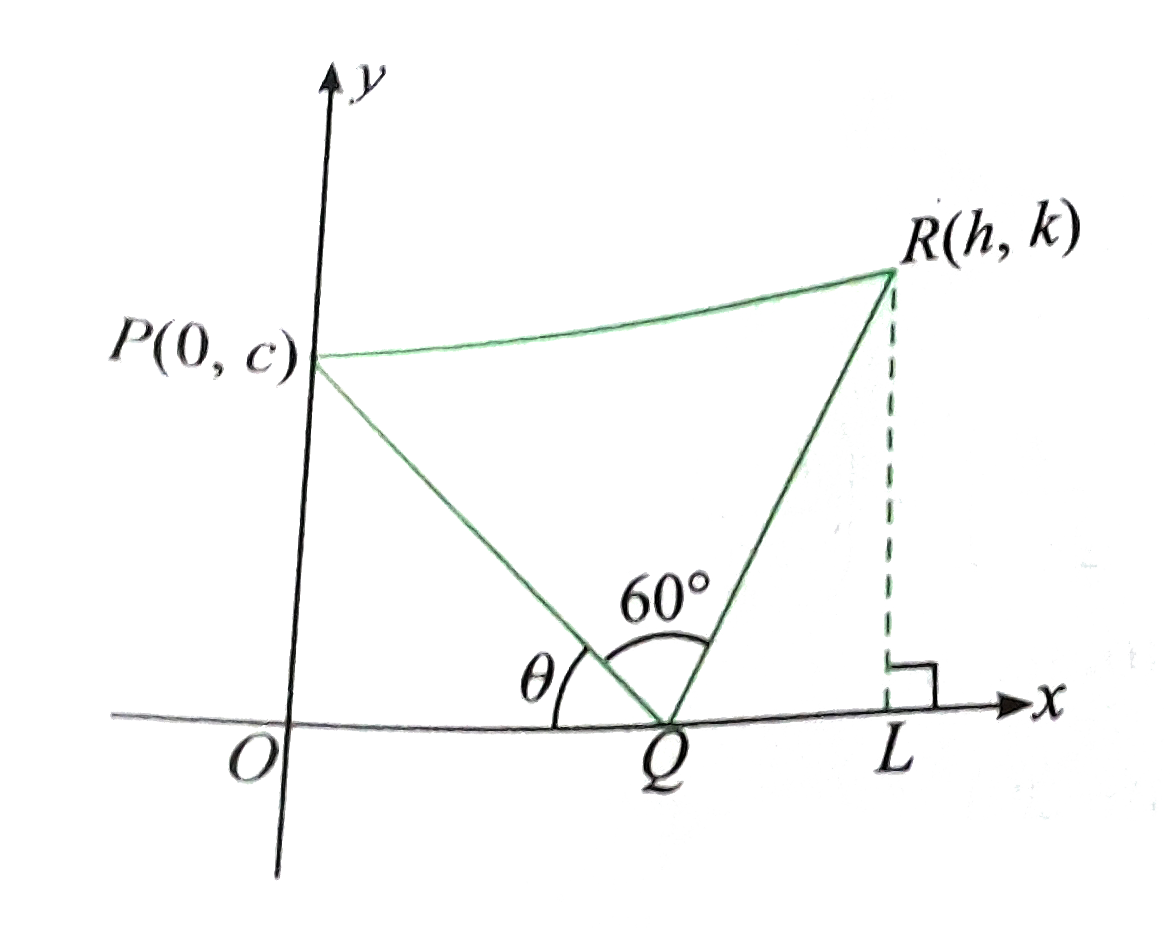
This given fixed point is `P(0,c)`.
From given fig.,

`h=OL=OQ+QL`
`=c cot theta+Qrcos(180^@-60^@-theta)`
`=c cot theta+ PQ {cos120^@.costheta+sin120^@.sintheta}`
`=c cot theta-(PQ)/(2) costheta + (sqrt3)/(2)PQ sintheta`
`=ccot theta -(1)/(2) c cosec theta cos theta +(sqrt3)/(2) c cosec theta sin theta" "[because sintheta =(c)/(PQ)]`
`therefore h=(c)/(2) (cot theta +sqrt(3))`(1)
Now, `k=RL=RQsin(180^@-60^@-theta)`
`=PQ{sintheta xx(1)/(2)+cos theta xxsqrt3/(2)}`
`=c cosec theta{(1)/(2)+sintheta xxsqrt3/(2)costheta}`
`therefore" "k=(c)/(2)(1+sqrt3cottheta)`
Eliminating `cot theta` from (1) and (2) , we get `k=sqrt3h-c`.
Therefore the required locus is `y=sqrt3x-c`, a straight line.
Promotional Banner

Topper's Solved these Questions

  • COORDINATE SYSYEM

    CENGAGE PUBLICATION|Exercise Concept applications 1.1|6 Videos
  • COORDINATE SYSYEM

    CENGAGE PUBLICATION|Exercise Concept applications 1.2|8 Videos
  • COORDINATE SYSYEM

    CENGAGE PUBLICATION|Exercise Illustration1.67|1 Videos
  • COORDINATE SYSTEM

    CENGAGE PUBLICATION|Exercise Multiple Correct Answers Type|2 Videos
  • CROSS PRODUCTS

    CENGAGE PUBLICATION|Exercise DPP 2.2|13 Videos

Similar Questions

Explore conceptually related problems

Two points O(0,0) and A(3,sqrt(3)) with another point P form an equilateral triangle. Find the coordinates of Pdot

P is a point on the line y+2x=1, and Qa n dR two points on the line 3y+6x=6 such that triangle P Q R is an equilateral triangle. The length of the side of the triangle is

If the point (0,0),(2,2sqrt(3)), and (p,q) are the vertices of an equilateral triangle, then (p ,q) is

The straight line through a fixed point (2,3) intersects the coordinate axes at distinct point P and Q. If O is the origin and the rectangle OPRQ is completed then the locus of R is

AP and AQ are two tangents drawn from an external point A to a circle with centre O, P and Q are points of contact. If PR is a diameter, prove that OA||RQ.

If P is any point on the plane l x+m y+n z=pa n dQ is a point on the line O P such that O P.O Q=p^2 , then find the locus of the point Qdot

If P Q is a double ordinate of the hyperbola (x^2)/(a^2)-(y^2)/(b^2)=1 such that O P Q is an equilateral triangle, O being the center of the hyperbola, then find the range of the eccentricity e of the hyperbola.

P(x , y) is a variable point on the parabola y^2=4a x and Q(x+c ,y+c) is another variable point, where c is a constant. The locus of the midpoint of P Q is

The co-ordinates of two points P and Q are (x_1,y_1) and (x_2,y_2) and O is the origin. If circles be described on OP and OQ as diameters then length of their common chord is

A variable line passes through a fixed point (x_(1),y_(1)) and meets the axes at A and B. If the rectangle OAPB be completed, the locus of P is, (O being the origin of the system of axes)

